The Crowning of King Elessar
On May 1 in the year 3019 of the Third Age, Aragorn II, son of Arathorn, heir of Isildur, was crowned King of Gondor and Arnor in the city of Minas Tirith. He took the name Elessar Telcontar: the Elfstone Strider. He had been in preparation for this moment, in one sense or another, for eighty-seven years. The Third Age was over. The age of Men had begun.
Six days had passed since the One Ring was destroyed in the fires of Mount Doom on March 25. Six days since Sauron's tower fell and his armies crumbled and the Nazgûl were consumed. Six days of medical care for Frodo and Sam in Ithilien, of recovering the wounded from the Pelennor Fields, of the slow unwinding of a war that had threatened to consume everything.
And then, on May 1, the city dressed itself in flowers and banners, and a king came home.
The Long Road to the Crown
No king in the history of Middle-earth waited longer for his throne. Aragorn was two years old when his father was killed by Orcs and his mother took him to Rivendell. He grew up as Estel, not knowing his own name, not knowing what he was heir to. When Elrond finally told him, on the day he turned twenty, he received simultaneously the knowledge of his destiny and the sight of Arwen Undómiel walking among the birch trees, and understood that the two were inseparably connected.
Elrond's condition was unambiguous. Arwen would not marry a man who was less than King of both Gondor and Arnor. So Aragorn had to become that king, not by conquest or by political manoeuvre, but by earning it: by becoming someone who deserved it so completely that the kingship was the natural conclusion of who he was rather than a prize he had claimed.
He spent sixty-seven years earning it. He served in the armies of Rohan and Gondor under false names. He hunted Gollum across the Dead Marshes for years, alone. He guarded the Shire for decades, protecting hobbits who had no idea he existed. He wore the same worn clothes and slept on the same hard ground that any Ranger slept on, with the Shards of Narsil in his pack and the Ring of Barahir on his finger and the knowledge of what he was kept entirely to himself.
By the time Frodo met him at the Prancing Pony, Aragorn had been preparing for this day for longer than any hobbit had been alive.
The Ceremony on the Pelennor
The crowning was conducted by Gandalf, which was itself significant. Gandalf was a Maia, a divine spirit in mortal form, whose authority exceeded that of any king or steward in Middle-earth. His placing of the crown on Aragorn's head was not merely ceremonial: it was the endorsement of the Powers of the West, the acknowledgement that the line of Kings had returned and that the long regency of the Stewards was finished.
The crown was the crown of Gondor: a tall white helm of the Númenórean kings, fitted with wings like a seabird's, set with jewels, worn last by Eärnur before he rode to his death in Minas Morgul a thousand years before. It had been kept in the Houses of the Dead ever since, waiting for a legitimate heir who never came, through nine centuries of Stewards ruling in the kings' absence.
Aragorn asked Frodo to carry it to him. This was not a small gesture. Frodo had carried the Ring to Mount Doom and given everything he had to ensure this moment could exist. Aragorn's choice to have the Ringbearer carry the crown to him was a public acknowledgement of what the war had cost and who had truly won it. Not the armies on the Pelennor. Not the charge of the Rohirrim. Not the Army of the Dead. A hobbit, in the dark, with a weight that was trying to destroy him, choosing every day to keep walking.
Tolkien describes the crowds on the walls and the fields going quiet as Frodo brought the crown forward. Then Gandalf set it on Aragorn's head, and he said the words that ended a thousand years of regency: "Et Eärello Endorenna utúlien. Sinome maruvan ar Hildinyar tenn' Ambar-metta." From the Great Sea to the Middle-earth I am come. In this place will I abide, and my heirs, unto the ending of the world.
The White Tree
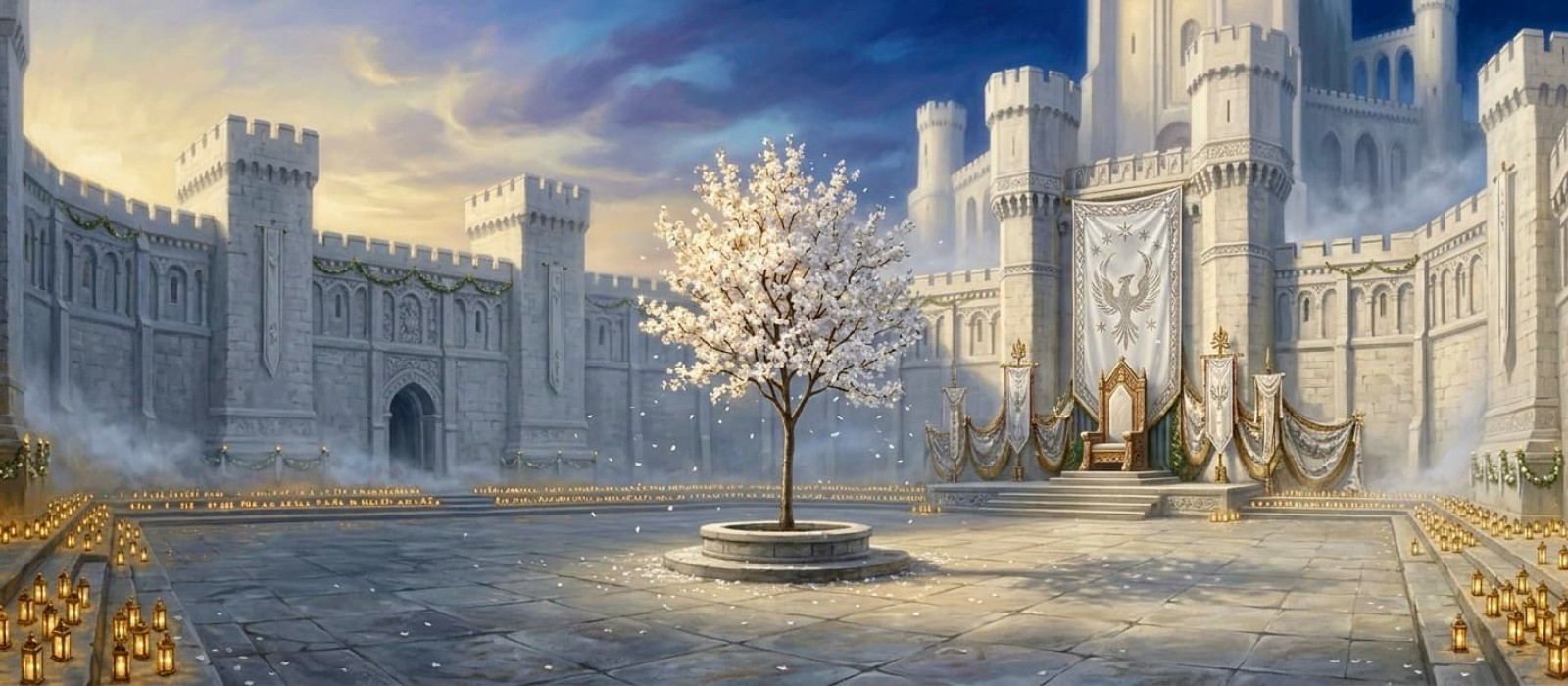
Before his coronation, Aragorn and Gandalf climbed the slopes of Mount Mindolluin, the mountain behind Minas Tirith, above the snowline, to the hallow where the kings of old had gone to meditate. There, in the snow, Aragorn found a sapling: a young tree, barely a foot tall, with white blossoms just opening.
It was a seedling of the White Tree of Gondor, a descendant of Nimloth the Fair, which had been the symbol of the kingdom since the days of Númenor, itself a descendant of Telperion, one of the Two Trees of Valinor that had lit the world before the sun and moon were made. The line of the tree, like the line of kings, had been thought extinct. The courtyard of Minas Tirith held a dead, dry trunk that no one had been able to replace because no legitimate heir existed to plant a new one.
Gandalf said: "This is the sign. The Return of the King."
Aragorn planted the sapling in the courtyard of the White Tower on the day of his coronation. It flowered. The court was filled with the scent of it. The symbolism was so complete it barely needed explanation: the dead tree replaced by a living one, the interregnum over, the kingdom restored not just in politics but in the deep order of things that Tolkien believed politics ultimately depended on.
Arwen Comes to Minas Tirith
On Midsummer's Day, six weeks after the coronation, Elrond brought Arwen to Minas Tirith. He had kept Elrond's condition faithfully for sixty-seven years. He was King of both Gondor and Arnor. There was nothing more to earn.
Tolkien describes Arwen arriving on the morning of Midsummer, riding with her father and her brothers and a company of Elves, her banner unfurled, and Aragorn going to meet her on the slopes of the city. They were married that evening on the Hill of Guard, beneath the White Tree, which was in full flower.
She was 2,778 years old. He was 88. They had waited thirty-eight years from the day they pledged their love on Cerin Amroth. They ruled together for 122 years.
Elrond said goodbye to his daughter and returned to Rivendell. He knew what the marriage meant: that when Aragorn died, Arwen would follow, and he would never see her again. He had helped, in every possible way, to bring about the thing that was going to cost him his daughter. Tolkien never found a way to describe that parting directly. He simply records that Elrond went, and that Arwen stayed, and that the choice had been freely made by all of them.
What the Coronation Meant for Middle-earth
Aragorn's coronation on May 1 was not merely the end of a story. It was the beginning of an age. The Third Age closed with the One Ring's destruction on March 25. The Fourth Age, Tolkien's age of Men, began formally with the crowning of King Elessar six weeks later.
Everything the Third Age had sustained by Elvish grace and divine intervention was now giving way to a world that would have to sustain itself. Nenya's power was gone. Vilya's power was gone. Narya's power was gone. Rivendell and Lothlórien would fade. Gandalf and Galadriel and Elrond would sail West. The world was inheriting itself, as Tolkien intended it to: not as a fallen thing abandoned by its makers, but as a grown thing, capable now of standing on its own.
Aragorn's kingdom was the proof of that. He ruled for 122 years, longer than any ordinary Man, in a reign of peace and reconstruction that gave the age of Men its best possible beginning. He rebuilt Annúminas as the northern capital. He replanted the White Tree. He extended the kingdom's influence while maintaining its justice. When he died in FA 120, he died as he had lived: on his own terms, choosing his end as the Númenórean kings had always had the right to choose it, with his affairs in order and his work complete.
He was, as Tolkien intended him to be, the king the long ages had been preparing for. The man worthy of the wait.
The Official Aragorn Collection — Made in New Zealand
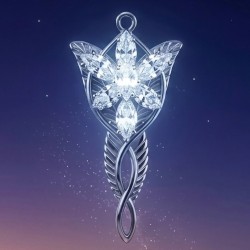
The jewellery most directly connected to Aragorn's story is also the jewellery most connected to Arwen's: the Evenstar pendant she gave him, the symbol of the choice she made and the promise he spent sixty-seven years earning. Made in New Zealand by the New Line Productions licence holders, in the country where every scene of their story was filmed.
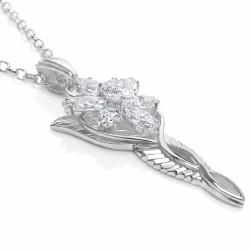
Arwen Evenstar Pendant
The pendant Arwen gave Aragorn before the Fellowship departed Rivendell: the evidence of her choice, given physical form. Solid 925 sterling silver, claw-set CZ stones, 45cm Belcher chain. Made in New Zealand by the New Line Productions licence holders.
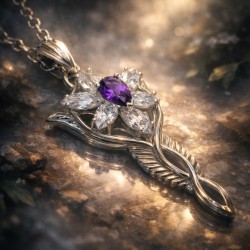
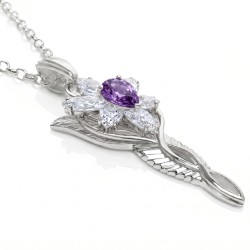
Shop Evenstar →Evenstar — Genuine Amethyst
The Evenstar with a genuine pear-cut amethyst at the centre, the only officially licensed Evenstar with a real gemstone. For the person who deserves the finest version of the most romantic piece of jewellery in Middle-earth. Made in New Zealand.
Shop Amethyst Evenstar →One Ring Wedding Band
The only official Lord of the Rings wedding band, solid gold with the Black Speech inscription on the inside surface. For the couple who want their rings to mean what Aragorn and Arwen's meant. Made in New Zealand by the New Line Productions licence holders.
Shop Wedding Band →The Middle-earth Calendar — Key Dates
Tolkien maintained a precise calendar for Middle-earth. These are the dates worth marking through the year:
- April 28 — Bilbo Baggins leaves Bag End (TA 2941). The Quest of Erebor begins.
- May 1 — Aragorn crowned King Elessar (TA 3019). The Third Age ends and the age of Men begins.
- September 22 — Bilbo and Frodo's shared birthday. Bilbo's 111th party (TA 3001). Frodo departs the Shire (TA 3018).
- October 6 — Frodo is stabbed by the Witch-king on Weathertop (TA 3018).
- January 13 — The Fellowship enters Moria (TA 3019).
- January 15 — Gandalf falls with the Balrog on the Bridge of Khazad-dûm (TA 3019).
- February 26 — The Fellowship breaks at Amon Hen. Frodo and Sam cross the Anduin alone (TA 3019).
- March 25 — The One Ring is destroyed. Sauron falls. The Third Age ends (TA 3019). Tolkien Reading Day.
- September 29 — The last ship sails from the Grey Havens. Frodo, Gandalf, Galadriel and Elrond depart Middle-earth (TA 3021).
- December 17 — The Battle of Five Armies (TA 2941). Also: The Hunt for Gollum film release date (2027).
Sources and Further Reading
- The Lord of the Rings, The Return of the King: "The Steward and the King" — the full account of the coronation, the White Tree, and Arwen's arrival at Midsummer
- The Lord of the Rings, Appendix A: "The Tale of Aragorn and Arwen" — the complete love story and the history of the crown of Gondor
- The Lord of the Rings, Appendix B: "The Tale of Years" — confirming May 1, TA 3019 as the date of the coronation
- Tolkien Gateway: tolkiengateway.net
Related Products