Arwen Undómiel — the Evenstar — was the daughter of Elrond Half-elven and Celebrían, granddaughter of Galadriel, and the most beautiful of the High Elves remaining in Middle-earth during the Third Age. Born in TA 241, she lived for 2,778 years before making the choice that defined her story: to give up Elven immortality for a single human lifetime with Aragorn. She became Queen of the Reunited Kingdom of Gondor and Arnor — and the last great bridge between the age of the Elves and the age of Men.
Most people who love The Lord of the Rings know Arwen from Liv Tyler's portrayal — the midnight-haired Elven princess who rides to the Ford of Bruinen, who gives Aragorn her pendant at Rivendell, whose fate seems to slowly unravel as Sauron's power grows. It is a beautiful performance of a beautifully written love story.
But it is not quite Tolkien's Arwen.
In the books, Arwen does not ride to the ford — that was Glorfindel. She does not visit Aragorn at Helm's Deep. She spends almost the entire War of the Ring in Rivendell, unseen, working in secret on a banner made of black cloth and mithril that would change the course of history. Her power is not the power of a sword. It is the power of lineage, sacrifice, and a choice so final that it could not be unmade.
This is her complete story.
What Does Arwen Mean? — The Name Behind the Evenstar
Arwen's full name is Arwen Undómiel. The first element — Arwen — is Sindarin Elvish, meaning "noble maiden." The second — Undómiel — is Quenya, meaning "Evenstar": Undómë ("evening twilight") combined with el ("star"). She was named for the evening star — Venus as it appears in the west just after sunset — the last and most beautiful light before the darkness comes.
The title Evenstar was not merely poetic. It was prophetic. The Elves understood that they were fading from Middle-earth — that the age of Men was coming, and their own time of glory was ending. Arwen, as the last and most beautiful of the High Elves still dwelling in Middle-earth, was the Evenstar of her people in exactly the way Venus is the evening star: the final brilliant point of light before the night swallows everything.
Her name in Sindarin — Elrenniel, "daughter of Elrond" — and in Quenya — Elerondiel — both simply mark her by her father. But it is Undómiel that history remembers. It is the name Tolkien gave her. It is the name engraved at the heart of the pendant that bears her image.
Arwen's Lineage — The Most Ancient Blood in Middle-earth
To understand what Arwen was, you have to understand what she carried. Her bloodline was not merely noble — it was the most extraordinary confluence of lineages in the entire history of Middle-earth, spanning thousands of years and every major house of Elves and Men.
Through her father Elrond, she descended from Eärendil the Mariner — the Half-elven hero who sailed to Valinor to beg the Valar to intervene against Morgoth, and who was set in the sky wearing a Silmaril as the planet Venus, the Star of Hope, the star that bears his name to this day in Middle-earth. Through Eärendil, she descended from Idril Celebrindal of Gondolin, and from Tuor, the mortal Man who married her. She also descended from Eärendil's wife Elwing, who was the daughter of Dior, who was the son of Beren and Lúthien — making Arwen a direct descendant of the most celebrated love story in all of Tolkien's legendarium, four thousand years before her own.
Through her mother Celebrían, she was the granddaughter of Galadriel — herself a daughter of Finarfin, son of Finwë, High King of the Noldor — and of Celeborn, a prince of the Sindar. And through Lúthien, her ancestor's ancestor, she carried the blood of Melian the Maia — one of the immortal divine beings who served the Valar. Arwen was the only being in Middle-earth during the Third Age who carried Maia blood directly in her lineage.
Tolkien wrote of her: "Frodo saw her whom few mortals had yet seen; Arwen, daughter of Elrond, in whom it was said that the likeness of Lúthien had come on earth again; and she was called Undómiel, for she was the Evenstar of her people."
She was not merely beautiful. She was the living echo of a legend the Elves believed could never walk among them again.
The Years in Lothlórien — Not a Princess in a Tower
The films show Arwen almost exclusively in Rivendell. In Tolkien's books, she spent much of her long life between Rivendell and Lothlórien — moving between her father's house and her grandmother Galadriel's golden realm, back and forth across the millennia, learning from both the greatest Elven lord and the greatest Elven queen who remained in Middle-earth.
She was not waiting for Aragorn. She had been alive for over two thousand years before he was born. She had watched kingdoms rise and fall, watched the Dwarves lose and reclaim Erebor, watched the shadow grow in Dol Guldur and be driven out, watched the world change in ways that no mortal would live long enough to comprehend. When she met Aragorn in the woods of Rivendell — him twenty years old, her over 2,700 — the disparity was not merely numerical. It was the difference between a human lifespan and an eternity.
Tolkien was deliberate about this. The Elves of the Third Age were not decorative creatures of beauty. They were ancient, deep, and powerful. Arwen's grace was not the grace of a young woman. It was the accumulated weight of millennia, worn lightly.
The Meeting — Aragorn Mistakes Her for Lúthien
The first meeting of Aragorn and Arwen is one of the most quietly extraordinary moments in all of Tolkien's writing — and it happens offstage, in an appendix, in a few sentences that carry the whole weight of the story's deepest theme.
Aragorn was twenty years old. He had been living in Rivendell under Elrond's protection, raised as "Estel" — Hope — without knowing his true lineage. Elrond had kept the truth from him to protect him. On the day Elrond finally revealed who he was — the Heir of Isildur, the last of the line of Kings, Aragorn son of Arathorn — the young man walked into the woods of Rivendell alone, singing the Lay of Lúthien.
He saw a woman walking among the birch trees, in grey and white, her dark hair loose. He thought for a moment that the ancient legend had walked back into the world. He called out her name: "Tinúviel! Tinúviel!" Arwen stopped and asked why he had called her by that name. He said he had thought she was Lúthien come again. She replied gravely: "So many have said. Yet her name is not mine. Though maybe my doom will be not unlike hers."
That last sentence is everything. In the first moment of their meeting, Arwen already sensed — or foreknew — that she might repeat her ancestor's sacrifice. The pattern was already forming. The story was already beginning to repeat itself.
The Choice of Lúthien — Immortality or Aragorn
As a Half-elven — one of the Peredhil — Arwen had the right that Elrond also possessed: the right to choose her kindred. She could choose the fate of the Eldar, sail to the Undying Lands when Middle-earth's time was done, and live beyond the circles of the world in the eternal West. Or she could choose the fate of Men — mortality, death, and whatever lay beyond it. The Elves believed that mortal Men went somewhere outside Arda entirely, beyond Tolkien's creation, into the unknown. Even Tolkien himself believed this was the greater gift, ultimately — but it was still a terrifying leap into the unknown dark.
Thirty years after their first meeting, Aragorn and Arwen were reunited in Lothlórien. She had been thinking of him for all those years. He had been thinking of little else. On the green mound of Cerin Amroth — a hill in the heart of Lothlórien, layered with grass and flowers, with the golden Mallorn trees all around — they pledged their love to each other. Arwen gave Aragorn the Ring of Barahir, the ancient ring of the House of Bëor, which she wore as a symbol of her lineage. And she irrevocably chose mortality.
Elrond, when he learned of it, was silent. Then he said to Aragorn: "My son, years come when hope will fade, and beyond them little is clear to me. And now a shadow lies between us. Maybe it has been appointed so, that by my loss the kingship of Men may be restored."
He knew that if Aragorn succeeded — if Sauron fell and the King returned — he would lose his daughter to death. His support for the Quest was therefore the most bittersweet thing in the entire story. Elrond helped Aragorn become the king who would eventually take his daughter away from him forever.
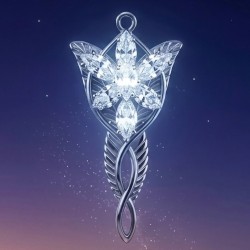
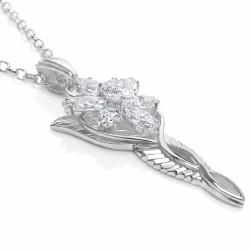
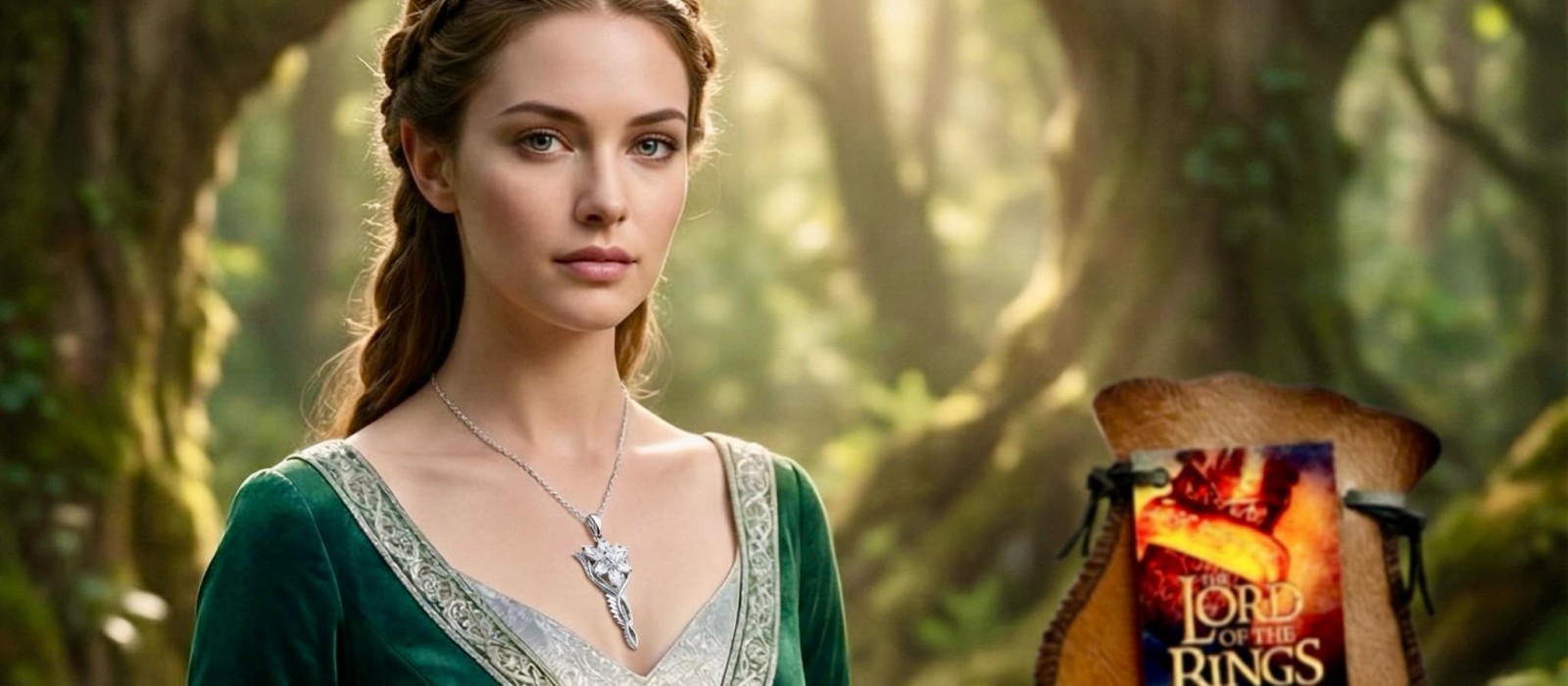
The Arwen Evenstar Pendant — the official licensed piece that carries her story — is the most gifted piece of Lord of the Rings jewellery in the world. Solid 925 sterling silver, claw-set stones, 11.3g, supplied with a 45cm Belcher chain, leather Hobbit pouch, and official Licence of Authenticity. Handcrafted in New Zealand by the New Line Productions licence holders. Backed by a 5-year written guarantee.
What Arwen Actually Did During the War of the Ring
In the films, Arwen rescues Frodo from the Nazgûl, contemplates sailing West, and has a vision of her future son Eldarion. These are inventions of Peter Jackson and his screenwriters — and good ones, dramatically. But in Tolkien's text, Arwen spent the War of the Ring in Rivendell, and what she did there was not passive.
She made a banner. Working in secret, with her own hands, she wove a standard of black cloth and embroidered upon it the White Tree of Gondor, the Seven Stars, and the crown of Elendil — all in mithril, gems, and gold. It was a royal standard of extraordinary craftsmanship, a declaration that the line of Kings had not ended.
This banner was sent with Arwen's brothers Elladan and Elrohir, and a company of Rangers of the North, to find Aragorn before he took the Paths of the Dead. He received it at Dunharrow. It was the sign that pushed him to take the most difficult and dangerous path of the entire war. And at the Battle of the Pelennor Fields — the largest battle of the Third Age — Aragorn unfurled it from the Black Ships of the Corsairs as he arrived to relieve the siege of Minas Tirith. It was the signal to Sauron and every army of darkness that the King had returned. The Enemy faltered. The battle turned.
Arwen's contribution to the War of the Ring was stitched in mithril thread, carried by her brothers, and unfurled on the most decisive battlefield of the age. It was exactly the kind of contribution Tolkien believed in: not the sword-swing, but the work done in the dark, the gift made in love, the symbol that changes everything.
Arwen's Gift to Frodo — "In Your Place Another Shall Come"
Before Frodo left Minas Tirith after the war, Arwen gave him a white gem on a silver chain. She said: "When the memory of the fear and the darkness troubles you, this will bring you aid."
More significantly, she gave him something invisible: her place on the ship. It was Arwen's right, as the daughter of Elrond, to sail West to the Undying Lands with her father. She had chosen mortality — that right was technically no longer hers to claim — but she could give the possibility of sailing to another. She said to Frodo: "In your place another shall come, and the Bearer of the Ring, though he go no further, shall pass over Sea."
It is one of the most generous acts in the entire story. Arwen, who had given up immortality, gave the broken and suffering Hobbit what she no longer needed — the chance to find healing beyond the grey seas of Middle-earth.
Queen of the Reunited Kingdom — 122 Years
Arwen and Aragorn were married on the first day of the new year of the Fourth Age — the year Tolkien marks as the beginning of the age of Men. She was 2,778 years old. He was 88. They ruled together as King and Queen of the Reunited Kingdom of Gondor and Arnor for 122 years. Their son Eldarion inherited the throne. They had at least two daughters.
By her marriage, as Tolkien writes, the long-sundered lines of the Half-elven were reunited — the line of Elrond (who had chosen to be Elven) joining again with the line of Elros (who had chosen to be Man) in the Fourth Age, twenty-seven generations after the brothers had parted. The union also preserved, in Eldarion and his sisters, the last living bloodline with direct descent from Lúthien, from Melian the Maia, from Eärendil the Mariner, and from Finwë, High King of the Noldor.
In Aragorn's line, the oldest blood of the Elves and the oldest blood of Men lived on — mortal, but carrying an inheritance that reached back to the very beginning of the world.
The Death of Arwen — Alone on Cerin Amroth
Aragorn died in FA 120. He was 210 years old — far older than ordinary Men could live, but nothing to Arwen's 2,900. He said his farewell to her. He chose his death as the Dúnedain had always chosen it — willingly, lying down before the end came in decrepitude and grief. He asked her not to follow grief into darkness, but she could not answer him as she wished.
After his death, Arwen said goodbye to her children and travelled from Minas Tirith back to Lothlórien — the forest realm of her grandmother, now empty. Galadriel had departed. The magic was gone. The Mallorn trees stood without their golden light. The realm that had been the most beautiful place in Middle-earth was silent.
She came at last to Cerin Amroth — the same hill where she and Aragorn had plighted their troth a hundred and sixty-one years before, under the golden trees, in what must have seemed like an endless afternoon. She lay down on the green grass. She did not rise again.
Tolkien writes only that "there is her green grave, until the world is changed, and all the days of her life are utterly forgotten by men that come after, and elanor and niphredil bloom no more east of the Sea."
She was the Evenstar. The last light of the Elder Days. And when she was gone, the long age of the Elves in Middle-earth was finished at last.
The Official Evenstar Collection — Every Variant
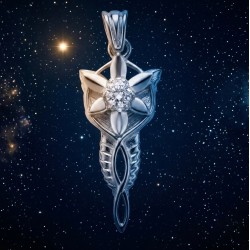
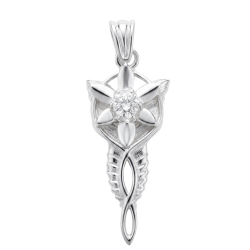
The Arwen Evenstar pendant is the official licensed piece at the heart of the lotrjewelry.com collection — the most gifted piece of Lord of the Rings jewellery in the world. All variants are solid 925 sterling silver with claw-set stones, handcrafted in New Zealand by the New Line Productions licence holders, and backed by a 5-year written guarantee.
Evenstar Necklace — Classic CZ
The full-size official Evenstar. 11.3g, 6cm × 2.5cm, 45cm Belcher chain. Claw-set CZ stones — not glued. Leather Hobbit pouch and Licence of Authenticity. The piece that started the collection.
Evenstar — Genuine Amethyst
Full-size Evenstar with a genuine pear-cut amethyst at the centre — the only officially licensed Evenstar with a real gemstone. The richest version of the collection. Same guarantee, same construction.
Evenstar — Genuine Blue Topaz
Full-size Evenstar with a genuine blue topaz centre stone. Cool, clear, and rare — the blue version of Arwen's pendant for those who feel a deeper connection to the stars of Eärendil.
Miniature Evenstar — CZ, Amethyst & Blue Topaz
35mm × 14mm — a lighter, more subtle version of the full Evenstar for everyday wear. Available in CZ, genuine amethyst, and genuine blue topaz. Sterling silver chain, protective pouch, and Licence card included.
Evenstar — Mini Gold Edition
The Miniature Evenstar in solid 9ct gold — the only official Evenstar in solid gold. For the collector who wants the most precious version of the most precious piece. Ships worldwide from New Zealand.
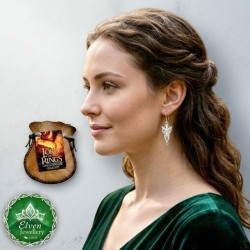
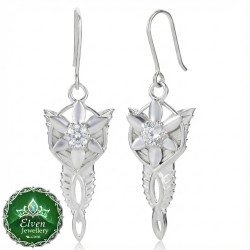
Evenstar Earrings
The Evenstar design in earring form — available in CZ, amethyst, and blue topaz. The complete Evenstar set: wear the pendant and the earrings together for the full Arwen effect. Sterling silver, nickel-free, sold as a pair.
Frequently Asked Questions About Arwen Undómiel
Who is Arwen in Lord of the Rings?
Arwen Undómiel — the Evenstar — is the daughter of Elrond Half-elven, granddaughter of Galadriel, and the most beautiful of the High Elves remaining in Middle-earth during the Third Age. Born in TA 241, she lived 2,778 years before choosing to give up Elven immortality to marry Aragorn and become Queen of the Reunited Kingdom. In Peter Jackson's films she is portrayed by Liv Tyler. In Tolkien's books her role is quieter but arguably more profound — she spends the War of the Ring weaving Aragorn's royal standard by hand in Rivendell.
Why did Arwen give up her immortality?
Arwen chose mortality for love of Aragorn — repeating the choice her ancestor Lúthien had made in the First Age when she chose to die with Beren rather than live without him. As a Half-elven, Arwen had the right to choose her kindred: she could sail to the Undying Lands with her father Elrond and live eternally, or choose the fate of Men — mortality, death, and whatever lies beyond the circles of the world. She made her choice irrevocably on the mound of Cerin Amroth in Lothlórien, pledging herself to Aragorn and accepting death as the price of that pledge.
What does the Evenstar pendant represent?
In Peter Jackson's films, the Evenstar pendant is the jewelled piece Arwen gives to Aragorn as a token of her love and her commitment to choosing mortality. In Tolkien's books, the equivalent object is the Elfstone — a green gem passed through the family from Galadriel. The pendant design used in the films was created specifically for the production and became one of the most iconic pieces of jewellery in cinema history. The official licensed version, handcrafted in New Zealand, reproduces that design in solid 925 sterling silver with claw-set stones.
Did Arwen wield a sword in Tolkien's books?
No. In Tolkien's books, Arwen does not ride to the Ford of Bruinen and does not wield a sword at any point in the story. The ford scene was given to Glorfindel — a powerful Elven lord — in the text. Peter Jackson's decision to give the scene to Arwen was a deliberate choice to give her a more active, visible presence in the first film. Tolkien's Arwen is powerful in a different way: through lineage, sacrifice, and the strategic gift of her banner to Aragorn.
What happened to Arwen's mother, Celebrían?
Celebrían was the daughter of Galadriel and Celeborn, and the wife of Elrond. In TA 2509, while travelling through the Redhorn Pass in the Misty Mountains, she was captured by Orcs and tormented. Elrond's sons Elladan and Elrohir rescued her, and Elrond healed her of her physical wounds — but she could not heal from the memory of what had happened. The following year, she sailed West to the Undying Lands. Arwen therefore grew up without her mother from the age of approximately 2,268 years — raised between her father in Rivendell and her grandmother Galadriel in Lothlórien.
How did Arwen die?
Arwen died in FA 121, the year after Aragorn's death, at the age of approximately 2,900 years. She returned to the now-empty realm of Lothlórien and laid herself down to rest on Cerin Amroth — the same mound where she and Aragorn had pledged their love 161 years earlier. Tolkien writes that there is her green grave "until the world is changed, and all the days of her life are utterly forgotten by men that come after." Her death was the final act in the departure of the Elves from Middle-earth.
Who were Arwen's children?
Arwen and Aragorn had one son — Eldarion, who inherited the throne of the Reunited Kingdom — and at least two daughters, whose names are not recorded in Tolkien's published texts. Eldarion and his sisters were not counted as Half-elven but as restored Dúnedain — mortal, but carrying within them the bloodlines of both Elrond's line (descended from Elves) and Elros's line (descended from Men), reunited after three thousand years of separation.
Was Arwen descended from Lúthien?
Yes, directly. Arwen was descended from Lúthien through the following line: Lúthien married Beren → their son was Dior → his daughter was Elwing → she married Eärendil → their son was Elrond → his daughter was Arwen. Arwen was therefore Lúthien's great-great-great-granddaughter. This is why Tolkien wrote that Arwen bore the likeness of Lúthien — not as a coincidence, but as a literal genetic inheritance across four thousand years of Elvish history. Through Lúthien, Arwen also carried the blood of Melian the Maia — one of the divine immortal beings who shaped Middle-earth before the First Age.
Sources & Further Reading
- The Lord of the Rings — Appendix A — 'The Tale of Aragorn and Arwen' — primary source for Arwen's story, her choice of mortality, and her death on Cerin Amroth
- The Fellowship of the Ring — 'Many Meetings' — Frodo's first sight of Arwen in Rivendell
- The Silmarillion — 'Of the Rings of Power and the Third Age' — context for the Half-elven lineage
- Tolkien Gateway — tolkiengateway.net
Related Products