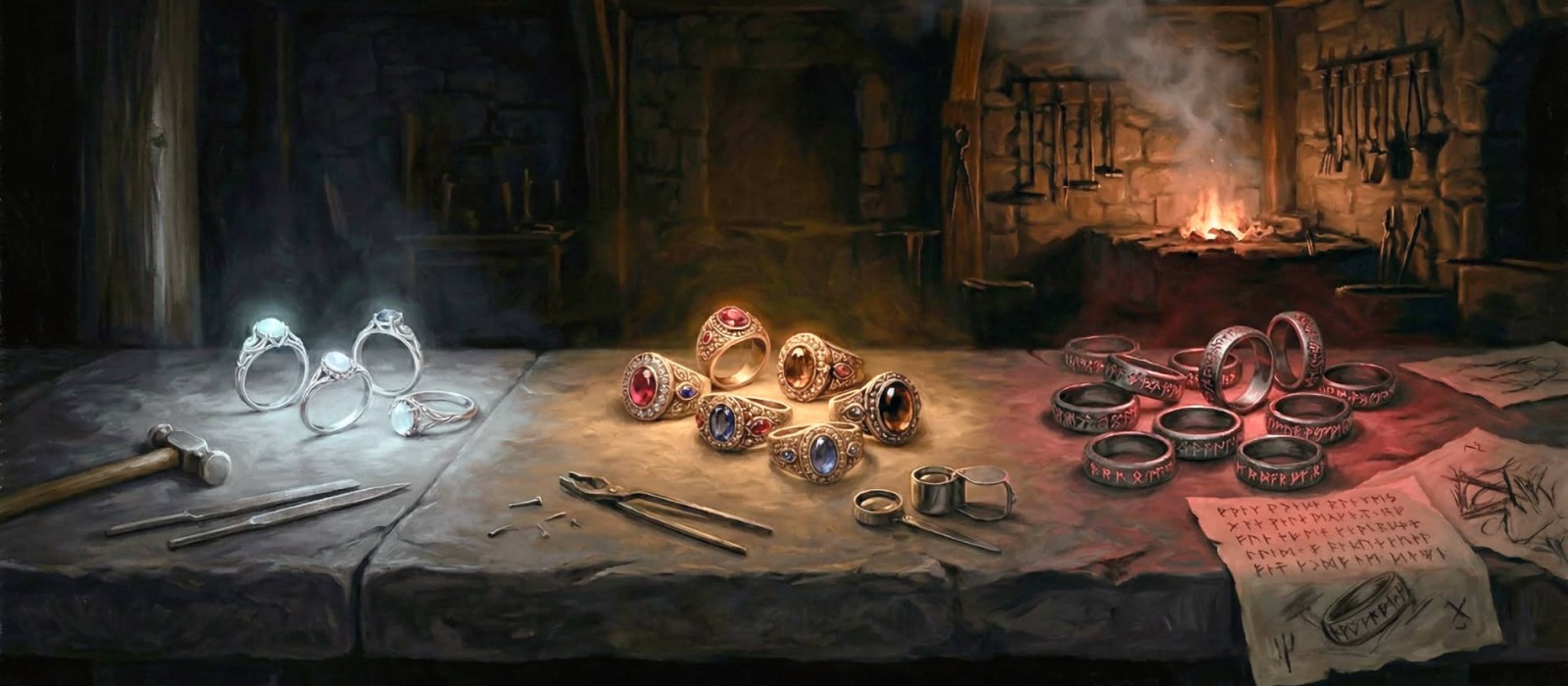
The Rings of Power were nineteen rings made in Eregion in the Second Age of Middle-earth — seven for the Dwarf-lords, nine for the kings of Men, and three for the Elven-kings — plus one more, forged in secret by Sauron alone in the fires of Mount Doom, designed to govern all the others. They were not merely weapons or symbols of status. They were instruments of a specific strategy: the gradual, patient enslavement of the most powerful people in Middle-earth through the amplification of their own desires.
Tolkien opens The Lord of the Rings with the verse that names them all: "Three Rings for the Elven-kings under the sky, / Seven for the Dwarf-lords in their halls of stone, / Nine for Mortal Men doomed to die, / One for the Dark Lord on his dark throne." It is not decorative. It is a structure. It describes a hierarchy of power and corruption, a ladder of enslavement, with the One Ring at the top and nineteen lives — Elvish, Dwarven, mortal — arrayed beneath it.
Understanding the Rings of Power means understanding what each set did to its bearers, why some were more corruptible than others, and what it cost the world when the One Ring was finally destroyed.
The Deception of Annatar — How the Rings Were Made
The Rings of Power were not Sauron's invention alone. They were made in Eregion — the Elvish kingdom founded in the Second Age in the lands of Eriador, east of the Misty Mountains — by the Gwaith-i-Mírdain, the People of the Jewel-smiths, under the leadership of Celebrimbor, grandson of Fëanor. The Elves were the finest craftsmen in Middle-earth. Sauron needed their skill to make what he wanted.
He arrived in Eregion in disguise — taking a form of extraordinary beauty and calling himself Annatar, the Lord of Gifts. He claimed to be an emissary of the Valar, bringing knowledge from the West to help the Elves preserve the beauty of Middle-earth. Gil-galad, the High King of the Noldor, distrusted him and refused to receive him. Galadriel distrusted him and warned against him. But Celebrimbor welcomed him, and together they created the Rings of Power.
What Sauron had understood — and what Celebrimbor did not — was that any ring made using Sauron's techniques and knowledge would be subtly bound to his will. He was not merely teaching craft. He was encoding a back door into every ring that came out of Eregion. The seven and the nine were made this way, under his direct instruction. The Three — Narya, Vilya, and Nenya — Celebrimbor made separately, in secret, without Sauron's hand upon them. They were the only ones that escaped the trap.
Then Sauron went to Mordor and forged the One Ring. When he put it on and spoke his words of command, the Elves felt his will through their rings immediately and removed them. The deception was over. Sauron went to war, destroyed Eregion, killed Celebrimbor, and began distributing the remaining rings to the people he intended to use them on.
The Nine — The Kings Who Became Wraiths
Nine rings were given to the great kings of Men — lords and sorcerers of great power and ambition, the most capable rulers of the mortal world in the Second Age. Sauron chose them carefully. He needed men who already desired power, whose hunger for greatness could be fed by the rings' gifts and then turned against them.
The Nine gave their bearers extraordinary power: long life, great strength, the ability to perceive things hidden from ordinary sight, influence over the minds of lesser men. For a time they were the most powerful rulers in Middle-earth — kings, sorcerers, and warlords who rose to dominance on the strength of what the rings gave them. They got exactly what they wanted.
The price was paid slowly and completely. The rings extended their lives not by making them more vital but by making them less physical — pulling them gradually from the material world into the Unseen realm where Sauron's will operated most directly. Over centuries they faded. Their bodies became transparent. Eventually they existed entirely in the wraith-world — the shadow dimension where spiritual beings moved — enslaved completely to Sauron's will, unable to act independently, their identities consumed by the rings' power as a fire consumes wood. They became the Nazgûl: the Ringwraiths, the Nine Walkers who served as Sauron's most terrible instruments.
The Witch-king of Angmar — greatest of the Nine, the lord who could not be killed by the sword of a Man — had been a great king of Men. Khamûl, the second of the Nine, had been a lord of the Easterlings. Their names, their histories, their original ambitions — all consumed. What remained was the ring's grip and Sauron's will operating through it.
Tolkien's point is precise: the Nine did not fall because they were weak. They fell because they were exactly what Sauron had chosen them to be — powerful, ambitious, and susceptible to the specific temptation the rings offered. Their strength was the mechanism of their destruction.
The Seven — The Dwarves Who Could Not Be Enslaved
Seven rings were given to the great Dwarf-lords — the kings of the seven houses of Durin's Folk and the other Dwarven kindreds. Sauron expected the same result as with the Men: gradual corruption, eventual enslavement. He was wrong.
The Dwarves were made by Aulë, one of the Valar — and Aulë had specifically designed them to be resistant to domination by outside wills. Their nature was stubborn, independent, and deeply internal. The Seven rings could not make them wraiths. They could not enslave them to Sauron's will. What the rings could do — and did, with devastating thoroughness — was amplify the Dwarves' existing appetites.
Dwarves loved gold and craftsmanship. The seven rings made their bearers extraordinarily wealthy — hoarders of treasure on a scale that exceeded any natural capacity — and inflamed that appetite beyond reason, to the point of dragon-sickness, the state of mind in which the possessor of a hoard cannot think of anything except the hoard and its potential loss. Thrór, grandfather of Thorin Oakenshield, is described in Tolkien's texts as having been affected by this — his increasing obsession with the Arkenstone and the treasure of Erebor, his eventual catastrophic journey to Moria, his death at the hands of the Orc Azog: all of it shadows of what the ring had done to the Dwarves who bore them.
Three of the seven were consumed by dragon-fire — the only force hot enough to destroy them short of the Cracks of Doom. Four Sauron eventually recovered by force or cunning. He gained nothing from any of them. The Dwarves had frustrated his plan completely, if not without cost to themselves.
The Three — Preserved Against Sauron's Knowledge
The Three Elven Rings — Narya the Ring of Fire, Vilya the Ring of Air, Nenya the Ring of Water — were the finest things ever made in Middle-earth, and the only Rings of Power that Sauron never touched. Celebrimbor made them separately, in secret, after growing suspicious of Annatar. They were his independent achievement, made from what he had learned without Sauron's direct involvement.
Their purpose was not power in the political sense. Elrond said at the Council: the Three were made for "understanding, making, and healing, not for strength or domination." They were instruments of preservation — designed to hold back the slow decay of time, to sustain beauty and wisdom against entropy. Vilya maintained Rivendell. Nenya maintained Lothlórien. Narya sustained the courage of free peoples against despair. Their work was subtle, continuous, and profound across three thousand years of the Third Age.
But they were not free. When Sauron forged the One Ring and spoke his words of mastery, the Elves felt it through the Three — the connection between his Ring and theirs, made through the shared craft Celebrimbor had used to make them. They removed the Three immediately and hid them. As long as Sauron held the One Ring, wearing the Three meant risking exposure to his will. For three thousand years the bearers — Gil-galad, then Elrond; Galadriel; Círdan, then Gandalf — kept them hidden, unworn in public, known only to a few.
When the One Ring was destroyed, the Three lost their power simultaneously. What they had preserved, they could preserve no longer. Rivendell began to fade. Lothlórien's golden light dimmed. The bearers sailed West, because Middle-earth could no longer sustain them and there was nothing left for them to sustain.
The One Ring — The Ring That Contained Sauron
The One Ring was not merely the most powerful of the Rings of Power. It was Sauron himself, partially externalised — the vessel into which he had poured a significant portion of his own native being, his will to dominate, his malice, his intelligence. Making it had made him weaker in one sense: he could never again operate at his full capacity without it. But while it existed, his spirit could not be permanently destroyed. As long as the One Ring existed, Sauron could be broken but not ended.
The One Ring's corruption was different in kind from the corruption of the other rings. The Seven and the Nine worked through amplification — taking existing desires and inflating them beyond reason. The One Ring worked through replacement — gradually substituting its own will for the bearer's, filling the space that the bearer's identity occupied until nothing of the original person remained except as a conduit for the Ring's purpose.
Gollum is the clearest study. Five hundred years of possession had not destroyed him physically — the Ring's life-extension effect kept him alive — but it had consumed his identity so completely that "Sméagol" had ceased to exist except as a buried, occasional voice, and "Gollum" — the name others gave the sound he made — was all that remained. He could not think about anything that was not the Ring. He could not want anything except its return. He was the Ring's creature in the most literal sense: a person who had been eaten from the inside out by an object's will.
This is why Frodo's failure at the Cracks of Doom was not a moral failing. The Ring had been doing to him, over eight months, what it had done to Gollum over five centuries — compressing the process because it was at its most powerful near its source, fighting most desperately against destruction. That Frodo got as far as he did, that any will remained in him at all at the end, is extraordinary. The Ring's destruction required both his achievement and Gollum's intervention — and behind both, Tolkien believed, the quiet operation of a Providence that had arranged things so that even the Ring's treachery — in preserving Gollum for five hundred years as its most faithful servant — was the instrument of its end.
The Rings After the One Ring's Destruction
When the One Ring was destroyed on the 25th of March, TA 3019, everything that depended on it failed simultaneously. The Nine were consumed — their physical forms dissolving as the sustaining power that had kept them in existence was annihilated. The Seven had been distributed: three burned in dragon-fire, four recovered by Sauron — all were now inert. The Three lost their preserving power the moment the One Ring fell into the fire, their connection to the same foundational craft severed.
Sauron's spirit survived — diminished beyond recovery, reduced to a shadow without form or will, unable to rebuild, unable to threaten Middle-earth again. The great design that had begun with his arrival in Eregion as Annatar, three thousand years before, had ended in the exact way he had been unable to imagine: with the Ring voluntarily given up, carried into his own realm, and destroyed by a creature he had never taken seriously.
The age of Rings was over. The age of Men had begun.
The Official Ring Collection — Made in New Zealand
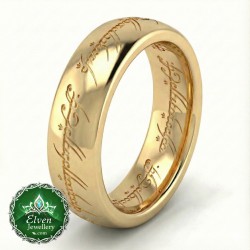
The official One Ring collection at lotrjewelry.com is the only officially licensed reproduction of the Ring that Sauron forged, Isildur took, Gollum kept, Bilbo found, and Frodo carried to Mount Doom. Made in New Zealand — where Middle-earth was filmed — by the New Line Productions licence holders. Solid 925 sterling silver or solid gold, custom-made to your exact size.
One Ring — Sterling Silver
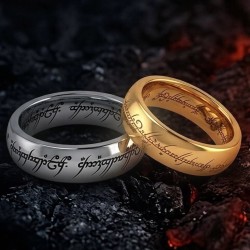
The precision engraved One Ring in solid 925 sterling silver. The Tengwar inscription in Black Speech on both inner and outer surface. Comfort Curve, custom-made to your exact size. Made in New Zealand by the New Line Productions licence holders.
Shop One Ring Silver →One Ring — UV Fire Script
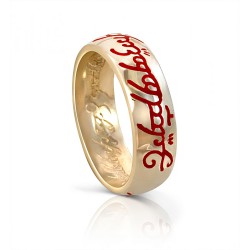
Sterling silver with red UV-reactive resin — the inscription glows as if written in fire under UV light. The Ring as Gandalf saw it in Frodo's hearth. Custom-made to size. Made in New Zealand by the New Line Productions licence holders.
Shop UV Fire Script →Nenya — Ring of Water
The official Galadriel's Nenya — one of the Three Elven Rings — in solid 925 sterling silver with white gold finish. The only officially licensed Elven Ring of Power in the collection. Made in New Zealand by the New Line Productions licence holders.
Shop Nenya →Frequently Asked Questions About the Rings of Power
How many Rings of Power were there?
Twenty Rings of Power were made in Eregion, plus the One Ring that Sauron forged separately. Of the twenty: three were made by Celebrimbor alone for the Elvish kings (Narya, Vilya, Nenya); seven were given to the Dwarf-lords; and nine were given to the kings of Men. Sauron then forged the One Ring in the fires of Mount Doom to govern all the others. The total is therefore twenty-one rings, though "the Rings of Power" in the strictest sense refers to the nineteen given to the free peoples, with the One Ring in a separate category as their master.
Why did the rings corrupt their bearers differently?
The nature of the corruption depended on the nature of the bearer. The Nine given to Men worked through the mortal condition — by extending life beyond its natural term, they pulled Men toward the wraith-world where Sauron's will was strongest, eventually consuming them entirely. The Seven given to Dwarves could not enslave them — Dwarves were made too stubborn for that — but amplified their existing love of wealth and craft into obsession. The Three given to the Elvish kings, made without Sauron's direct influence, did not corrupt at all but sustained and preserved. The One Ring's corruption was the most total: a direct substitution of its own will for the bearer's.
Who were the nine Ringwraiths?
The nine Ringwraiths — the Nazgûl — were once the greatest kings and sorcerers of Men in the Second Age, who accepted rings from Sauron and were gradually reduced to wraiths as the rings extended their lives by pulling them into the Unseen realm. Their names and identities were largely lost to history. The most powerful was the Witch-king of Angmar, who became Sauron's greatest servant and led the assault on Minas Tirith. The second was Khamûl, a lord of the Easterlings. The identities of the other seven are not recorded in Tolkien's published texts, though he provided some additional detail in unpublished material gathered in Unfinished Tales.
What happened to the Seven Rings of the Dwarves?
Three of the seven Dwarf-rings were consumed by dragon-fire — the only force besides the Crack of Doom hot enough to destroy a Ring of Power. Four were recovered by Sauron, either by force or cunning, over the course of the Third Age. He gained essentially nothing from any of them: the Dwarves, made by Aulë to be resistant to outside domination, could not be enslaved through the rings. The rings made them wealthy and inflamed their appetite for gold and treasure, but produced no wraiths and no servants. Sauron considered the experiment with the Dwarves a failure.
Is the Amazon series "The Rings of Power" based on Tolkien's books?
The Amazon Prime Video series The Lord of the Rings: The Rings of Power is set in the Second Age of Middle-earth and draws on Tolkien's appendices to The Lord of the Rings, The Silmarillion, and Unfinished Tales for its historical framework — the period of the rings' making, the deception of Annatar, the fall of Númenor, and the Last Alliance. However, Amazon does not hold the rights to The Silmarillion or Unfinished Tales directly, so the series makes significant use of original invention alongside the material it can licence. Tolkien scholars and fans have varied opinions on how faithfully the series represents the spirit of the source material.
Why couldn't anyone simply use the One Ring against Sauron?
Because the One Ring was not a neutral tool — it was a fragment of Sauron's own will, designed to dominate. Any being who used it to oppose Sauron would have to use it as it was designed: as an instrument of domination. In doing so, they would be reshaped by it into another Dark Lord — their intentions twisted by the Ring's nature toward the same ends it was always designed to serve. This is why Gandalf, Galadriel, and Aragorn all refused it when offered. The only way to end Sauron's power permanently was to destroy the Ring, not use it.
Sources & Further Reading
- The Lord of the Rings — The Fellowship of the Ring: 'The Shadow of the Past' and 'The Council of Elrond' — Gandalf and Elrond's accounts of the Rings' history and purpose
- The Silmarillion: 'Of the Rings of Power and the Third Age' — the most complete canonical account of the rings' making, distribution, and eventual fate
- The Lord of the Rings — Appendix B: 'The Tale of Years' — chronological history of the Rings across the Second and Third Ages
- Unfinished Tales of Númenor and Middle-earth, ed. Christopher Tolkien: 'The History of Galadriel and Celeborn' and 'The Hunt for the Ring' — additional detail on the Three Elven Rings and the distribution of the Nine
- The Letters of J.R.R. Tolkien, ed. Humphrey Carpenter: Letters 131 and 183 — Tolkien's direct explanations of the Rings' symbolism, the nature of their corruption, and what the One Ring represented
- Tolkien Gateway — tolkiengateway.net
Related Products