Galadriel — Lady of Lothlórien, bearer of Nenya the Ring of Water, the mightiest of the Elves who remained in Middle-earth after the fall of Gil-galad, was born in Valinor before the First Age began, granddaughter of two Elvish kings, and one of the very few beings in Tolkien's entire legendarium who crossed from the Blessed Lands to Middle-earth and remained there for more than seven thousand years. She was the last great Elvish ruler in Middle-earth. She sustained the beauty of Lothlórien for three thousand years with Nenya's power. She refused the One Ring when it was offered to her, the most significant act of restraint in the entire story. And she was, to Tolkien's own description, "the greatest of Elven women."
There is a scene near the end of The Fellowship of the Ring where Galadriel stands in her garden beside the Mirror — the silver basin of water that shows the past, the present, and the possible and Frodo offers her the One Ring. She holds out her hand. The Ring on Frodo's palm seems to grow. The garden darkens. And then she lets her hand fall.
"I passed the test," she says. "I will diminish, and go into the West, and remain Galadriel."
The word "diminish" is the most important one. She understood what refusing the Ring meant: that when it was destroyed, Nenya's power would fail with it, Lothlórien would fade, and her three thousand years of preservation would come undone. She chose that over the alternative. That choice and everything it cost her is the measure of who she was.
Origins — Born of Two Royal Lines
Galadriel's lineage placed her at the intersection of the two greatest Elvish royal houses. On her father's side, she was the granddaughter of Finwë, High King of the Noldor, the most gifted and ambitious of the Elvish peoples, the makers and craftsmen and scholars whose history drives almost everything in Tolkien's Silmarillion. On her mother's side, she was the granddaughter of Olwë, King of the Teleri, the sea-loving Elves of Alqualondë, whose ships Fëanor and the Noldor later stole in an act of violence that poisoned the Noldor's departure from Valinor for the rest of the First Age.
She was, therefore, not entirely Noldorin. She carried Telerin blood, the blood of a people associated with the sea, with starlight on water, with a different and quieter relationship to the world than the Noldor's burning ambition. Tolkien writes that the light of her hair was so remarkable it was said to have inspired Fëanor to try to capture the light of the Two Trees of Valinor in the Silmarils, the most extraordinary act of craft in the history of the world. Fëanor asked for a strand of her hair three times. She refused all three times. She had distrusted him from the beginning and perceived in him a darkness that she feared, even before its full consequences were visible.
Her given names reflect her dual nature. Her father named her Artanis, Noble Woman. Her mother named her Nerwen — Man-Maiden, a reference to her exceptional height and physical strength, which exceeded that of most male Elves. The name Galadriel, meaning "Maiden Crowned with a Radiant Garland," in reference to her hair, was given to her by Celeborn, the man she would marry. He met her in Doriath and gave her the name she carried through all the ages of her life in Middle-earth.
The Exile — Crossing the Grinding Ice
When Fëanor led the rebellion of the Noldor — the departure from Valinor against the Valar's wishes, driven by the theft of the Silmarils by Morgoth and Fëanor's oath to recover them, Galadriel was among those who left. Her reasons were her own, and different from Fëanor's: she had long desired to see Middle-earth and to rule a realm of her own. She was proud, independent, ambitious, and frustrated with the limitations of Valinor. She had dreams, as Tolkien writes, of "far lands and dominions that might be her own to order as she would without tutelage."
She and Fëanor had already parted ways. When Fëanor and the Noldorin vanguard reached the shore at Alqualondë and stole the Telerin ships, killing Elves in the process, the First Kinslaying, the most shameful act in Elvish history, Galadriel was not part of it. She and her people followed the second host under Fingolfin. When Fëanor's people burned the stolen ships at Losgar rather than sending them back for Fingolfin's host, Galadriel crossed to Middle-earth the hard way: on foot, across the Grinding Ice of the Helcaraxë, the treacherous frozen strait between Aman and the far north of Middle-earth, in a winter crossing that killed many and tested the rest beyond endurance.
She arrived in Beleriand as the Moon rose for the first time, a detail Tolkien placed deliberately, marking the beginning of a new era with her arrival. She was in Middle-earth, and she would not leave it for seven thousand years.
Doriath — Meeting Celeborn
In the early First Age, Galadriel came to Doriath, the hidden kingdom of Thingol and Melian, the most beautiful and most protected realm in Beleriand, ringed by the Girdle of Melian that no enemy could pass. She befriended Melian, the Maia who was Thingol's queen, and the two developed a friendship of deep mutual respect, the greatest Elven woman and the greatest Maia woman, each recognising in the other something of comparable depth and power.
It was in Doriath that she met Celeborn, a prince of the Sindar, kinsman of Thingol himself. Tolkien's accounts of how and exactly when they met vary across his different writings, but the core fact is consistent: they fell in love in Doriath, and he gave her the name she would carry for the rest of eternity. They married, and they would remain together across all the remaining ages of Middle-earth's recorded history, one of the great love stories of the legendarium, conducted so quietly and with such mutual self-sufficiency that it is easy to overlook beside the more dramatic pairings of Beren and Lúthien or Aragorn and Arwen.
Their love was not the love of tragedy. It was the love of equals, two people of great individual power and intelligence who chose each other freely, complemented each other's natures, and remained faithful across seven thousand years without requiring catastrophe to prove it. That is rarer in Tolkien's mythology than the tragic kind, and in its way more remarkable.
The Second Age — Eregion and the Distrust of Annatar
When the First Age ended with the War of Wrath and Morgoth's defeat, Galadriel and Celeborn chose to remain in Middle-earth. The Valar offered pardon to the surviving Noldor and the right of return to Valinor. Galadriel refused, not from stubbornness or punishment, but because her desire to see and govern a realm of her own remained unquenched. She and Celeborn moved east and eventually established themselves in Eregion, the Elvish kingdom founded near the western gates of Moria, where the Elven-smiths under Celebrimbor were developing their craft.
Eregion was Galadriel's strategic creation as much as anyone's. She had a natural sympathy for the Dwarves' passionate love of crafts, and recognised the potential of establishing trade with Khazad-dûm. She had studied under Aulë himself in Valinor, the same divine craftsman who made the Dwarves, and her kinship with the Dwarven passion for making things was genuine. Under her influence, the relations between Elves and Dwarves in Eregion were better than they had been at any point since the First Age.
Then Annatar arrived. The Lord of Gifts, as he called himself, was beautiful, knowledgeable, claiming to be an emissary of the Valar. Galadriel distrusted him immediately and completely. Sauron tried to seduce the Eldar, but found in Galadriel his main adversary. She refused to receive him and warned against him. But Celebrimbor and the Gwaith-i-Mírdain welcomed him, and Annatar's influence eventually moved them against Galadriel's counsel. She left Eregion through the gates of Moria — Celeborn refused to enter the Dwarven kingdom, and went to Lothlórien.
She was right. Annatar was Sauron. When his deception was revealed, and the One Ring was forged, the war that followed destroyed Eregion entirely. Celebrimbor, dying, entrusted Galadriel with Nenya, the Ring of Water, the greatest of the Three he had made without Sauron's touch. She hid it. She did not use it while Sauron held the One Ring. She waited.
Lothlórien — The Realm Nenya Built
After the Last Alliance defeated Sauron at the end of the Second Age, Galadriel and Celeborn became the Lord and Lady of Lothlórien, the Elvish forest realm on the eastern slopes of the Misty Mountains, where the golden Mallorn trees grew and time moved differently than in the world outside.
Now she could use Nenya. With the One Ring's immediate threat removed, Sauron's spirit fled, his physical form destroyed at the Last Alliance — the Ring of Water could be used openly to sustain and preserve the beauty of the realm. For three thousand years of the Third Age, Nenya maintained Lothlórien: keeping the Mallorn trees in their golden beauty, preserving the quality of light in the forest, sustaining a sanctuary of Elvish grace in a world that was growing increasingly dark and diminished.
The Fellowship experienced this when they rested in Lothlórien after Moria. Tolkien describes it carefully, the sense that time moved differently there, that wounds and griefs lost some of their urgency, that the beauty was not the beauty of the present world but of something older and more enduring. Frodo felt, lying under the Mallorn trees, that he was "seeing things that were meant to be before the shadow came." That was Nenya's work. Galadriel's will through the Ring, holding three thousand years of Middle-earth's slow decay at arm's length.
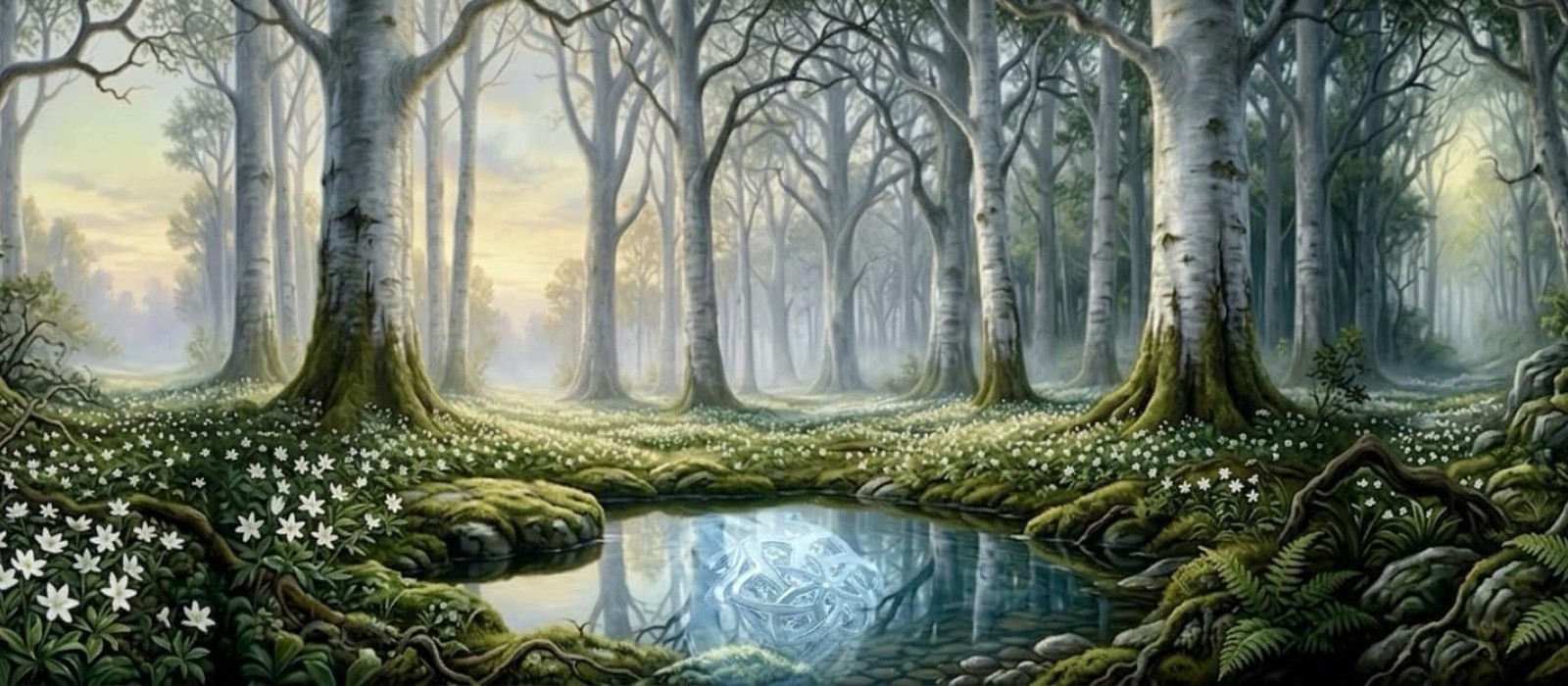
She also built the Mirror, the stone basin in the garden of Caras Galadhon, filled with the water of the Silverlode, in which she could show visitors the past, the present, and the possible future. It was an instrument of Nenya's power, the Ring of Water giving her mastery over what water reflected and revealed. When Frodo looked in the Mirror and saw the Eye of Sauron searching for him, it was because Galadriel could perceive, through the connection between the Rings, that Sauron was aware someone nearby carried the One Ring. She told Frodo: "I perceive that you see as in a glass darkly that which he sees with his Eye."
The White Council — Why She Wanted Gandalf
Galadriel was instrumental in forming the White Council, the gathering of the wise that included Saruman, Gandalf, Elrond, Círdan, and others, specifically to oppose the growing shadow in Dol Guldur. When it came time to choose a head for the Council, Galadriel urged the members to choose Gandalf. She had recognised from his arrival at the Grey Havens that Gandalf was the right being for the age's central challenge, not Saruman, whose superior rank and rhetorical skill impressed the others, but Gandalf, whose humility, patience, and love of ordinary things made him uniquely suited to the mission the Valar had defined for the Istari.
Saruman's pride would not accept the appointment she proposed, and he manoeuvred the Council into choosing him as head instead. Galadriel accepted this; she was patient, but she maintained her own counsel and her own independent judgement throughout the Third Age. When Saruman eventually opposed action against Dol Guldur, delaying the White Council's attack for decades, she understood that his reasons were not the ones he stated. She pressed for action anyway.
Her relationship with Gandalf was the closest thing to a genuine political and spiritual partnership in the story. They shared information, advised each other, and maintained a trust that Saruman, watching it from outside, found threatening and infuriating. When Gandalf was imprisoned by Saruman on Orthanc, it was Galadriel who sent the Eagles. When Gandalf returned from death as Gandalf the White, it was Galadriel who clothed him in white and acknowledged his new authority.
Gimli — The Unexpected Devotion
One of the most quietly remarkable things about Galadriel is what happened between her and Gimli, son of Glóin, when the Fellowship came to Lothlórien after Moria.
Celeborn, entering with the Fellowship, was initially sharp about the Dwarf in the company; his distrust of Dwarves, shaped by the destruction of Doriath in which Dwarves had a part, surfaced immediately. Galadriel rebuked him gently and welcomed Gimli with courtesy. She spoke to him in Khuzdul, the secret language of the Dwarves, which she had apparently learned during her time in Eregion. The effect on Gimli was total and permanent. He became her most passionate devotee.
When Galadriel offered each member of the Fellowship a gift and asked what they desired, Gimli asked only for one strand of her hair. The request was so unexpected, so unlike anything a Dwarf was expected to ask of an Elf, that the room went quiet. She gave him three. Tolkien notes that Galadriel had refused Fëanor three times when he asked for her hair — a request she found self-serving and arrogant. She gave Gimli three strands freely, without hesitation, because the request came from genuine reverence rather than possessive desire.
Gimli carried those three strands for the rest of his life and, when he finally sailed West at the end of the Fourth Age, the only Dwarf ever granted passage to Valinor, he went partly because Galadriel was there. The most improbable devotion in the story, between the Lady of the Elves and a Dwarf from Erebor, grew from a moment of unexpected courtesy and a gift of hair.
The Refusal — "I Will Diminish and Remain Galadriel"
When Frodo offered Galadriel the One Ring in the garden at Caras Galadhon, she was tested in a way that Gandalf had feared to be tested and Saruman had already failed. She had desired the Ring. She admitted this openly, not as a confession of weakness but as an honest account of what was in her. For long years, she had imagined what she could do with it: combined with Nenya's preserving power, wielded by someone of her wisdom and her genuine love of beauty and life, it could have sustained Middle-earth against Sauron's darkness permanently.
She described what she saw as she reached toward it: "In place of the Dark Lord you will set up a Queen. Not dark but beautiful and terrible as the Morn! Treacherous as the Sea! Stronger than the foundations of the Earth! All shall love me and despair!"
The vision she described was not of evil. It was of herself, at full power, using everything she had, Nenya, the One Ring, three thousand years of accumulated wisdom, to impose her vision of good on the world. It would have been genuinely better than Sauron's domination. It would still have been domination. The free will of every other being in Middle-earth would have been subordinated to her will, however beautiful and well-intentioned that will was. She understood this with perfect clarity.
She let her hand fall. She chose diminishment over that. She remained Galadriel, herself, bounded, mortal-seeming, with a Ring whose power was already borrowed time, rather than become the thing that the One Ring was designed to create.
The Gifts — What She Gave the Fellowship
Galadriel's gifts to the Fellowship were not merely generous. They were precisely chosen, each one addressing the specific need or nature of its recipient with an insight that made the giving itself an act of knowing.
To Frodo, she gave the Phial of Galadriel — a crystal vessel containing the light of Eärendil's star, caught in the waters of her fountain. She told him, "It will shine still brighter when night is about you. May it be a light to you in dark places, when all other lights go out." It was the light that saved him from Shelob in the Pass of Cirith Ungol. To Sam, she gave a box of soil from Lothlórien and a mallorn seed, which became the finest tree in the Shire after the Scouring, the first mallorn in Middle-earth outside Lothlórien, a piece of what Nenya had sustained now growing in the land Sam loved.
To Gimli, she gave the three strands of her hair. To Aragorn she gave a sheath for Andúril and a green stone — the Elfstone, the Elessar — which connected him to the heritage of his kingship and gave him his royal name. To Legolas, she gave a bow of the Galadhrim. To Boromir, two golden arm-bands. To Merry and Pippin, belts of silver and gold. To Gandalf, a staff and a ring, Narya, the Ring of Fire, though this is never stated directly in the main text.
Each gift was a tool, a symbol, and a prophecy simultaneously. She gave people what they would need, chosen by someone who could see through the Mirror, through Nenya, through seven thousand years of watching the world — further than anyone else in the story.
Nenya — The Ring on Her Finger
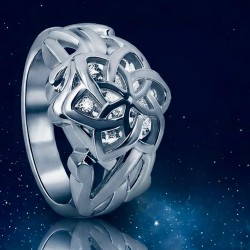
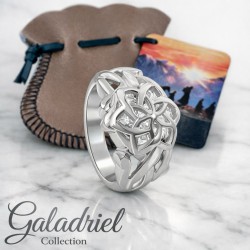
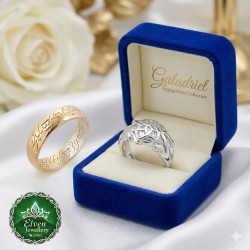
Nenya — the Ring of Water, the Ring of Adamant, the White Ring, is the only officially licensed Elven Ring of Power in the entire Lord of the Rings jewellery collection. Made of mithril set with a stone of adamant, it was the instrument through which Galadriel sustained Lothlórien for three thousand years, the ring that flickered like a frosty star on her finger when Frodo saw it, and the ring she carried over the Sea when its purpose was completed.
It has become, for many people, something more than a collector's piece. Nenya's symbolism, preservation of what is beautiful, endurance across time, and a love that does not diminish make it a natural choice for engagement. A ring associated with Galadriel: the woman who loved Celeborn across seven thousand years, who sustained beauty against all the forces that wanted to consume it, who chose to diminish rather than corrupt herself. There is no more fitting symbol for a commitment made with that intention.
The official Nenya is made in New Zealand by the New Line Productions licence holders, in solid 925 sterling silver with white gold finish, and in solid 9ct white gold. The mithril aesthetic, cool, silver-white, the colour of starlight, translates into precious metal exactly as Tolkien described it.
Nenya — Sterling Silver
The official Galadriel's Ring of Water in solid 925 sterling silver with white gold finish. The only officially licensed Elven Ring of Power in the collection. The ring that sustained Lothlórien for three thousand years. Made in New Zealand by the New Line Productions licence holders. Supplied with Licence of Authenticity.
Shop Nenya Sterling Silver →Nenya — White Gold
The official Nenya in solid 9ct white gold — the closest available material to Tolkien's mithril. The Ring of Water in the metal of starlight. Custom-made to your exact size in New Zealand by the New Line Productions licence holders. The most precious version of the most elegant ring in the collection.
Shop Nenya White Gold →The Sailing West — An End and a Reunion
On September 29, TA 3021, Galadriel rode to the Grey Havens and boarded the last ship West. With her sailed Elrond, Gandalf, Frodo, and Bilbo. She took Nenya on her finger, its power spent, its work done, and departed Middle-earth after more than seven thousand years.
In Valinor, she was reunited with her daughter Celebrían, who had sailed West five centuries earlier after being injured by Orcs. She was reunited with the Valar whose counsel she had defied at the beginning of her story. The ban on her return, imposed because she had left without the Valar's full blessing, a participant in the rebellion of the Noldor, was lifted specifically in acknowledgement of her refusal of the One Ring. That refusal was, in the Valar's judgement, the act that cancelled the debt of the exile. She had been offered absolute power and set it down. She came home.
Celeborn did not sail with her. He remained in Middle-earth for a time, how long, Tolkien leaves uncertain, before eventually crossing the Sea himself to be reunited with his wife. Their parting at the Grey Havens is not described, but it carries the same quality as everything else about their relationship: quiet, mutual, without drama, the confidence of people who have been together across seven thousand years and know that separation is temporary.
Frequently Asked Questions About Galadriel
Who is Galadriel in Lord of the Rings?
Galadriel is the Lady of Lothlórien, the Elvish forest realm in Middle-earth, and the bearer of Nenya, the Ring of Water. She is the mightiest of the Elves remaining in Middle-earth during the Third Age: born in Valinor before the First Age, granddaughter of two Elvish kings, participant in the Noldor's exile, and the one who sustained Lothlórien's beauty for three thousand years with Nenya's power. She is played by Cate Blanchett in Peter Jackson's films and by Morfydd Clark in Amazon's The Rings of Power.
Why did Galadriel refuse the One Ring?
Galadriel understood that using the One Ring, even with the best intentions, would make her a new Dark Lord. She would have imposed her will on the world in place of Sauron's, however much more beautiful and benevolent that will was. She said: "In place of the Dark Lord you will set up a Queen. All shall love me and despair." She chose instead to "diminish and go into the West", to accept the loss of Nenya's power and Lothlórien's beauty rather than become what the Ring was designed to create. Tolkien considered this the most important test of will in the entire story after Frodo's.
How old is Galadriel?
Galadriel was born in Valinor before the First Age of Middle-earth, before time in Middle-earth was counted in the way Tolkien's chronology describes it. By the time of The Lord of the Rings, she had lived through the entire First Age, the Second Age, and most of the Third Age, a span of roughly seven thousand years. She was, along with Círdan the Shipwright, among the oldest beings still living in Middle-earth at the time of the War of the Ring. Her exact birth year is not specified in any published Tolkien text.
What is Galadriel's ring — Nenya?
Nenya, the Ring of Water, the Ring of Adamant, the White Ring, was one of the Three Elven Rings made by Celebrimbor in Eregion without Sauron's direct involvement. Made of mithril set with a stone of adamant (diamond), it was given to Galadriel when Sauron's deception was discovered. She bore it in secret throughout the Third Age, using its preserving power to sustain the beauty of Lothlórien and her own extraordinary gifts of sight and understanding. It lost its power when the One Ring was destroyed, and Galadriel carried it to Valinor when she sailed West.
Why did Galadriel give Gimli three hairs?
When Galadriel offered each Fellowship member a gift, Gimli asked only for one strand of her hair, a request so unexpected, so unlike anything a Dwarf might be expected to ask of an Elf, that the room went silent. She gave him three. The significance is in the contrast with Fëanor: the greatest craftsman in Elvish history had asked for a strand of her hair three times, and she had refused three times, because his desire for it was possessive and arrogant. She gave Gimli three freely, because his request came from genuine reverence. It was a recognition of an unexpected kindred spirit and the beginning of the most unlikely friendship in Middle-earth.
Did Galadriel participate in the Kinslaying?
No. Galadriel was not part of the First Kinslaying at Alqualondë, the attack by Fëanor's people on the Telerin Elves to steal their ships. She and her people had already separated from Fëanor and followed Fingolfin's host. According to one of Tolkien's later accounts, she actually fought heroically against Fëanor, defending Alqualondë alongside Celeborn. Her departure from Valinor was therefore not driven by guilt or the Noldor's collective punishment but by her own independent desire to see and govern a realm of her own in Middle-earth.
What happened to Galadriel after the War of the Ring?
After the One Ring was destroyed and Nenya lost its power, Galadriel remained in Middle-earth briefly to attend Aragorn's coronation and wedding. She then rode north with Elrond, Gandalf, and the four hobbits. On September 29, TA 3021, she sailed from the Grey Havens to Valinor, the Undying Lands, on the last ship, accompanied by Elrond, Gandalf, Frodo, and Bilbo. In Valinor, she was reunited with her daughter Celebrían and released from the ban on her return that had existed since the Noldor exile. Celeborn remained in Middle-earth for a time before eventually sailing West himself to be reunited with her.
Is Nenya suitable as an engagement ring?
Many people choose Nenya as an engagement ring, and the symbolism is genuinely fitting. Galadriel and Celeborn's love lasted across seven thousand years, through war, exile, separation, and loss, without diminishing. Nenya itself is a ring of preservation — of keeping what is beautiful and true against the forces that want to consume it. A ring associated with the most enduring love in Tolkien's legendarium, made in the metal of starlight, chosen for what it represents rather than merely for how it looks: there are worse foundations for a commitment. The official Nenya is available in solid sterling silver with white gold finish and in solid 9ct white gold, both made in New Zealand by the New Line Productions licence holders.
Sources & Further Reading
- The Lord of the Rings — The Fellowship of the Ring: 'Lothlórien', 'The Mirror of Galadriel', 'Farewell to Lórien' — the primary source for Galadriel's role in the War of the Ring, the Mirror, the refusal of the Ring, and the gifts to the Fellowship
- The Silmarillion: 'Valaquenta', 'Of the Flight of the Noldor', 'Of the Rings of Power and the Third Age' — Galadriel's origins, her exile, and her role in the Second Age's events
- Unfinished Tales of Númenor and Middle-earth, ed. Christopher Tolkien: 'The History of Galadriel and Celeborn' — the most detailed published account of her activities across the Second and Third Ages, including her distrust of Annatar and the distribution of Nenya
- The Lord of the Rings — Appendix B: 'The Tale of Years' — chronological history of Galadriel's movements through the Second and Third Ages
- The Letters of J.R.R. Tolkien, ed. Humphrey Carpenter: Letters 297, 320, and 353 — Tolkien's discussions of Galadriel's nature, her ban from Valinor, and her eventual pardon
- Tolkien Gateway — tolkiengateway.net/wiki/Galadriel
Related Products