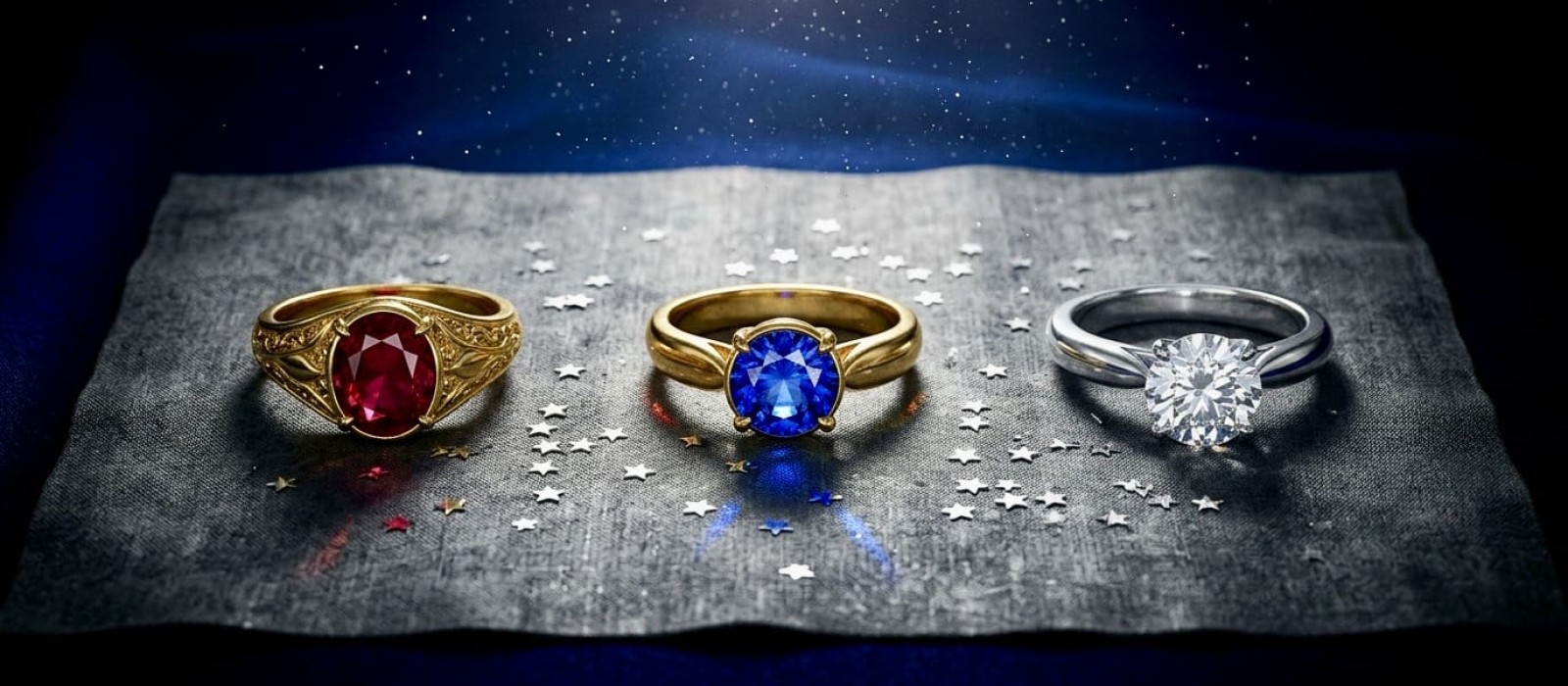
Three Rings were made by Celebrimbor in Eregion at the end of the Second Age — without Sauron's direct hand — for the preservation and protection of the Elvish world. Narya the Ring of Fire, borne by Gandalf. Vilya the Ring of Air, borne by Elrond. Nenya the Ring of Water, borne by Galadriel. They were the finest things the Elves ever made, and they were bound, in the end, to a Ring they had nothing to do with — the One Ring that Sauron forged in secret in the fires of Mount Doom, whose destruction was the price of their power.
Tolkien wrote the verse that introduced the Rings of Power — "Three Rings for the Elven-kings under the sky, / Seven for the Dwarf-lords in their halls of stone, / Nine for Mortal Men doomed to die, / One for the Dark Lord on his dark throne" — as the epigraph to the entire Lord of the Rings. It is not a decorative flourish. It is a précis of the whole story. Understand the Rings and you understand what the story is about.
The Three were the best of them — made without Sauron's corruption, intended for a different purpose than domination, and kept secret from him throughout the Third Age. But they were vulnerable to the same thing all the others were: the One Ring. As long as the One Ring existed, Sauron could perceive the thoughts of the Three's bearers. When it was destroyed, the Three lost their power simultaneously. Everything they had preserved — the beauty of Rivendell, the golden light of Lothlórien, the courage the Ring of Fire had kindled in cold hearts across three thousand years — faded with them.
Here is their complete story.
The Forging — How the Three Were Made
In the Second Age, around SA 1200, Sauron — disguised as Annatar, the Lord of Gifts — came to the Elven-smiths of Eregion in Eriador and offered them instruction in the craft of ring-making. His stated purpose was to help the Elves preserve the beauty of Middle-earth against the entropy of time. His actual purpose was to bind them. Most of the Rings of Power that came out of Eregion — the Seven and the Nine — were made under his direct instruction, with his techniques and his influence woven into their metal.
But Celebrimbor — the greatest Elven craftsman of the age, grandson of Fëanor — made the Three himself, in secret, without Sauron's hand upon them. He understood something of Sauron's nature, or at least he distrusted him enough to make these three rings independently. They were made from the knowledge Sauron had provided — so they were not entirely free of his influence — but they had not been touched by him. They were the Elves' own work, for their own purposes.
Those purposes were, as Elrond told the Council: not strength or domination or hoarded wealth, but "understanding, making, and healing." The Three were not weapons. They were not tools of power in the ordinary sense. They were instruments of preservation — designed to hold back the slow decay that was consuming Middle-earth, to keep beautiful things beautiful, to sustain Elvish wisdom and grace against the grinding passage of time.
When Sauron put on the One Ring and spoke his words of mastery, the Elves felt it through the Three — felt his will trying to enter their minds through the connection between his Ring and theirs. They took off the Three immediately and hid them. The deception was over. Sauron had never intended to help them. He went to war, destroyed Eregion, tortured Celebrimbor to death, and scattered the other Rings.
The Three he never recovered. They vanished into the hands of Gil-galad, Galadriel, and eventually Gandalf — kept in secret for the entire Third Age, their bearers never publicly acknowledged, their location never confirmed to Sauron.
Narya — The Ring of Fire, Borne by Gandalf
Narya — the Ring of Fire, the Red Ring — was made of gold set with a ruby. Its element was fire, and its purpose was the kindling of hearts: the sustaining of courage, the preservation of hope, the warming of the human spirit against despair.
It was originally given to Gil-galad, the High King of the Noldor, along with Vilya. When the five Istari — the Wizards — arrived at the Grey Havens at the beginning of the Third Age, Círdan the Shipwright gave Narya to Gandalf in secret. He said: "Take this ring, Master, for your labours will be heavy, but it will support you in the weariness that you have taken upon yourself. For this is the Ring of Fire, and with it you may rekindle hearts in a world that grows chill."
Gandalf bore Narya secretly throughout the Third Age. Even Sauron, who knew the Three existed, did not know Gandalf carried one. The Ring's influence worked through him in ways that were subtle and consistent: his ability to rouse people to action when they had given up, to restore hope when the situation appeared hopeless, to encourage the ordinary and the small against the overwhelming and the powerful. Every time Gandalf succeeded in turning Rohan toward the War of the Ring, every time he kept the Council of Rivendell focused on what could be done rather than on what could not, every time he persuaded a reluctant hobbit that the adventure was necessary — the Ring of Fire was in his pocket, and its warmth was part of what he brought to every room he entered.
Narya went over the Sea with Gandalf in TA 3021, its power faded but its purpose completed.
Vilya — The Ring of Air, Borne by Elrond
Vilya — the Ring of Air, the Blue Ring, the Ring of Sapphire — was made of gold set with a great blue sapphire. It was described as the mightiest of the Three. Its element was air, and Tolkien connects it to Manwë — the greatest of the Valar, lord of the winds and the sky, whose beloved wife Varda was the maker of the stars. This is why Frodo noticed, during his time in Rivendell, that the stars seemed to shine with unusual brilliance overhead. Vilya's domain was the sky, and where Elrond bore it, the sky responded.
It was originally held by Gil-galad, who gave it to Elrond after the War of the Elves and Sauron when Rivendell was established as an Elvish stronghold. Elrond bore it for the entire Third Age — three thousand years — using its power to preserve the valley of Rivendell against the corruption and decay that was spreading across Middle-earth. His healing powers were extraordinary, partly by his own nature and partly sustained by the Ring: the wounds he could cure, including Frodo's Morgul-blade injury, were beyond the reach of any other healer in the story. The flood he called down at the Ford of Bruinen to sweep away the Nazgûl was powered by Vilya.
The stars shone more brightly over Rivendell because Vilya was there. The beauty was sustained against time. The wisdom was preserved. When the Ring was destroyed and Vilya's power faded, the preservation failed — and Elrond departed, because there was nothing left to preserve and nothing to keep him.
Nenya — The Ring of Water, Borne by Galadriel
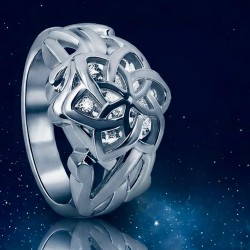
Nenya — the Ring of Water, the Ring of Adamant, the White Ring — was made of mithril set with a white stone of great brilliance, described as adamant (diamond). Its element was water, and its purpose was preservation and protection — but also, in Galadriel's hands, something more: the sustaining of a vision of what Middle-earth could be, against the encroachment of everything it was becoming.
Nenya was given directly by Celebrimbor to Galadriel, who sent it secretly to Gil-galad at the time the Seven and Nine were captured. Later she reclaimed it. She bore it in Lothlórien throughout the Third Age — and Lothlórien was its most visible and extraordinary creation. The golden Mallorn trees that grew there, the timeless quality of the light, the sense that time moved differently within the wood — all of this was Nenya's work. Frodo could see it on Galadriel's finger when she revealed it to him: "On her finger was Nenya, the ring wrought of mithril, with a single white stone flickering like a frosty star."
Nenya was "invisible to all but the bearers and those who might be granted sight by the bearers" — meaning Tolkien does not tell us that everyone who entered Lothlórien could see it. Only those with the specific sensitivity could perceive it. Sam, characteristically, saw only a "star shining through her hand" when Galadriel held it up. He was seeing something true without knowing what it was.
Galadriel refused the One Ring when Frodo offered it to her — the most explicit and direct refusal in the story. She said: "I pass the test. I will diminish, and go into the West, and remain Galadriel." She understood that if she took the Ring and used Nenya in conjunction with it, she would become a second Dark Lord — "beautiful and terrible as the Morning and the Night." She chose to let Nenya fail rather than corrupt herself by using the One Ring's power to save it.
When the One Ring was destroyed, Nenya lost its power. Galadriel sailed West, and Lothlórien, without the Ring's preservation, began to fade.
The Vulnerability — Why the Three Were Bound to the One
This is the most important thing about the Three, and the thing most easily missed: they were made without Sauron's direct hand, but they were made using the techniques he had taught the Elves. That knowledge was corrupted knowledge — it worked, but it worked through a mechanism Sauron had designed. And the One Ring, which he had forged specifically to govern all other Rings, could reach through that mechanism and affect the Three even though it had never touched them.
As long as Sauron held the One Ring, the Three's bearers were in danger of having their minds read through the connection. This is why the Elves removed them the moment he put it on in the Second Age. This is why they were kept secret throughout the Third Age — because if Sauron had located the Three and their bearers while he still held the One Ring, he could have used them to find and control Galadriel, Elrond, and Gandalf simultaneously, destroying the last great sources of wisdom and resistance in Middle-earth.
And this is why the destruction of the One Ring was both victory and loss. The One Ring's destruction broke Sauron permanently — but it also broke the Three. Their power faded. What they had preserved, preserved no longer. The beauty of Rivendell, the light of Lothlórien, the courage of ordinary people stirred by Narya's warmth — these were the casualties of the war's winning. Tolkien intended this: the end of the Third Age was the end of the Elder Days, the end of magic itself, the beginning of the age of Men without Elvish grace to sustain it.
The Official Nenya Ring — Made in New Zealand
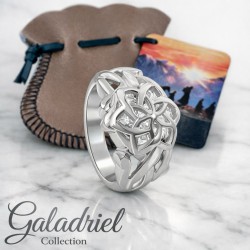
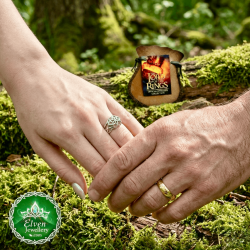
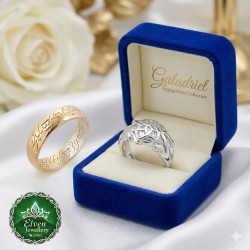
The official Nenya — Galadriel's Ring of Water — is the only officially licensed Elven Ring of Power in the entire Lord of the Rings jewellery collection. It is the ring that sustained Lothlórien, that Galadriel refused to corrupt by combining its power with the One Ring, that she bore for thousands of years and carried over the Sea when Middle-earth's time of grace was done. Made in New Zealand by the New Line Productions licence holders, in solid 925 sterling silver with white gold finish.
Nenya — The Ring of Water, Ring of Adamant
The official Galadriel's Nenya in solid 925 sterling silver with white gold finish. The only officially licensed Elven Ring of Power in the collection. One of the Three Rings that sustained the beauty of the Elder Days until the War of the Ring was won and their time was done. Made in New Zealand by the New Line Productions licence holders. Supplied with Licence of Authenticity.
Shop Nenya — Ring of Water →Frequently Asked Questions About the Three Elven Rings
What were the Three Elven Rings?
The Three were Narya (Ring of Fire, red ruby, borne by Gandalf), Vilya (Ring of Air, blue sapphire, borne by Elrond), and Nenya (Ring of Water, adamant/diamond, borne by Galadriel). They were made by Celebrimbor in Eregion at the end of the Second Age without Sauron's direct involvement — unlike the Seven and the Nine — and their purpose was preservation and healing rather than domination. They sustained Rivendell, Lothlórien, and the courage of peoples across Middle-earth throughout the Third Age, and lost their power when the One Ring was destroyed.
Who were the bearers of the Three Rings?
Narya the Ring of Fire was given by Círdan the Shipwright to Gandalf when the wizards arrived in Middle-earth. Vilya the Ring of Air was given by Gil-galad to Elrond after the founding of Rivendell. Nenya the Ring of Water was given by Celebrimbor directly to Galadriel. All three were kept secret throughout the Third Age — their bearers never publicly identified, their locations never confirmed. The bearers' identities were only revealed after the One Ring was destroyed, at which point secrecy was no longer necessary.
Why did the Three lose their power when the One Ring was destroyed?
Because the Three, though not made by Sauron, were made using techniques he had taught Celebrimbor. The One Ring was forged specifically to govern all other Rings of Power through that shared mechanism. When the One Ring was destroyed, it took with it the foundational power that connected all the Rings — including the Three. Their preservation stopped working. Rivendell began to lose the timeless quality Vilya had given it. Lothlórien's golden light faded. The warmth Narya had kindled in hearts grew ordinary. This was the cost Tolkien built into the story: the war could not be won without losing what the Three had preserved.
Why didn't the Elves use the Three Rings against Sauron?
The Three were not weapons — they were instruments of preservation and healing. Elrond said explicitly at the Council: the Three were made for "understanding, making, and healing, not for strength or domination." Using them as weapons of war would have been contrary to their purpose and probably beyond their capability. More importantly, using them while Sauron held the One Ring would have allowed him to perceive their bearers through the Ring's connection — exposing Gandalf, Elrond, and Galadriel simultaneously to his influence. The Three were kept secret precisely because their bearers could not use them openly while the One Ring existed.
What did the Three Rings actually do?
Their primary function was the preservation of beauty and the resistance to the decay of time. In Rivendell, Vilya slowed time's passage, maintained the valley's beauty, and strengthened Elrond's extraordinary healing powers — including the ability to cure Frodo's Morgul-blade wound and to call the flood at the Ford of Bruinen. In Lothlórien, Nenya sustained the golden Mallorn trees, the timeless quality of the forest, and Galadriel's Mirror. Narya, carried by Gandalf, sustained his ability to rekindle courage and hope in people who had given them up — a subtler effect but arguably the most important one in the story.
Why is Nenya the only Ring in the official jewellery collection?
Nenya was made into an official licensed piece because of its direct association with Galadriel — one of the most beloved characters in the films and the most visually distinctive of the Three Ring bearers. The ring's design — mithril with a brilliant white stone — translates beautifully into jewellery form. Vilya and Narya, while equally significant lore-wise, have not yet been made as official licensed pieces. Nenya remains the only official Elven Ring of Power in the collection, making it both commercially distinctive and lore-appropriate: it is, after all, the Ring whose element is water, whose bearer refused to corrupt herself, and whose light Frodo saw flickering like a frosty star on Galadriel's finger.
Sources & Further Reading
- Tolkien, J.R.R. — The Lord of the Rings, The Fellowship of the Ring: "The Council of Elrond" — primary source for Elrond's account of the Rings' purpose and the Three's secrecy
- Tolkien, J.R.R. — The Silmarillion: "Of the Rings of Power and the Third Age" — primary account of the forging of all Rings of Power, Celebrimbor's role, and the fates of the Three
- Tolkien, J.R.R. — The Lord of the Rings, Appendix B: "The Tale of Years" — timeline of the Second and Third Ages, including Sauron's deception of the Elven-smiths
- Tolkien, J.R.R. — Unfinished Tales of Númenor and Middle-earth, ed. Christopher Tolkien: "The History of Galadriel and Celeborn" — most detailed account of the forging of the Three and the distribution of Narya, Vilya and Nenya
- Tolkien, J.R.R. — The Letters of J.R.R. Tolkien, ed. Humphrey Carpenter: Letter 131 — Tolkien's own explanation of the Rings' symbolism, the nature of Sauron, and why the Three were bound to the One
- Tolkien Gateway — tolkiengateway.net — peer-maintained Tolkien encyclopaedia drawing on the full published canon
Related Products