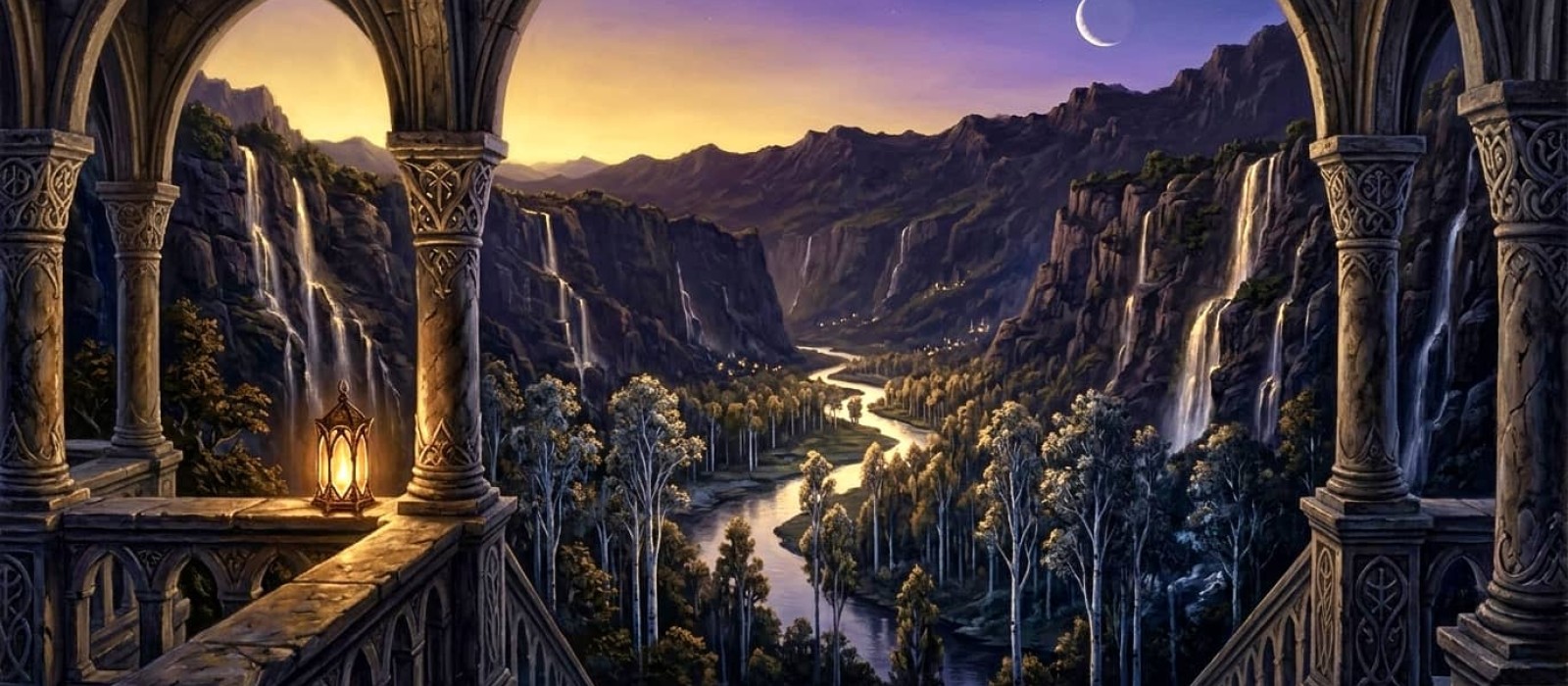
Elrond Half-elven — Master of Rivendell, bearer of Vilya, herald of Gil-galad — was born in the First Age and dwelt in Middle-earth for over six thousand years. Son of Eärendil the Mariner and Elwing, great-great-grandson of Beren and Lúthien, twin brother of Elros who became the first King of Númenor: his bloodline was the most extraordinary convergence of Elvish and mortal heritage in the history of Middle-earth. He founded Rivendell in the Second Age and kept it as a sanctuary of wisdom and healing for three thousand years, until the destruction of the One Ring made his departure to the West both possible and necessary.
Tolkien described Elrond as "the thread that ties together all three of the great tales of the legendarium" — Beren and Lúthien, the Fall of Gondolin, and the events of The Lord of the Rings itself. He is not a peripheral figure who appears in Rivendell to offer advice and read maps. He is the living repository of the entire Elder Days — a being whose family history encompasses the greatest stories in Middle-earth, who watched the Last Alliance and stood at the Crack of Doom when Isildur refused to destroy the Ring, who held the most powerful of the Three Elven Rings for three thousand years, and who finally, when it was over, sailed West to be reunited with the wife he had not seen for five centuries.
This is his complete story.
Origins — Born at the End of the First Age
Elrond was born in the Havens of Sirion in Beleriand, late in the First Age — around FA 532 — the son of Eärendil the Mariner and Elwing his wife. Both his parents were themselves Half-elven: Eärendil the son of Tuor (a Man of the Edain) and Idril Celebrindal of Gondolin; Elwing the daughter of Dior, son of Beren and Lúthien. Through Lúthien, Elrond carried in his blood the heritage of Melian the Maia — one of the divine spirits who had shaped Beleriand itself.
Not long after his birth, the Havens of Sirion were destroyed by the sons of Fëanor pursuing the Silmaril that Elwing carried. Elrond and his twin brother Elros were captured. Their parents escaped — Eärendil sailing the seas, Elwing transforming into a bird and flying out over the water. The twins were raised, unexpectedly, by Maedhros and Maglor — the two remaining sons of Fëanor — who had compassion on them and did not harm them. Elrond grew up in the company of his people's enemies, fatherless and motherless, in a world that was ending around him.
At the end of the First Age, when the Valar intervened in the War of Wrath and Morgoth was defeated, the half-elven were given a choice of kindred. Elros chose to be counted among Men — and lived a mortal life of five hundred years as the first King of Númenor, the great island continent given to the Dúnedain. Elrond chose to be Elven — and was therefore immortal. The brothers never met again. Their lines diverged across thousands of years: Elrond's into the Elvish world of Rivendell, Elros's into the mortal line of kings that led eventually to Aragorn.
Founding Rivendell — The Refuge That Held
In the Second Age, when Sauron — as Annatar, the Lord of Gifts — deceived the Elves of Eregion and the War of the Elves and Sauron began, Elrond led a force east to help defend Eregion. He arrived too late. Sauron had already destroyed the city and killed Celebrimbor. Elrond retreated north with survivors from Eregion, and in a hidden valley at the foot of the Misty Mountains he founded a refuge: Imladris, which Men called Rivendell.
The valley was besieged by Sauron's forces for years. It held. When Númenórean ships arrived to relieve the siege, Sauron was caught between two armies and driven back. A council decided that Rivendell should be maintained as an Elvish stronghold in the east — and Gil-galad, the High King of the Noldor, appointed Elrond his vice-regent in Eriador and gave him Vilya, the greatest of the Three Elven Rings.
Rivendell became, under Elrond's stewardship and Vilya's power, the most important sanctuary in Middle-earth west of the Misty Mountains. The Ring preserved it against decay, slowed the passage of time within its borders, and filled it with a quality of peace that visitors felt immediately. Bilbo Baggins, arriving after his adventure with Thorin's company, found he could not keep track of days there. The Fellowship of the Ring rested there for two months before setting out, and left stronger for it. Rivendell was not merely a house. It was, as Tolkien called it, "the Last Homely House East of the Sea" — the last place of safety before the wild.
Vilya — The Mightiest of the Three
Vilya was made of gold with a great blue sapphire — it was called the Ring of Air, the Ring of Sapphire, and the Blue Ring. Tolkien describes it as the mightiest of the Three Elven Rings. It had been made by Celebrimbor without Sauron's direct influence, and its purpose — like Nenya and Narya — was preservation and healing rather than domination.
Elrond bore it in secret throughout the Third Age. Even at the Council of Elrond, when the history of the Rings of Power was laid out for the assembled representatives of the free peoples, the bearers of the Three were not named publicly — their secrecy was their protection. Only after the One Ring was destroyed, when all the Three lost their power simultaneously, was it revealed that Elrond had carried Vilya all along.
What Vilya did for Rivendell was subtle but total. It kept the valley whole when everything around it was subject to decay and shadow. It helped make Elrond's healing powers extraordinary — he could cure wounds that no other being in Middle-earth could treat, including Frodo's Morgul-blade wound, which would have killed any lesser healer. When the Nazgûl pursued Frodo to the Ford of Bruinen, it was Elrond who summoned the flood from the river — calling the waters with the power of Vilya — that swept the Ringwraiths away. The Ring allowed him to protect and preserve in ways that had nothing to do with force or battle.
The Last Alliance — Standing at the Crack of Doom
Near the end of the Second Age, Sauron — having destroyed Númenor through his manipulation of Ar-Pharazôn — returned to Mordor and began rebuilding his power. The Last Alliance of Elves and Men was formed: Elendil of Gondor and Gil-galad of the Noldor leading their combined armies from Rivendell to Mordor in SA 3431. Elrond served as Gil-galad's herald — his second in command, the man who carried his orders and stood at his side.
The siege of Barad-dûr lasted seven years. At the end of it, Sauron came out to fight personally. Both Gil-galad and Elendil were killed. Sauron's physical form was destroyed by Elendil's son Isildur, who used the broken hilt of Narsil to cut the One Ring from Sauron's hand.
Elrond and Círdan the Shipwright were both present when Isildur stood at the edge of the Cracks of Doom with the Ring. Both urged him to destroy it. Tolkien says they pleaded with him. Isildur refused. He called it his weregild — his compensation for the deaths of his father and brother. He kept it. Elrond watched him walk away with the most dangerous object in Middle-earth still on his finger, and understood that the war was not truly over.
He lived with that knowledge for three thousand years.
The Third Age — Keeper of Memory and Hope
After the Last Alliance, Elrond returned to Rivendell and spent the Third Age as its keeper — a role that was simultaneously archival, diplomatic, strategic, and deeply personal. He joined the White Council, the gathering of the wise that included Gandalf, Saruman, and Galadriel, established to counter the growing threat of Sauron's return. He kept the heirlooms of the fallen North Kingdom of Arnor: the Shards of Narsil, the Ring of Barahir, the Sceptre of Annúminas.
In TA 2933, a two-year-old boy was brought to Rivendell by his mother — the son of Arathorn II, who had just been killed by Orcs. Elrond accepted him. He named him Estel — Hope — and raised him as his own son alongside his own twins Elladan and Elrohir, concealing the boy's true identity for his protection. When the boy was twenty years old, Elrond told him who he was: Aragorn II, son of Arathorn, heir of Isildur, the man with the strongest claim to the throne of Gondor. He gave him the Ring of Barahir and the Shards of Narsil. And when the young Aragorn met Arwen in the birch woods of Rivendell that same day — his daughter, who had returned from Lothlórien — Elrond began to dread what he already understood was coming.
Arwen — The Bittersweet Love
Elrond's relationship with the question of Aragorn and Arwen is the most emotionally complex thing about him. He loved his daughter. He also understood that if Aragorn succeeded — if Sauron fell and the King returned — Arwen would choose mortality and he would lose her to death. His condition — that Arwen could not marry Aragorn until he was King of both Gondor and Arnor — was not merely a father's obstruction. It was the only honest position available to him: if she was going to sacrifice immortality, it should at least be for the full realisation of what Aragorn could become, not for a half-claim.
When the moment finally came — when the War of the Ring was won and Aragorn was crowned King Elessar — Elrond brought Arwen to Minas Tirith for the wedding himself. He gave her away. He had helped, in every possible way, to make happen the thing that was going to take his daughter from him forever. He said to Aragorn: "I give to you now the flower of the House of Elrond, and the heir of Isildur. Not till now have I understood the tale of your life."
Three years later, he sailed West. He would be reunited with Celebrían — his wife, who had been so badly injured by Orcs in TA 2509 that she had sailed to Valinor to heal, and whom he had not seen for five centuries. He would lose Arwen to mortality and never see her again. Both things were true at once.
The Official Nenya Ring — Galadriel's Ring, Elrond's Collection
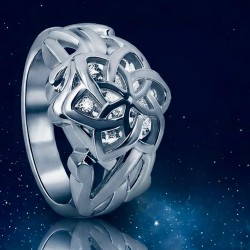
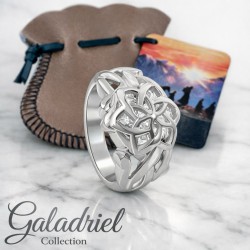
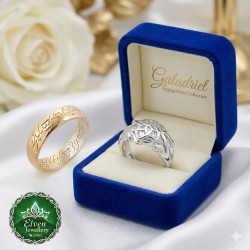
Elrond bore Vilya — the Ring of Air, the mightiest of the Three. Galadriel bore Nenya — the Ring of Water. Together they were two of the three Elven Rings that sustained the last great Elvish sanctuaries of Middle-earth through the Third Age. The official Nenya ring is the only officially licensed Elven Ring of Power in the entire collection — made in New Zealand by the New Line Productions licence holders, in solid 925 sterling silver and white gold.
Nenya — The Ring of Water, Ring of Adamant
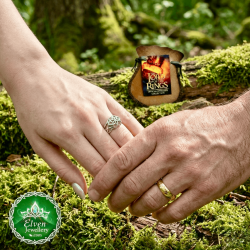
The official Galadriel's Ring of Power — Nenya the Ring of Water — in solid 925 sterling silver with white gold finish. The only officially licensed Elven Ring in the collection. One of the Three Rings that sustained Rivendell, Lothlórien, and the last sanctuaries of the Elder Days. Made in New Zealand by the New Line Productions licence holders.
Shop Nenya — Ring of Water →Frequently Asked Questions About Elrond
Who is Elrond in Lord of the Rings?
Elrond Half-elven is the Lord of Rivendell — the Elvish sanctuary in the Misty Mountains that serves as the Fellowship's launching point and one of the last refuges of Elvish wisdom in the Third Age. Born in the First Age as the son of Eärendil the Mariner and Elwing, he is over six thousand years old during the events of The Lord of the Rings. He is the bearer of Vilya — the greatest of the Three Elven Rings — the father of Arwen, and the foster-father of Aragorn. He is played by Hugo Weaving in Peter Jackson's films and by Robert Aramayo in Amazon's The Rings of Power.
What is Elrond's ring — Vilya?
Vilya — the Ring of Air, also called the Blue Ring or the Ring of Sapphire — was made of gold with a great blue sapphire. It was the mightiest of the Three Elven Rings, made by Celebrimbor in Eregion without Sauron's direct influence. It was originally given to Gil-galad and passed to Elrond after the Second Age. Elrond bore it in secret throughout the Third Age, using its power to preserve Rivendell, heal the wounded, and protect the valley from Sauron's influence. It lost its power when the One Ring was destroyed and went over the Sea with Elrond.
Why did Elrond not destroy the One Ring when he had the chance?
Elrond was present at the Cracks of Doom when Isildur chose not to destroy the Ring, and he urged Isildur to cast it in — but he could not compel him. The Ring was in Isildur's possession. Tolkien's world does not allow for simply taking something from its bearer by force in that context — especially not at the end of a long war with both armies present. Elrond pleaded and Isildur refused. It is one of the great what-ifs of the legendarium: had Isildur listened to Elrond and Círdan at that moment, the War of the Ring three thousand years later would never have been necessary.
Is Elrond related to Aragorn?
Yes, distantly. Elrond's twin brother Elros chose to be counted among Men and became the first King of Númenor — the great island kingdom from which the Dúnedain were descended. Aragorn, as the heir of Isildur and descendant of Elros's line, is therefore a very distant relative of Elrond — the two Half-elven lines reunited in the Fourth Age when Aragorn married Arwen. This is part of what makes Aragorn's marriage to Arwen so structurally significant: it closed a divergence that had opened at the end of the First Age, when the twin brothers chose different fates.
What happened to Elrond after the War of the Ring?
After the destruction of the One Ring and the wedding of Aragorn and Arwen — which Elrond attended in Minas Tirith — he returned to Rivendell. Three years later, in TA 3021, he departed from the Grey Havens on the last ship to the Undying Lands, accompanied by Gandalf, Galadriel, Frodo, and Bilbo. He was reunited in Valinor with Celebrían, his wife, who had sailed West five centuries earlier after being injured by Orcs. He never saw his daughter Arwen again. She had made her choice and accepted mortality — dying in Lothlórien in FA 121, the year after Aragorn's death.
Who were Elrond's children?
Elrond and Celebrían had three children: twin sons Elladan and Elrohir, born in TA 130, and their daughter Arwen Undómiel, born in TA 241. Elladan and Elrohir were deeply affected by their mother's capture and torture by Orcs in TA 2509 — they spent much of the rest of the Third Age riding out to hunt Orcs alongside the Rangers of the North, never quite forgiving the Orcs of the Misty Mountains. Their own choice of kindred — Elf or Man — was left open by Tolkien: they were bound to make their choice only after Elrond departed Middle-earth, and what they chose is not recorded.
Sources & Further Reading
- The Silmarillion — 'Of the Voyage of Eärendil' (Elrond's birth) and 'Of the Rings of Power and the Third Age' (founding of Rivendell, the Last Alliance)
- The Lord of the Rings — The Fellowship of the Ring — 'Many Meetings' and 'The Council of Elrond'; Appendix A: 'The Tale of Aragorn and Arwen'
- Unfinished Tales, ed. Christopher Tolkien — 'The History of Galadriel and Celeborn' — most detailed account of Vilya's distribution
- Tolkien Gateway — tolkiengateway.net
Related Products