
Galadriel — Nerwen, Artanis, Alatáriel, the Lady of the Golden Wood — is the oldest of the named figures still walking in Middle-earth during the events of The Lord of the Rings. She was born before the First Age, in Valinor, in the full light of the Two Trees of the Valar. She is the last surviving child of Finarfin, granddaughter of Finwë, High King of the Noldor. She has been in Middle-earth since the First Age — over seven thousand years by the time Frodo sees her in Lothlórien — and the Galadriel of The Fellowship of the Ring is not a softened version of a warrior. She is a being whose understanding has been forged across millennia of loss, choice, and the deepest kind of patience.
Tolkien's Galadriel is one of the most carefully developed characters in his entire legendarium — and also one of the most revised. He returned to her history repeatedly over decades, expanding it, adjusting it, correcting what earlier versions had left incomplete. The result is a portrait of extraordinary depth: a woman of immense personal power who came to Middle-earth in an act of near-rebellion, who made choices in the First Age that she spent the rest of her existence working to transcend, and who finally proved herself — not in battle, but in refusal — when Frodo offered her the One Ring in her garden and she let it go.
This is the story of that journey: from the Undying Lands to the war-ravaged fields of Beleriand, through the great politics of the Second Age, through three thousand years of the Third Age as the quiet guardian of Lothlórien, to the moment of her test and the sailing West that followed it.
The First Age — Why Galadriel Left Valinor
Galadriel was born in Aman — the Undying Lands, the home of the Valar and the Elves who had made the great journey West. She was the daughter of Finarfin and Eärwen, granddaughter of Finwë on one side and Olwë of the Teleri on the other. In Valinor she was already notable: tall, with hair of silver and gold that she inherited from both her grandfathers' lineages, a mind of extraordinary clarity and power, and a spirit that was — even in the peace of Aman — drawn toward the possibility of governance and independence.
Tolkien writes that she was the only woman among the leaders of the great revolt of the Noldor — the terrible exodus from Valinor led by Fëanor following the theft of the Silmarils by Morgoth. Her reasons were not Fëanor's. She did not follow his oath or his feud. She was drawn by her own desire to see Middle-earth, to have a realm of her own, to use the gifts she had been given in a wider stage than Valinor could provide. In the Elvish worldview of Tolkien's published Silmarillion, this was understood as a form of pride — and the Noldor's exodus ended in the Kinslaying at Alqualondë, where Fëanor's people killed the Teleri for their ships, and the entire enterprise was cursed by the Valar. Galadriel did not participate in the Kinslaying. But she was part of the migration that produced it, and she bore that shadow.
She spent the First Age in Beleriand — the great coastal landmass of north-western Middle-earth that was destroyed in the War of Wrath at the end of the Age. She fought in those wars. She knew Melian, the Maia who was Queen of Doriath, and learned ring-lore and arts of the mind from her that she would later use in Lothlórien. When the War of Wrath ended and the Valar offered the surviving Noldor the right of return to Valinor, Galadriel refused. Her reasons are not fully explained in the published texts, but Tolkien implies both that she was not yet ready to face the Valar's judgment and that she had not yet accomplished what she had come to Middle-earth to do.
The Second Age — The Ring-maker's Patron and Nenya
In the Second Age, Galadriel and her husband Celeborn settled in various parts of Middle-earth, eventually establishing themselves in Lothlórien — the forest realm in the angle between the rivers Anduin and Celebrant in the central lands of Middle-earth. Tolkien's accounts of exactly when and how they came to Lothlórien vary between different versions of the history, but by the time the Rings of Power were made in Eregion, Galadriel was a major figure in the politics of Elvish Middle-earth.
She distrusted Annatar — the fair being who came to Eregion offering instruction in ring-craft — from the moment he arrived, and refused to receive him. This was not prescience exactly, but the deep perception that her years and her training with Melian had given her: Annatar felt wrong. Gil-galad agreed. But Celebrimbor and the Elven-smiths of Eregion welcomed him, and the Rings of Power were made. When Annatar's deception was revealed — when Sauron put on the One Ring and the Elves felt his will through their rings — Galadriel received Nenya, one of the Three Elven Rings made by Celebrimbor in secret, without Sauron's hand. She bore it for three thousand years, using its power to sustain Lothlórien against the shadow spreading from Dol Guldur.
The Second Age ended with the Last Alliance — the seven-year siege of Barad-dûr by the combined armies of Elves and Men, the deaths of Gil-galad and Elendil, the cutting of the One Ring from Sauron's hand by Isildur, and Isildur's refusal to destroy it. Galadriel was not personally on the battlefield at the Siege of Barad-dûr in the way that Gil-galad and Elrond were, but the outcome of the Last Alliance shaped everything that followed: the Ring was not destroyed, Sauron's power was broken but not ended, and the Third Age began with the seeds of its own conclusion already planted.
The Third Age — Guardian of Lothlórien
Galadriel spent the Third Age doing what Nenya allowed her to do: preserving. She maintained Lothlórien as a sanctuary — a place where the beauty of the Elder Days survived intact against the encroachment of darkness, where time moved differently, where the Golden Mallorn trees did not fade. She was a member of the White Council, the gathering of the wise that included Gandalf, Saruman, and Elrond, established to counter Sauron's return. Tolkien's texts imply that she preferred Gandalf to Saruman as the Council's head, but that Saruman's greater apparent prestige and skill at rhetoric won the position.
The Galadriel Tolkien shows us in The Fellowship of the Ring is a woman of immense stillness. She speaks in a voice that is simultaneously gentle and inexorable. She tests the Fellowship members individually in their minds — showing each of them a vision of what the Ring could offer them, and watching each response. She offers comfort and counsel without sentimentality. Her gifts are practical. Her words are precise. She does not waste anything.
This stillness is not passivity. It is the quality of a person who has learned, across seven thousand years and enormous personal cost, that the most powerful thing she can do is often to do nothing — to preserve, to watch, to wait for the right moment. The First Age warrior who marched from Valinor with ambitions for a realm of her own has become someone who understands that the desire for dominion — even well-intentioned dominion — is the mechanism by which evil perpetuates itself.
The Test — The Ring in the Garden
Everything in Galadriel's seven-thousand-year journey comes to its point in her garden at Caras Galadhon, when Frodo offers her the One Ring beside the Mirror.
She had wanted it. She was honest about this. For many long years she had imagined what she might do if the One Ring came to her hand. She had the power. She had Nenya. She had wisdom accumulated across the entirety of Middle-earth's history as she had lived it. With the One Ring, she could have preserved everything Nenya had been straining to sustain — not just Lothlórien but all of it, the whole of what remained of beauty and grace in the world — and driven back the shadow permanently.
And she would have become a Dark Lord. She said this herself: "In place of a Dark Lord you would have a Queen — not dark but beautiful and terrible as the Morning and the Night! Treacherous as the Sea! Stronger than the foundations of the Earth! All shall love me and despair!"
Then: "I pass the test. I will diminish, and go into the West, and remain Galadriel."
The word "diminish" is the key. She was not choosing powerlessness. She was choosing to let the things Nenya had preserved fade — to let Lothlórien lose its timeless quality, to let the golden light dim, to let the Elder Days finally end — rather than sustain them through a domination that would have been structurally identical to Sauron's, whatever its intentions. She had come a very long way from the young woman who left Valinor wanting a realm of her own. This was its completion.
Galadriel in The Rings of Power — The Second Age Version
Amazon Prime Video's The Lord of the Rings: The Rings of Power series depicts Galadriel in the Second Age — hundreds of years before the events of The Fellowship of the Ring — and portrays her as significantly more combative, driven, and impatient than Tolkien's Third Age Galadriel. Morfydd Clark's performance shows a being consumed by grief for her brother Finrod and by the conviction that Sauron has survived and is rebuilding, at a time when most of her peers have decided the threat is over.
The Tolkien canon supports the broad outline of this characterisation — Galadriel was indeed a warrior and a leader of her people, and she did come to Middle-earth in the First Age and remain through the Second Age out of a complex mixture of ambition and duty. The specific storylines of the series, however, involve significant invention: her role as commander of northern armies, her relationship with the human character Halbrand, and various details of the plot are not drawn from Tolkien's texts and represent the showrunners' own additions to the framework they were licensed to use.
What is lore-accurate is the essential tension the series dramatises: a young Galadriel who has not yet learned the restraint and patience that define the Third Age version. The arc from passionate, impatient warrior to the still and luminous guardian of Lothlórien is genuine — Tolkien implies it across multiple texts, even if he never dramatised it directly. The series is filling in a gap that Tolkien left, with greater and lesser degrees of faithfulness depending on which scene you are watching.
The Sailing West — The End of the Third Age
When the One Ring was destroyed in TA 3019, Nenya lost its power and Lothlórien began to fade. Galadriel had known this would come. She had accepted it when she refused the One Ring. In TA 3021, she sailed from the Grey Havens on the last ship to the Undying Lands — accompanied by Gandalf, Frodo, Bilbo, and Elrond.
After more than seven thousand years, she was going home. The Valar had long since lifted the ban on the return of those Noldor who had not participated in the Kinslaying. Galadriel's own penance — whatever form it had taken — had been completed. She had proven herself not in the way she had originally imagined, not through the governance of a great realm sustained by the power of a magical ring, but through the harder thing: through refusal, through diminishment accepted willingly, through the understanding that letting go was the greater power.
Middle-earth was left to Men. The age of Elves was over. The golden light of Lothlórien faded. What remained was a forest, and a memory, and the long slow work of a new age beginning.
The Official Nenya — Galadriel's Ring of Water
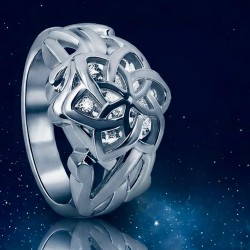
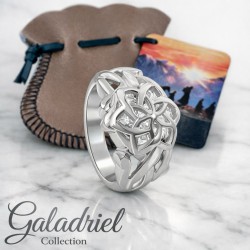
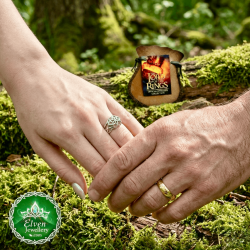
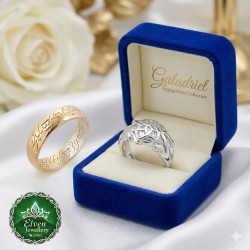
Nenya — the Ring of Water that Galadriel bore for three thousand years and sacrificed when she refused the One Ring — is the only officially licensed Elven Ring of Power in the jewellery collection. Made in New Zealand by the New Line Productions licence holders, in solid 925 sterling silver with white gold finish. The ring that sustained Lothlórien, made in the country where Lothlórien was filmed.
Nenya — Sterling Silver
The official Galadriel's Nenya in solid 925 sterling silver with white gold finish. The Ring of Water, the Ring of Adamant. Made in New Zealand by the New Line Productions licence holders. Supplied with official Licence of Authenticity.
Shop Nenya Sterling Silver →Arwen Evenstar — Classic CZ
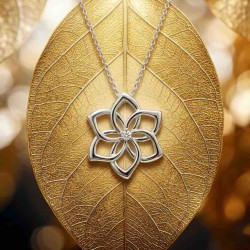
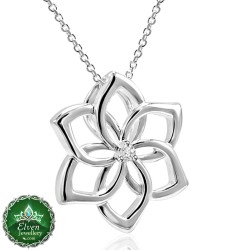
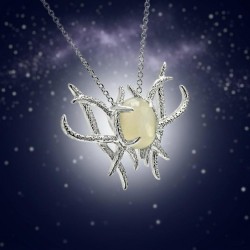
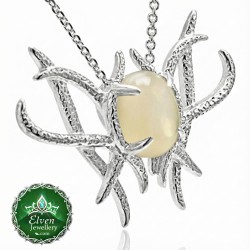
The official Evenstar pendant — the most gifted piece of LOTR jewellery in the world. Full-size, solid 925 sterling silver, claw-set CZ stone, 45cm chain. Arwen and Galadriel together define the feminine strength of Tolkien's legendarium. Made in New Zealand.
Shop Evenstar →Frequently Asked Questions About Galadriel
How old is Galadriel in The Lord of the Rings?
Galadriel was born in Valinor before the First Age began — in the Years of the Trees, before the Sun and Moon were made. By the time of The Lord of the Rings (TA 3018–3019), she is over seven thousand years old by Sun-years, making her the oldest of the named characters still present in Middle-earth. Only Círdan the Shipwright, who greeted the Elves at the first great journey to Valinor in the First Age, is described as definitely older. She is one of perhaps a handful of beings in Middle-earth with direct memory of Valinor in the Years of the Trees.
Why did Galadriel come to Middle-earth?
Galadriel came to Middle-earth as part of the Noldor's great migration from Valinor at the beginning of the First Age — the exodus led by Fëanor following Morgoth's theft of the Silmarils. Her reasons were her own: she was drawn by the desire to see and govern lands of her own, to use her extraordinary gifts on a wider stage than Valinor provided. She did not follow Fëanor's oath or share his specific grievance. When the migration was cursed by the Valar after the Kinslaying at Alqualondë — in which Galadriel did not participate — she was nonetheless bound by the general ban on return that was placed on the Noldor.
What is the difference between the Galadriel of The Rings of Power and the books?
Tolkien's Galadriel in The Lord of the Rings is thousands of years older than the Second Age character depicted in The Rings of Power, and has accumulated a stillness and restraint through those centuries that the younger version does not yet possess. The broad arc — from passionate, ambitious Elvish warrior to wise, restrained guardian — is genuinely present in Tolkien's lore. However, many specific plot elements of the Amazon series, including Galadriel's role as a military commander, her relationship with Halbrand, and various storyline details, are inventions of the showrunners rather than material drawn from Tolkien's texts.
Why did Galadriel refuse the One Ring?
Galadriel understood that using the One Ring would turn her into a new Dark Lord — not because her intentions were bad, but because the Ring was a fragment of Sauron's will designed to dominate, and any being who wielded it would find that purpose gradually overriding their own. A Middle-earth preserved by Galadriel using the One Ring would have been a Middle-earth under benevolent domination — better than Sauron's, perhaps, but no less a suppression of free will. She chose to "diminish and go into the West" — to let Lothlórien fade and sail home — rather than become that. It was the culmination of the entire arc of her existence in Middle-earth.
What is Galadriel's Mirror?
Galadriel's Mirror is a stone basin in her garden at Caras Galadhon, filled with water drawn from a stream, in which she can show visitors images of the past, the present, and possible futures. It is not a simple prophetic device — Galadriel herself warns that the Mirror shows "many things, and not all have yet come to pass. Some never come to be, unless those that behold the visions turn aside from their path to prevent them." Sam sees the Shire in danger. Frodo sees Galadriel's hand with Nenya on it. The Mirror shows true things, not comfortable things. Its power is generally understood to be connected to Nenya, whose element is water.
What happened to Galadriel after the War of the Ring?
After the destruction of the One Ring and the end of the War of the Ring, Galadriel remained briefly in Middle-earth — long enough to participate in the victory celebrations at Minas Tirith, to witness the wedding of Aragorn and Arwen, and to see the beginning of the Fourth Age. In TA 3021 she sailed from the Grey Havens on the last ship to the Undying Lands, accompanied by Gandalf, Frodo, Bilbo, and Elrond. She was the last of the great Elven rulers of Middle-earth to depart, and her sailing marked the final end of the Elder Days.
Sources & Further Reading
- The Lord of the Rings — The Fellowship of the Ring: 'The Mirror of Galadriel' and 'Farewell to Lórien' — Galadriel's test, her refusal of the One Ring, and her gifts to the Fellowship
- The Silmarillion: 'Of the Flight of the Noldor' and 'Of the Rings of Power and the Third Age' — Galadriel's origins, her reasons for leaving Valinor, and her role in the Second Age
- Unfinished Tales of Númenor and Middle-earth, ed. Christopher Tolkien: 'The History of Galadriel and Celeborn' — the most detailed account of Galadriel's history through the Second and Third Ages, including her receipt of Nenya
- The Letters of J.R.R. Tolkien, ed. Humphrey Carpenter: Letters 320 and 348 — Tolkien's later thoughts on Galadriel's character, her time in Valinor, and her relationship to the Noldor's exile
- Tolkien Gateway — tolkiengateway.net
Related Products