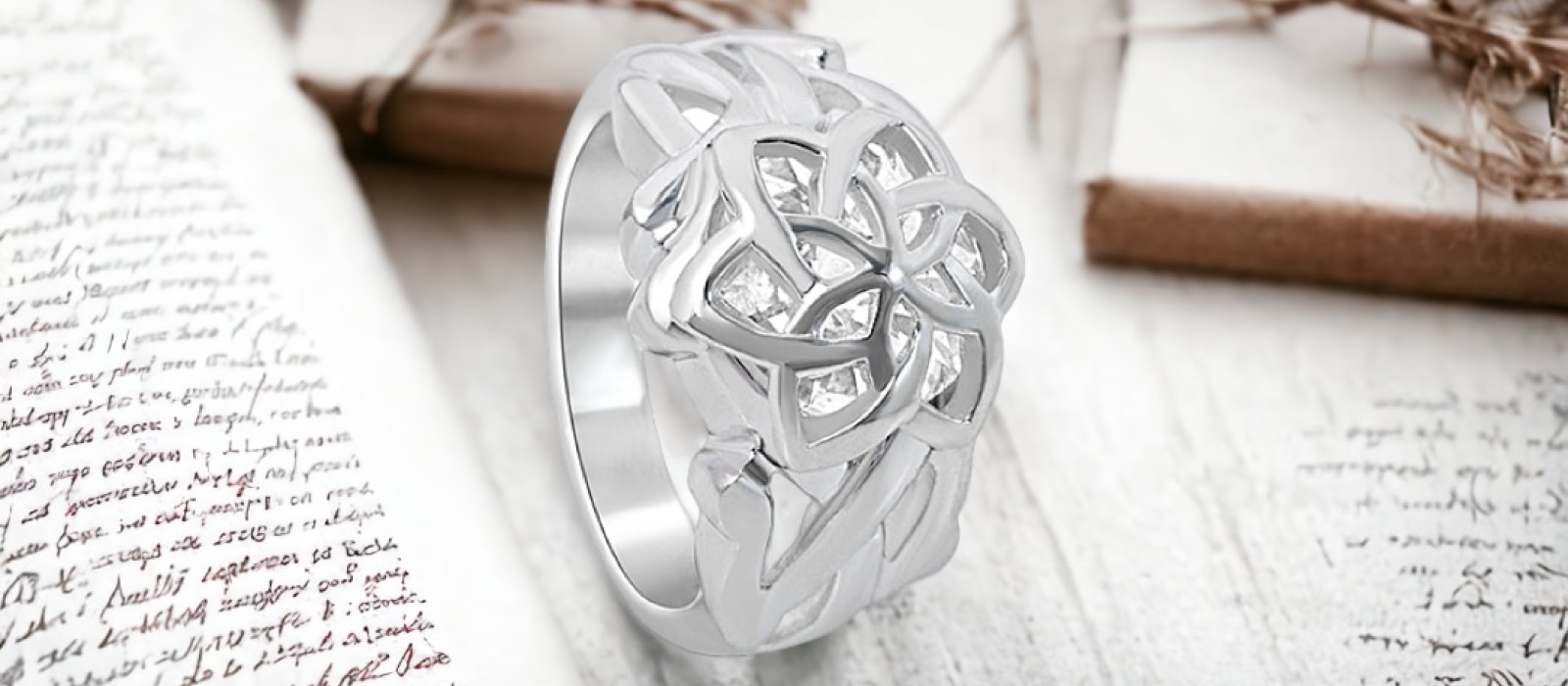
Nenya — the Ring of Water, the Ring of Adamant, the White Ring — was one of the Three Elven Rings made by Celebrimbor in Eregion without Sauron's direct influence, and the one entrusted to Galadriel, Lady of Lothlórien. Made of mithril set with a stone of adamant, it was the instrument through which Galadriel sustained the beauty of Lothlórien across three thousand years of the Third Age — holding time at bay, preserving the golden Mallorn trees, and maintaining a sanctuary of Elvish grace in a world that was slowly losing everything it had once been. It was the most visible of the Three in its effects, and the most personal in what its loss meant when the One Ring was finally destroyed.
Frodo saw it at Galadriel's fountain in Lothlórien — a white gem on her finger, flickering like a frosty star. He had the Ring on his own finger at that moment, and Tolkien implies that the One Ring's sensitivity allowed him to perceive what ordinarily would have been invisible. Galadriel noticed him noticing. She held up her hand and said: "Yes, you see it — Nenya, the Ring of Adamant. And with it Lothlórien endures."
That small exchange contains almost everything Tolkien wanted to say about Nenya. It is not a weapon. It is not a symbol of power in the political sense. It is the reason the forest is what it is — the active principle behind everything that makes Lothlórien different from the rest of Middle-earth. And Galadriel's acknowledgement of it to the Ring-bearer is itself significant: she was revealing a secret she had kept for three thousand years, to a hobbit carrying the only object that could destroy her Ring's power, because she understood that the secret no longer mattered. The war was here. The Ring had been found. Whatever happened now would end the age of the Three.
The Making of Nenya — Celebrimbor's Secret Work
The Three Elven Rings were made by Celebrimbor — grandson of Fëanor, the greatest craftsman of the Second Age — in secret, without Sauron's direct hand. This matters enormously. Most of the Rings of Power made in Eregion were produced under Sauron's instruction, when he was present in his disguise as Annatar the Lord of Gifts. Those rings — the Seven for the Dwarves, the Nine for the kings of Men — were bound to Sauron's will from the moment of their making, encoded with a back door through the craft techniques he had provided.
Celebrimbor grew suspicious. He made the Three independently, using what he had learned from Sauron but without his presence and without his touch upon the metal. They were his own achievement — the finest things he ever made, and the only Rings of Power that Sauron never physically handled.
Nenya was made of mithril — the extraordinary metal found only in the mines of Moria, silver-bright, harder than steel, lighter than any comparable material, incorruptible under ordinary conditions. Tolkien describes it as "the metal of the Elves," more precious than gold, the material from which Bilbo's coat of rings was made. Set into the mithril band was a stone of adamant — which Tolkien uses as an archaic English word for diamond, the hardest of natural stones, brilliant white, colourless in the way that pure starlight is colourless.
Nenya's element was water — and Tolkien's choice of element for Galadriel's ring is not accidental. Water preserves. Water flows around obstacles. Water sustains life. Water carries the reflections of things above it, including stars. All of these qualities are expressed in what Nenya did for Lothlórien.
What Nenya Did — The Preservation of Lothlórien
Tolkien writes in The Silmarillion that where the Three Rings abode, "their mirth also dwelt and all things were unstained by the griefs of time." This is the technical description of what the Three did: they slowed the natural process of decay — not dramatically, not visibly in the way that magic works in lesser fantasy, but in the persistent, pervasive way that changes everything about a place without you ever being able to point to a single moment of transformation.
In Lothlórien this manifested most completely. The Mallorn trees — a species of tree from the ancient West, brought to Middle-earth by Galadriel herself, which had golden leaves that did not fall in autumn — continued to flourish under Nenya's influence when they should long since have succumbed to the shadow spreading from Dol Guldur to the south. The light in Lothlórien was different from light elsewhere — not brighter exactly, but more itself, as if it had not been worn down by the centuries. The Fellowship experienced this as a sense of time moving differently, of history becoming less urgent, of wounds and griefs becoming less pressing. Frodo thought he was seeing things as they were meant to be before the shadow came.
Galadriel could have used Nenya more aggressively. She was one of the most powerful beings in Middle-earth — the last surviving child of Finarfin, who had lived since the Years of the Trees in Valinor, who bore Elvish wisdom accumulated across literal thousands of years. Combined with Nenya's power, she could theoretically have wielded a force that would have challenged Sauron directly. She chose not to. Her philosophy — consistent throughout Tolkien's writings — was that domination of others, even in their defence, was a form of the same evil she was fighting. Nenya sustained. It did not conquer.
Galadriel's Refusal — The Most Important Decision in the Story
The moment when Frodo offers Galadriel the One Ring in her garden at Caras Galadhon is one of the most structurally important scenes in The Lord of the Rings, and it turns entirely on Nenya.
Galadriel had desired the One Ring. Tolkien is honest about this in his portrayal of her — not as a corruption or a weakness, but as the specific temptation available to someone of her power and her history. She had come to Middle-earth in the First Age under a cloud, part of the migration of the Noldor that had ended so badly. She had spent thousands of years in Middle-earth watching things she loved fade and be destroyed. She had used Nenya to preserve a fragment of beauty against that decay. The One Ring, wielded by someone of her power combined with Nenya's preservation, could have sustained that beauty indefinitely and driven back the shadow permanently. Or so it seemed.
She said: "I do not deny that my heart has greatly desired to ask what you offer. For many long years I had pondered what I might do, should the Great Ring come into my hands, and behold! it was brought within my grasp." She held out her hand. The Ring on Frodo's palm seemed to grow larger. The moment stretched.
Then she let her hand fall and said: "I pass the test. I will diminish, and go into the West, and remain Galadriel."
The word "diminish" is precise. She understood that refusing the One Ring meant accepting the end of what Nenya had built. When the One Ring was destroyed, the Three would lose their power — and Lothlórien, without Nenya's sustaining influence, would fade. She was choosing that fate over the alternative. A Middle-earth preserved by Galadriel wielding the One Ring would have been a Middle-earth under a new domination — better intentioned than Sauron's, perhaps, but structurally identical in its suppression of other wills. She would not be that. She remained Galadriel, with all the loss that meant.
The Fate of Nenya — When the One Ring Was Destroyed
On the 25th of March, TA 3019, when Gollum fell into the Crack of Doom with the One Ring, the Three Elven Rings lost their power simultaneously. The connection that had always existed between them and the foundational craft from which the One Ring was made — the shared techniques Celebrimbor had learned from Sauron, even though Sauron had not touched the Three — severed in an instant.
Lothlórien began to fade. Not catastrophically, not overnight, but irreversibly. The quality of light that Nenya had sustained — the sense of timelessness, the beauty held against decay — dimmed and did not return. The Mallorn trees would eventually fade as ordinary trees faded. The mirror would lose its power. The forest would become, in time, a forest like other forests.
Galadriel had known this was coming. She had known it since the moment she decided to refuse the One Ring. She sailed West in TA 3021 — one of the last ships from the Grey Havens, carrying Frodo, Bilbo, Gandalf, and Elrond. She took Nenya with her, its power spent. What she brought to Valinor was not a ring of power but a memory of what it had sustained and what it had cost.
Nenya — Galadriel's Mirror Connection
One of the subtler expressions of Nenya's power is Galadriel's Mirror — the stone basin in her garden filled with water, in which she could show visitors images of things that were, things that are, and things that yet might be. Tolkien does not state explicitly that the Mirror is powered by Nenya, but the connection is strongly implied: Nenya's element is water, its purpose is perception and preservation, and the Mirror — which shows true things across vast distances of space and time — is precisely the kind of instrument that a Ring of Water used by the wisest Elf in Middle-earth would produce.
When Sam looks in the Mirror and sees the Shire under threat, he is seeing something real — a possible future, not a lie or a temptation. When Galadriel looks in the Mirror herself, she sees both the deep past and the far future with equal clarity. The Mirror is Nenya expressed as vision: the preservation of truth across time, the maintenance of sight when everything else is becoming uncertain and dark.
The Official Nenya Ring — Made in New Zealand
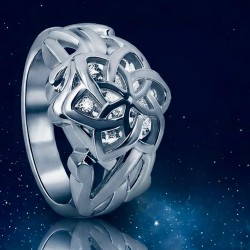
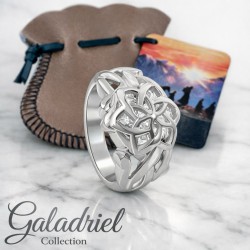
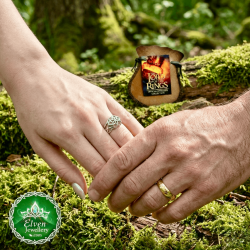
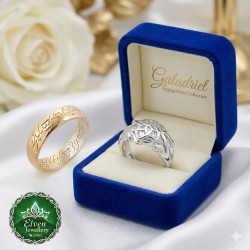
The official Nenya is the only officially licensed Elven Ring of Power in the Lord of the Rings jewellery collection — made in New Zealand by the New Line Productions licence holders, in solid 925 sterling silver with white gold finish. It reproduces the ring exactly as depicted in Peter Jackson's films: the mithril band, the white stone, the distinctive Elvish design that Tolkien described and the film's jewellery department interpreted. The only official Nenya in the world, from the country where Lothlórien was filmed.
Nenya — Sterling Silver
The official Galadriel's Nenya in solid 925 sterling silver with white gold finish. The Ring of Water, the Ring of Adamant — one of the Three Elven Rings that sustained the Elder Days. The only officially licensed Elven Ring of Power. Made in New Zealand by the New Line Productions licence holders.
Shop Nenya Sterling Silver →Nenya — White Gold
The official Nenya in solid 9ct white gold — the closest material approximation to Tolkien's mithril available in precious metal. The Ring of Water in the metal of starlight. Custom-made in New Zealand by the New Line Productions licence holders. The definitive version of the collection's most elegant piece.
Shop Nenya White Gold →Frequently Asked Questions About Nenya
What is Nenya?
Nenya — also called the Ring of Water, the Ring of Adamant, and the White Ring — was one of the Three Elven Rings made by Celebrimbor in Eregion at the end of the Second Age. Made of mithril set with a stone of adamant, it was given to Galadriel, Lady of Lothlórien, who used its power throughout the Third Age to preserve the beauty and timeless quality of her forest realm. It was the most visible of the Three in its effects, and among the most clearly described in Tolkien's text.
What powers did Nenya have?
Like all Three Elven Rings, Nenya's primary power was preservation — the slowing of time's decay, the sustaining of beauty against entropy. In Lothlórien, this manifested as the continued flourishing of the golden Mallorn trees, the unusual quality of light in the forest, the sense that time moved differently within its borders, and Galadriel's ability to maintain a sanctuary of Elvish grace in a world increasingly dominated by shadow. Nenya also sustained Galadriel's Mirror — the basin of water in which she could perceive the past, present, and possible futures. It was not a weapon and was not designed for conquest or domination.
Why did Galadriel refuse the One Ring when Frodo offered it to her?
Galadriel understood that using the One Ring — even to preserve what Nenya had built — would make her into a new Dark Lord. The One Ring was not a neutral tool: it was a fragment of Sauron's will, designed to dominate. Any being who wielded it would find their own will gradually subsumed by its purpose. A Middle-earth preserved by Galadriel wielding the One Ring would have been a Middle-earth under benevolent domination — better than Sauron's, perhaps, but structurally identical in its suppression of free will. She chose to "diminish and go into the West" rather than become that. It was the right choice and she knew it, which made it no less costly.
What happened to Nenya when the One Ring was destroyed?
When the One Ring was destroyed on the 25th of March, TA 3019, Nenya lost its power simultaneously. The Three Rings were bound to the One through the shared craft techniques from which they were made — even though Sauron never touched them, the foundational mechanism was the same. Without the One Ring sustaining that foundation, the Three became ordinary rings. Lothlórien's timeless quality faded. The golden light dimmed. Galadriel sailed West in TA 3021, taking Nenya — its power spent — with her. She understood this would happen before she refused the One Ring. The refusal was also an acceptance of this loss.
What does Nenya look like?
Tolkien describes Nenya as made of mithril — the extraordinary silver-white metal found in the mines of Moria — set with a stone of adamant, which he uses as an archaic term for diamond. It therefore appeared as a silver-white band set with a brilliant white stone of exceptional clarity. In the published description Frodo sees it as "a white gem like a frosty star" flickering on Galadriel's finger. The official licensed jewellery reproduces this in solid sterling silver with white gold finish, with a brilliant white stone in a setting designed to echo the Elvish craftsmanship Tolkien described.
Why is Nenya the only Elven Ring in the official jewellery collection?
Nenya was selected for the official jewellery collection because of its direct association with Galadriel — one of the most beloved and visually distinctive characters in the films — and because its design translates exceptionally well into actual jewellery: the mithril-and-diamond aesthetic produces a ring of genuine elegance that works as a wearable piece of fine jewellery as well as a collector's piece. Vilya (Elrond's Ring of Air) and Narya (Gandalf's Ring of Fire) have not been made as official licensed pieces. Nenya remains the only official Elven Ring of Power in the entire Lord of the Rings and Hobbit licensed collection.
Sources & Further Reading
- The Lord of the Rings — The Fellowship of the Ring: 'The Mirror of Galadriel' — Frodo's sight of Nenya on Galadriel's finger and her account of what it sustains
- The Lord of the Rings — The Fellowship of the Ring: 'The Council of Elrond' — Elrond's description of the Three Rings' purpose: "understanding, making, and healing"
- The Silmarillion: 'Of the Rings of Power and the Third Age' — the making of the Rings, Celebrimbor's independent forging of the Three, and the fate of the Rings after the destruction of the One
- Unfinished Tales of Númenor and Middle-earth, ed. Christopher Tolkien: 'The History of Galadriel and Celeborn' — the most detailed account of Nenya's distribution and Galadriel's history as a Ring-bearer
- The Letters of J.R.R. Tolkien, ed. Humphrey Carpenter: Letter 131 — Tolkien's explanation of the Rings' purpose and why the Three were bound to the One despite being made without Sauron's touch
- Tolkien Gateway — tolkiengateway.net
Related Products