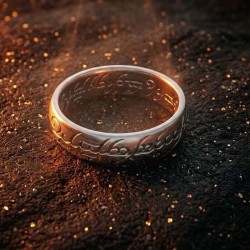
The One Ring — also called the Ruling Ring, the Master Ring, and Isildur's Bane — was forged by the Dark Lord Sauron in the fires of Mount Doom in the Second Age of Middle-earth, around the year SA 1600. It was not merely a ring of power. Sauron poured a great part of his own native strength into it, making it the anchor of his will and the instrument through which he intended to dominate all other Rings of Power and enslave their bearers. Its destruction was the only means by which his power could be permanently broken.
There is a moment at the Council of Elrond when Gandalf speaks the Ring's inscription aloud in the Black Speech of Mordor — the language Sauron himself constructed, the language no one in that age uses willingly. The sky goes dark over Rivendell. The beauty of the valley dims. Even the Elves flinch.
It is a small moment in a long book. But it tells you everything about the nature of the One Ring — that its mere words, spoken aloud by a wizard in an Elven garden, are enough to cast a shadow over the world. The Ring was not a weapon or a tool. It was a fragment of Sauron's own soul, given physical form. It had a will. It had desires. It had patience that lasted through millennia. And it was, in the end, the thing that destroyed itself.
This is its complete story.
The Forging — Why Sauron Made the One Ring
To understand the One Ring, you have to understand what Sauron was trying to do — and how badly it went wrong.
In the Second Age, Sauron was not yet the dark tower and the lidless eye. He was a shapeshifter, a deceiver, an intelligence of extraordinary subtlety. He took the form of a fair being who called himself Annatar — Lord of Gifts — and came to the Elven-smiths of Eregion, the Gwaith-i-Mírdain, led by Celebrimbor. He offered them knowledge of ring-craft beyond anything they had achieved alone. They accepted. Together, under Sauron's instruction, they forged the Rings of Power: seven for the Dwarf-lords, nine for the kings of Men.
The Three Elven Rings — Narya, Vilya, and Nenya — Celebrimbor made himself, in secret, without Sauron's direct touch. They were the greatest of the lesser rings, and they were made with a different purpose entirely: not domination, but preservation. The preservation of beauty, memory, and life against the slow decay of time.
But Sauron had a plan. While the Elves worked in Eregion, he withdrew to Mordor in secret. In the volcanic chambers of Orodruin — the Mountain of Doom — he forged a ring unlike the others. He could not merely use skill for what he needed. He needed to surpass the Three, which were formidable enough that any ring intended to govern them must be of surpassing power. To achieve that power, he did something no craftsman would willingly do: he transferred a great part of his own essential being into the metal.
Tolkien writes in The Silmarillion: "And much of the strength and will of Sauron passed into that One Ring; for the power of the Elven-rings was very great, and that which should govern them must be a thing of surpassing potency."
The moment the Ring was complete, Sauron put it on and spoke words of command. The Elves heard him. They immediately took off their own rings and realised they had been deceived from the start. Sauron had never wanted to help them. He had wanted to rule them.
War followed. Celebrimbor was captured and killed. The Rings of Power were scattered. And Sauron, now wearing the One Ring openly, declared himself Lord of the Earth.
What the One Ring Looked Like — and What Was Written on It
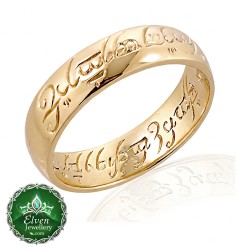
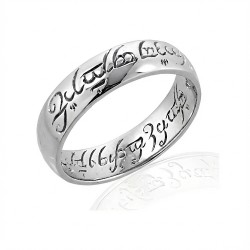
To the naked eye, the One Ring appeared to be a perfectly plain band of gold — no gems, no ornament, no visible inscription. It was, by the standards of the jewellery craft it represented, almost ostentatiously simple. But it was not plain. It was heavy in a way that had nothing to do with its size. Those who carried it felt its weight not just in their fingers but in their minds — a constant, pressing gravity that Frodo described as something like a great eye, searching.
The Ring's most uncanny physical property was its ability to change size. It could expand or contract at will, slipping off a finger at the moment it decided its wearer was no longer useful to it. This is how it betrayed Isildur at the Gladden Fields — the ring simply slid off his hand into the river as Orcs pursued him. It is how it left Gollum after five hundred years of possession. The Ring was never truly its bearer's. It was always Sauron's, patiently waiting to return to him.
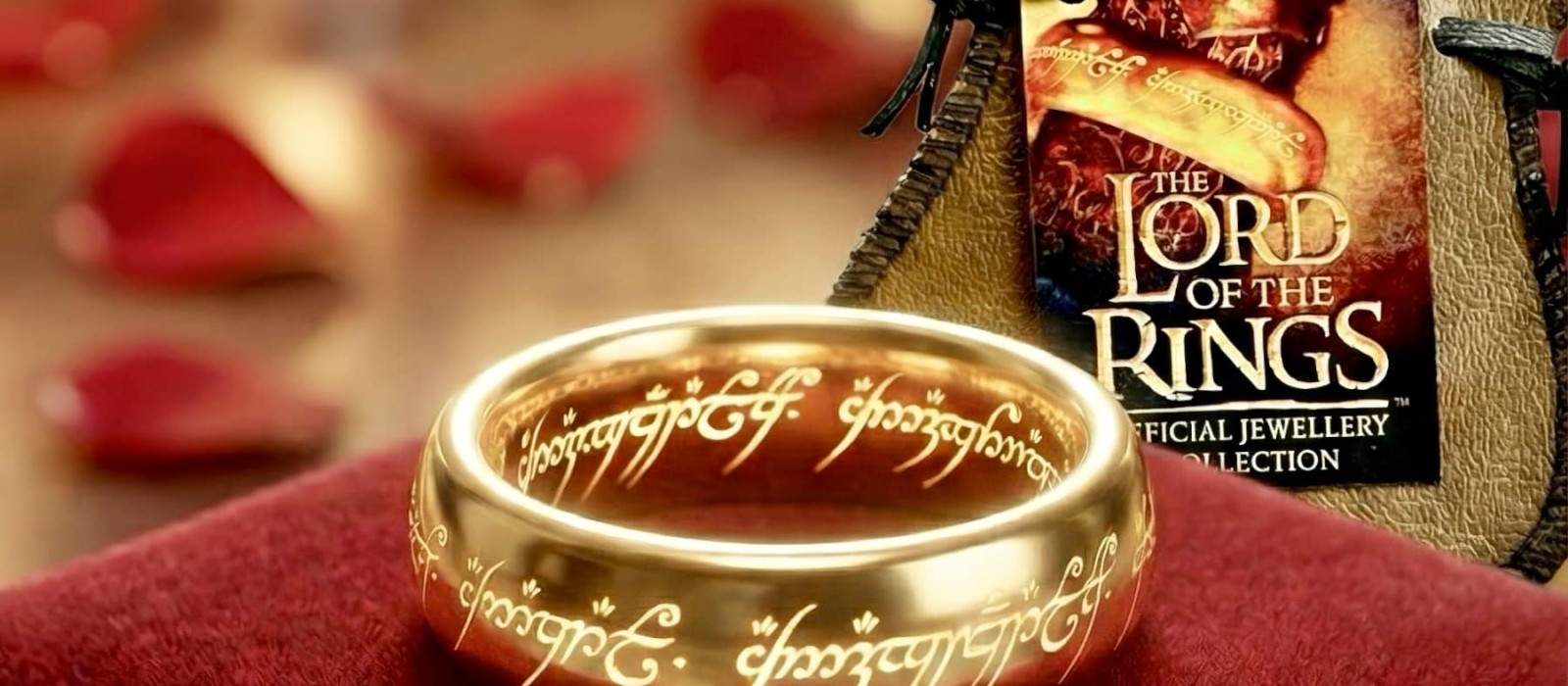
When heat was applied — Gandalf held it in the flames of Frodo's fire at Bag End to confirm its identity — letters appeared along both the inner and outer surfaces. They were written in the Tengwar script, in the Black Speech of Mordor that Sauron himself had constructed as a language of command:
Ash nazg durbatulûk, ash nazg gimbatul,
ash nazg thrakatulûk agh burzum-ishi krimpatul.
"One Ring to rule them all, One Ring to find them,
One Ring to bring them all and in the darkness bind them."
These words are the Ring's spell — the binding verse that tied the other Rings of Power to Sauron's will. When he first spoke them at the moment of forging, the Elves of Eregion heard his voice in their minds and understood everything. The inscription is simultaneously the Ring's identity, its purpose, its history, and its threat. Tolkien considered it one of the things he was most satisfied with in the entire work.
What Powers Did the One Ring Actually Give?
The Ring's powers were not uniform. They scaled with the nature and stature of the bearer — a hobbit experienced them very differently from a king or a wizard. Tolkien was explicit about this in his letters: the Ring's full powers could only be wielded by someone with commensurate spiritual and mental strength, and no bearer in the story came close.
The most immediate effect for ordinary mortals was invisibility. The Ring shifted its wearer partially out of the physical world and into the Unseen — the dimension in which wraiths, spirits, and the Nazgûl operated. In that state, the wearer was invisible to ordinary eyes but dangerously visible to everything that existed primarily in the Unseen. Wearing the Ring in the presence of the Nazgûl was not a defence. It was an invitation.
The Ring also arrested aging. Sméagol — the hobbit who became Gollum — possessed it for nearly five hundred years without dying. Bilbo, who carried it for sixty years, barely aged at all. But this was not vitality. It was a kind of terrible suspension. Bilbo described feeling "stretched and thin, like butter scraped over too much bread." The Ring kept its bearers alive, but it did not sustain them. They simply continued, wearing away.
The Ring's master power — the one Gandalf and Galadriel were most afraid of — was domination. A being of sufficient power who wore the Ring could theoretically use it to command the wills of all those bearing the lesser rings, including Sauron himself. This is why both Gandalf and Galadriel refused it when it was offered to them. Gandalf said: "With that power, I should have power too great and terrible. And over me the Ring would gain a power still greater and more deadly." They understood that they would not use the Ring as they intended. The Ring would use them.
The Corruption — How the Ring Worked on Its Bearers
The Ring's corruption was not random. It was precise, tailored, and patient. It found the specific desire in each person who carried it and amplified that desire beyond any natural limit, twisting it until the person could not think of anything else.
Samwise Gamgee, when he briefly took the Ring during the approach to Mordor, had a vision of himself as a great gardener who could make all the barren places of the world bloom. It was a beautiful vision. It was also a trap — Sam could see, even as he watched it, how quickly that gardener would become a tyrant, "using it to conquer and keep slaves." He put the Ring down.
Boromir saw himself as a mighty war-king who would drive Sauron from the world and save Gondor from shadow. Galadriel saw herself as a queen of surpassing beauty and terrifying power. Frodo saw himself as a great Ring-lord, wearing many rings, and all men falling before him. Each vision was constructed from the bearer's own genuine and reasonable desires — the gardener who loves growing things, the soldier who loves his homeland, the queen who loves her people, the hobbit who wants the shadow removed from the world. The Ring took what was real and true and twisted it toward conquest and domination.
Gollum is the clearest example of where that corruption ended. Five hundred years of possession had reduced a hobbit to a creature who lived in darkness under a mountain, calling the Ring "my precious," speaking of himself in the third person, unable to sustain any thought that did not return to the Ring's whereabouts. His will had been so thoroughly consumed that he had essentially ceased to exist as a person. Only the obsession remained.
The History of the One Ring — From the Fires of Doom to the Fires of Doom
The Ring's journey through Middle-earth is one of the strangest in fiction — a story told largely through absence, through the Ring's presence at pivotal moments of history and its patience through the long ages between them.
The Siege of Barad-dûr — Isildur Takes the Ring (SA 3441)
The Last Alliance of Elves and Men — Gil-galad and Elendil leading the combined armies of the free peoples against Mordor — laid siege to Sauron's fortress for seven years. On the slopes of Orodruin, Sauron came out to fight in person. Both Gil-galad and Elendil were killed. Isildur, Elendil's son, took the shattered hilt-shard of Narsil and cut the Ring from Sauron's hand. Sauron's physical form was destroyed. His spirit fled.
Elrond and Isildur stood at the edge of the Cracks of Doom. Elrond urged Isildur to cast the Ring into the fire and end it then and there. Isildur refused. He said it was his to keep as weregild for the deaths of his father and brother. He called it "the precious." He was already lost.
The Gladden Fields — The Ring Betrays Isildur (TA 2)
Two years later, Isildur was ambushed by Orcs at the Gladden Fields. He put on the Ring to escape — invisible, wading into the river Anduin under cover of night. The Ring slipped off his finger. In the water it had become slippery, the Orcs spotted him through the Unseen, and he was shot. The Ring sank to the bottom of the Anduin and lay there for nearly two thousand years.
Sméagol Finds the Ring — and Becomes Gollum (TA 2463)
A hobbit-like creature named Déagol found the Ring while fishing in the Gladden Fields. His companion Sméagol saw it and immediately desired it. He asked Déagol for it as a birthday present. When Déagol refused, Sméagol strangled him and took it. The Ring had been out of active circulation for two thousand years. It took less than five minutes to make its first kill after resurfacing.
Sméagol was driven from his community and retreated under the Misty Mountains, where the Ring sustained him in darkness for nearly five hundred years. He became Gollum — the name came from the horrible swallowing sound he made in his throat.
Bilbo Baggins — The Most Important Accident in the Third Age (TA 2941)
In the tunnels beneath the Misty Mountains, Gollum lost the Ring in the dark. A hobbit named Bilbo Baggins, separated from Gandalf and Thorin's company, found it by accident in the pitch black. He put it in his pocket. He then encountered Gollum, who proposed a riddle game — the winner would get what he most desired. Gollum assumed he would be eating Bilbo. Bilbo asked his final riddle entirely by accident: "What have I got in my pocket?"
This was not a fair riddle. Gollum was furious. But Bilbo had answered correctly, and he ran. He was invisible — wearing the Ring — and reached the gate of the mountains, squeezed through, and escaped. What Tolkien later came to understand, writing The Lord of the Rings, was that this moment was not pure chance. The Ring had chosen to leave Gollum. It had sensed Bilbo, and decided he might serve its purposes better.
Gandalf's Fire Test — Confirming the Ring (TA 3018)
Sixty years after Bilbo found the Ring, Gandalf had grown suspicious. He visited Bilbo and then, seventeen years later, returned to Bag End, where Frodo now lived. He took the Ring and held it in the flames of the hearth fire. The letters appeared. Gandalf read them. "I cannot read the fiery letters," said Frodo. "No," said Gandalf. "But I can. The letters are Elvish, of an ancient mode, but the language is that of Mordor, which I will not utter here." He had confirmed what he feared. The Ring that had been in the Shire for sixty years was Isildur's Bane.
Why the Ring Could Not Simply Be Used Against Sauron
This is the question Boromir asked at the Council of Elrond, and it is the right question. If the Ring was powerful enough to give its bearer dominion over the other Rings of Power, why not use it? Why not let Gandalf or Galadriel or Aragorn wield it and use its power against the very enemy who made it?
The answer is the nature of the Ring itself. It was not a neutral tool. It was a fragment of Sauron's will and Sauron's desire — specifically, his desire to dominate. To use the Ring, you had to use it as it was designed to be used: as an instrument of domination. Any person who took it with good intentions would find, very quickly, that the Ring was reshaping their intentions. They would become, in Tolkien's words, "another Dark Lord."
Even if a person of great power and pure heart took the Ring and wielded it to defeat Sauron — what then? They would still have it. They would still feel it. Its patience was infinite, and its purpose was fixed. Galadriel articulated this perfectly when Frodo offered it to her: "I pass the test. I will diminish, and go into the West, and remain Galadriel."
The only way to destroy Sauron permanently was to destroy the Ring. And the only place it could be destroyed was where it was made — in the Cracks of Doom at Mount Doom.
The Destruction — Accident, Will, and Providence
Frodo reached the Sammath Naur — the Chambers of Fire inside Mount Doom — on the 25th of March, TA 3019. He had carried the Ring from the Shire to Mordor on foot, through every temptation and physical deterioration the Ring could inflict. He had watched it reduce him from a healthy hobbit to something gaunt and barely alive. He stood at the edge of the Cracks of Doom.
And he could not do it. He put the Ring on.
This is one of the most important moments in all of Tolkien's writing, and he was explicit about its meaning in his letters. Frodo did not fail. He succeeded in carrying the Ring to the one place where it could be destroyed, against impossible odds, with a will eroded by months of the Ring's assault. No one could have done more. But the Ring's power at its home was overwhelming, and at the final moment Frodo's will broke. He claimed the Ring for himself.
Sauron, suddenly aware, turned all his attention toward Mount Doom in desperate urgency. At that moment, Gollum — who had followed them into Mordor, who had bitten the Ring from Frodo's finger in a last frenzied attack — danced with joy at the edge of the fire and fell. The Ring fell with him into the Cracks of Doom. The fire took it. Sauron's power collapsed. His tower fell. His armies crumbled. The nine Nazgûl were consumed in the same moment.
Tolkien believed, and stated in his letters, that the destruction of the Ring was an act of Providence — that a higher power had arranged things so that Gollum, preserved through five hundred years of the Ring's service precisely so he could be at this moment in this place, would accomplish what Frodo could not. The Ring's own treachery — in preserving Gollum, in driving him to pursue it all the way into Mordor — was the mechanism of its destruction.
Evil, as Tolkien saw it, was ultimately self-defeating. The Ring destroyed itself.
The Official One Ring Collection — Made in New Zealand
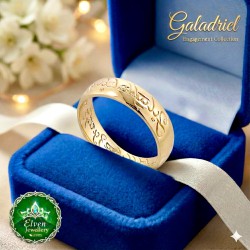
The official One Ring collection at lotrjewelry.com is made in New Zealand — the country that is Middle-earth — by the New Line Productions license holders. Every ring is made to your exact size, in solid 925 sterling silver or solid gold, with a Comfort Curve profile. Not plated. Not inspired by. The real thing.
One Ring — Silver (Precision Engraved)
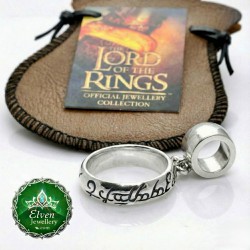
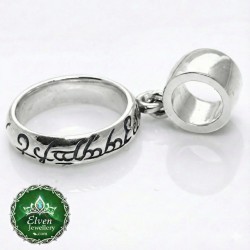
The definitive One Ring in solid 925 sterling silver. Precision-engraved Black Speech inscription, Comfort Curve profile, custom-made to your exact size in approximately 5 days. UK/NZ/AU and US sizing. Supplied with a pouch and official Licence of Authenticity.
Shop One Ring Silver →One Ring — Gold
The One Ring in solid gold — 9ct or 18ct. As close to Tolkien's original as it is possible to get: the ring Sauron forged "of fine gold." Custom-made in New Zealand. Comfort Curve. Free DHL shipping on gold orders. The ultimate collector's piece.
Shop One Ring Gold →One Ring — UV Fire Script
Sterling silver with red UV-reactive resin — the inscription glows under ultraviolet/black light, appearing as if written in fire. Exactly as Tolkien described it: "wreathed with flame." Not glow-in-the-dark — UV activated. Custom-made to size.
Shop UV Fire Script →One Ring UV — Gold
The UV Fire Script ring in solid 9ct or 18ct gold. The fire inscription glows red under UV light, set in gold that actually looks like Tolkien's golden ring. The rarest version in the collection. Custom-made in New Zealand. Free DHL shipping.
Shop Gold UV Ring →One Ring Wedding Band
The only official Lord of the Rings wedding band — solid gold, Black Speech inscription on the inside surface, Comfort Curve. Jens Hansen explicitly says their rings are "not suitable as a wedding ring." This one is made specifically for that purpose.
Shop Wedding Band →One Ring Bangle
The One Ring inscription is hand-engraved on both surfaces of a 6mm sterling silver cuff bangle — inside and outside. Three silver sizes, gold option. Approximately 2 weeks to make. The Black Speech is carried on your wrist.
Shop One Ring Bangle →Frequently Asked Questions About the One Ring
Why couldn't the Eagles just fly the Ring to Mount Doom?
This is the most frequently asked question about the entire story. The answer has several layers. The Eagles were not servants of the free peoples to be deployed at will — they were the Eagles of Manwë, divine messengers who intervened in history at specific moments of profound need, not on request. But the deeper problem is the Ring itself. Carrying the Ring — even in flight, even swiftly — meant the Ring was in motion toward its destruction, and its will would resist that with everything it had. It would have exerted its corruption on whoever carried it. A direct flight to Mordor would have been immediately visible to Sauron, whose attention was deliberately kept elsewhere by Aragorn's actions at the Black Gate. The entire strategy of the Quest depended on Sauron not knowing the Ring was approaching Mount Doom. An Eagle flight would have been noticed instantly.
Why didn't the Ring make Sauron invisible when he wore it?
The Ring's invisibility effect on mortals works because it shifts them partially into the Unseen world — the spiritual dimension in which wraiths and divine beings primarily exist. Sauron already existed primarily in that dimension. He was a Maia — one of the divine spirits who shaped the world alongside the Valar. The Ring could not shift him into a world he was already more native to. When a mortal wears the Ring, they are made partially Unseen. When Sauron wore it, he was simply himself, with his full power augmented.
What does the One Ring inscription mean?
The inscription reads in Black Speech: "Ash nazg durbatulûk, ash nazg gimbatul, ash nazg thrakatulûk agh burzum-ishi krimpatul." In English: "One Ring to rule them all, One Ring to find them, One Ring to bring them all and in the darkness bind them." The words are the Ring's own spell — the binding verse that connected all other Rings of Power to Sauron's will. They appear on both the inner and outer bands and are invisible until the Ring is exposed to fire. Tolkien's linguist created Black Speech as a harsh, unpleasant language deliberately designed to feel oppressive and wrong when spoken aloud.
Why was Tom Bombadil completely unaffected by the Ring?
Tolkien deliberately left Tom Bombadil unexplained, but his immunity to the Ring is consistent across multiple readings. When Frodo put the Ring on in Tom's house, he did not become invisible to Tom. When Tom put the Ring on himself, it did not affect him at all. The most widely accepted explanation — supported by Tolkien's letters — is that Tom existed outside the Ring's domain of influence entirely. He predated the Ring. He predated Sauron. He had no desire for power, no will to dominate, nothing for the Ring to amplify or corrupt. It had no purchase on him at all. Tolkien described him as a deliberate enigma — an embodiment of "the spirit of the (vanishing) Oxford and Berkshire countryside" — something that simply was, before any of the struggles of the Ages began.
Why didn't the Ring corrupt the Dwarves?
Sauron gave seven rings to seven Dwarf-lords, expecting to dominate them as he had dominated the Nine kings of Men. It did not work. The Dwarves were made by Aulë, one of the Valar — their nature had been specifically designed to be resistant to domination by outside wills. The seven rings did corrupt them, but differently: they made the Dwarves who held them extraordinarily wealthy, and inflamed their natural appetite for gold to the point of dragon-sickness. But they could not be enslaved through the rings and did not become wraiths. Sauron later recovered the seven rings — three were consumed by dragon-fire, and four he reclaimed — but he gained no servants from them.
Was Frodo's failure at the Cracks of Doom a moral failing?
Tolkien addressed this directly in his letters. No — Frodo did not fail morally. He succeeded in accomplishing something that no other living being could have done: carrying the Ring from the Shire to the fires of Mount Doom. The Ring's assault on his will was cumulative and relentless, and the Ring at its source had a power that broke his resistance at the final moment. Tolkien wrote that Frodo deserved no blame — that his deed was "supererogratorily meritorious," meaning he gave more than could be required of anyone. The destruction of the Ring required both Frodo's achievement and Gollum's, and behind both of them, Tolkien believed, was divine Providence arranging the outcome that could not otherwise have come to pass.
What happened to the Three Elven Rings after the One Ring was destroyed?
The Three — Narya, Vilya, and Nenya — were sustained by the power of the One Ring, even though they were made independently of it. When the One Ring was destroyed, the Three also lost their power. This meant that everything the Three had preserved or sustained — the beauty of Rivendell and Lothlórien, the vitality of the Elvish realms, much of the magic that remained in Middle-earth — faded and was lost. Tolkien saw this as the necessary price of Sauron's defeat: the victory of the war could not save what the Elves had made, and the Third Age ended with the diminishment of magic itself. The Elves had always known this would happen. It was part of why Galadriel said that whether Sauron won or lost, the Elves would lose.
If a dragon ate the One Ring, would it be destroyed?
This is one of Tolkien's most entertaining lore questions. The answer is almost certainly no — though Tolkien never addressed it directly. The Ring could only be unmade in the fires of Orodruin, where it was forged. Ordinary dragon fire — even the fire of the greatest dragons — was not hot enough to destroy it. Glaurung, Ancalagon the Black, and Smaug were all formidable fire-drakes, but their fire was not the volcanic heat of Mount Doom. If Smaug had swallowed the Ring, it would likely have sat in his stomach harmlessly for as long as he lived. The Ring's vulnerability to dragon fire was specifically tested in Tolkien's drafts and rejected. Only the Crack of Doom would do.
Sources & Further Reading
- The Lord of the Rings — The Fellowship of the Ring — 'The Shadow of the Past' and 'The Council of Elrond' — Gandalf's fire test, Elrond's history of the Rings, and the Council's debate
- The Silmarillion — 'Of the Rings of Power and the Third Age' — Sauron's forging of the One Ring and the deception of Celebrimbor
- The Lord of the Rings — Appendix B — 'The Tale of Years' — full chronological timeline of the Ring from SA 1600 to TA 3019
- Unfinished Tales, ed. Christopher Tolkien — 'The Disaster of the Gladden Fields' — the most detailed account of Isildur's death and the Ring's betrayal
- The Letters of J.R.R. Tolkien, ed. Humphrey Carpenter — Letter 131 — Tolkien's own explanation of the Ring's symbolism and the metaphysics of power transfer
- Tolkien Gateway — tolkiengateway.net
Related Products