J.R.R. Tolkien was a professional philologist — a scholar of language, its history, and its structure — who spent his career at Oxford studying Old English, Middle English, and the Norse and Germanic tongues. He did not merely invent a world. He invented the languages first, and the world grew around them. The Elvish writing systems — Tengwar and Cirth — are not decorative additions to Middle-earth. They are among its deepest achievements: fully functional scripts, with grammatical rules, phonological systems, and centuries of fictional history, created by one of the twentieth century's leading language scholars for the sheer love of the craft.
When Gandalf holds the One Ring in the flames of Frodo's hearth and letters appear along its surface — letters that glow red in the heat before fading again as the Ring cools — the effect is not merely dramatic. It is Tolkien the linguist showing his work. Those letters are real. The script is Tengwar, a writing system with a complete and internally consistent phonological design. The language is Black Speech, a language Tolkien constructed specifically for Sauron's servants. The inscription can be transliterated, translated, and linguistically analysed. Everything is there, behind the surface of a single visual moment in a children's fireside scene that opens one of the most significant novels of the twentieth century.
This is a guide to the scripts of Middle-earth — what they are, how they work, where they appear, and what they mean.
Tolkien the Linguist — Why the Languages Came First
Tolkien began inventing Elvish languages as a teenager. He was not yet thinking about a world — he was thinking about linguistic systems, about what a language would look like if it evolved in a particular direction, with particular aesthetic qualities, from a particular kind of phonological starting point. He was especially drawn to Finnish, which he had taught himself from a grammar, and to Welsh, and to the particular music of words in those languages — the vowel sounds, the compound constructions, the way meaning accumulated in the shape of a word.
He eventually created two fully developed Elvish languages: Quenya, based partly on Finnish, the High Elvish tongue of the ancient Noldor — a language of ceremony, lore, and the deep past, spoken in Valinor and used in the Third Age primarily for formal occasions and the names of important things; and Sindarin, based partly on Welsh, the Grey-Elvish tongue that had become the common language of the Elves in Middle-earth during the Third Age — the language Legolas speaks, the language of Rivendell and Lothlórien, the language in which "Mithrandir" and "Andúril" and "Imladris" are formed.
The writing systems — Tengwar and Cirth — were developed within the fictional history of Middle-earth to record these languages. But because Tolkien designed them as real systems, they can write almost any language, including English. The inscription on the One Ring is in Tengwar writing Black Speech. The inscription on the Doors of Moria is in Tengwar writing Sindarin. The runes on Thrór's Map in The Hobbit are Cirth writing Old English (standing in for Westron, the Common Speech). The same script, multiple languages. Exactly as the Roman alphabet, which Tolkien studied professionally, writes Latin, English, French, Italian, Welsh, Finnish, and hundreds of others.
Tengwar — The Script of the Elves and the Ring
Tengwar is the most elegant of Tolkien's scripts and the one that appears most prominently in The Lord of the Rings. It was invented, within the fiction, by Fëanor — the greatest craftsman in the history of the Elves, the maker of the Silmarils, a figure of towering genius and catastrophic pride — in the early First Age. It is a featural alphabet, meaning the shapes of the letters are not arbitrary: they are designed so that related sounds have related shapes. A letter for a voiced consonant is visually related to the letter for its unvoiced counterpart. A letter for a nasal sound has a recognisable relationship to the letter for its corresponding stop. The system has an internal logic that reflects real phonological relationships.
Tengwar was adapted into several "modes" — different arrangements for different languages. Writing Quenya in Tengwar uses different conventions than writing Sindarin, which uses different conventions than writing English or Black Speech. This mirrors how real scripts work: the Roman alphabet uses different conventions in English (where C can represent K or S) than in Italian (where C before E or I is always the CH sound of "church"). Tengwar is a real orthographic system, not a cipher.
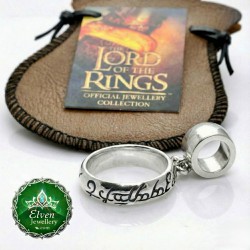
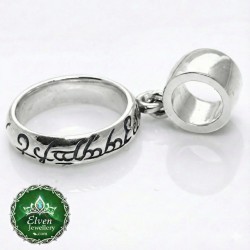
The most famous appearance of Tengwar is the inscription on the One Ring. Tolkien designed the inscription himself, and it was reproduced exactly on the official licensed jewellery. The letters appear on both the inner and outer surface of the ring, visible only when it is heated — exactly as Gandalf described them when he held it in Frodo's fire.
Ash nazg durbatulûk, ash nazg gimbatul,
ash nazg thrakatulûk agh burzum-ishi krimpatul.
"One Ring to rule them all, One Ring to find them,
One Ring to bring them all and in the darkness bind them."
Tolkien wrote this inscription in the Black Speech — the language he had constructed specifically for Sauron and his servants. It is one of the very few complete sentences of Black Speech in the entire legendarium. Tolkien considered it one of the most satisfying things he wrote. The harsh, guttural phonology was entirely deliberate — a language designed to feel oppressive and wrong when spoken aloud, which is why Gandalf refuses to repeat it at Frodo's fireside, and why its utterance at the Council of Elrond causes the sky over Rivendell to momentarily darken.
The Doors of Moria — "Speak, Friend, and Enter"
The West-gate of Moria — Ennyn Durin Aran Moria, the Doors of Durin Lord of Moria — is one of the most celebrated instances of Elvish script in all of Tolkien's writing, and it contains one of the most famous riddles in literature.
The doors were made by Celebrimbor — the greatest Elven craftsman of the Second Age, who later made the Rings of Power — in collaboration with Narvi the Dwarf. The inscription in Tengwar above the arch reads, in Sindarin: "Ennyn Durin Aran Moria: pedo mellon a minno. Im Narvi hain echant: Celebrimbor o Eregion teithant i thiw hin." In translation: "The Doors of Durin, Lord of Moria. Speak, friend, and enter. I, Narvi, made them. Celebrimbor of Hollin drew these signs."
The puzzle is in the phrase "pedo mellon a minno" — "Speak, friend, and enter." Gandalf spends a frustrating hour trying to work out the password, trying various Elvish words of power and command. It is Frodo who eventually asks the obvious question: what if it is not a riddle with a hidden answer, but simply an instruction? The command is "speak 'friend' and enter." Speak the word for friend. Mellon. The doors open.
Tolkien designed this as a comment on Elvish philosophy — on the difference between the Elves' way of thinking and the more suspicious, power-oriented approach of those looking for a secret password. The Elves who made those doors were friends of the Dwarves. They built a door that would open to any friend. They were not hiding from enemies; they were welcoming allies. The inscription is not a security measure. It is an invitation. The puzzle exists only because those trying to enter were thinking about it in the wrong way.
Cirth — The Runes of the Dwarves and Men
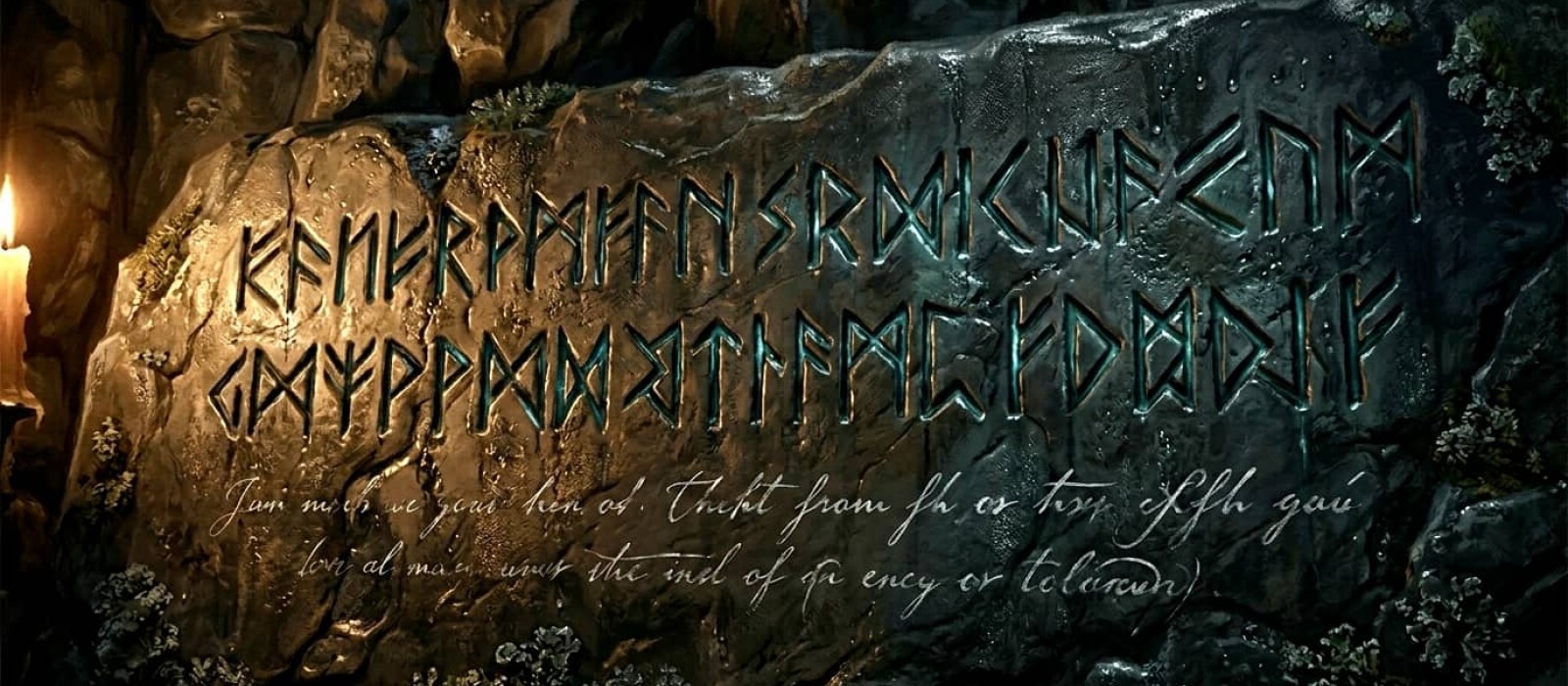
Cirth — also called Angerthas, meaning "long rune-rows" — is an older and simpler script than Tengwar. Where Tengwar is a fluid, elegant cursive system with flowing strokes well suited to writing on vellum or parchment, Cirth is angular and designed for carving — into stone, wood, or metal. The strokes are straight lines and simple angles, the kind of marks you can make with a chisel or a knife without the curved strokes that require a pen.
Within the fiction, Cirth was invented by Daeron, the loremaster and minstrel of the Elvish realm of Doriath in the First Age. But it was the Dwarves who took it up most enthusiastically and developed it most extensively — particularly the variant called Angerthas Moria, which the Dwarves of Khazad-dûm used throughout their occupation of the great halls under the Misty Mountains. When Tolkien needed a script for Thrór's Map in The Hobbit — the moon-letters that Elrond reads on Midsummer's Eve, and the main map runes showing the directions around Erebor — he used Cirth.
The inscription on Balin's tomb in Moria — "Balin son of Fundin Lord of Moria" — is written in Angerthas Moria. It is visible in Tolkien's original artwork and in Peter Jackson's film, and it uses the Dwarven variant of the script that Tolkien had constructed for exactly this fictional context. Even the tombstone inscription has a linguistically correct backstory.
Moon-letters — The Secret Writing of Thrór's Map
One of the most charming applications of Tolkien's rune-lore is the moon-letters on Thrór's Map in The Hobbit — runes written in silver ink that can only be read when moonlight falls on them at the same angle as the moon was at when they were written. Elrond explains this to Gandalf and Thorin at Rivendell, and when he reads them, they reveal the instructions for finding the secret door into Erebor: "Stand by the grey stone when the thrush knocks and the setting sun with the last light of Durin's Day will shine upon the keyhole."
This detail is pure Tolkien — an application of his deep interest in the relationship between writing, secrecy, and the natural world. The moon-letters are not just a clever plot device. They are an expression of the Dwarvish imagination: a people who carve things into stone, who think in geological time, who would naturally choose the moon as the index for a secret message because it is cyclical, precise, and entirely beyond the power of enemies to manipulate. You cannot fake the moon. The letter cannot be read until the world is in the right state to read it.
The One Ring Inscription — On the Official Jewellery
The inscription on the One Ring is the most recognisable use of Tolkien's scripts in the entire collection. Tolkien designed it himself, in Tengwar script writing Black Speech — the language he constructed for Sauron. It appears on the official One Ring collection at lotrjewelry.com exactly as Tolkien designed it and as it appears on the screen: on both the inner and outer surface of the ring, in the precision-engraved and UV Fire Script versions.
The UV Fire Script edition is the most literal interpretation of Tolkien's description: the inscription filled with red UV-reactive resin that glows under ultraviolet light — exactly as he described it appearing in fire, written in letters of flame. The precision-engraved silver edition shows the inscription in clean silver-on-silver engraving, exactly as the ring would appear before heating.
One Ring — Precision Engraved Silver
The Black Speech inscription engraved in solid 925 sterling silver. The ring as it appears cold — plain gold (here silver) with barely visible lettering until the right light catches it. Comfort Curve, custom-made to size. Made in New Zealand by the New Line Productions licence holders.
Shop Engraved Silver →One Ring — UV Fire Script
The inscription filled with red UV-reactive resin — glows as if written in fire under ultraviolet light. The ring as Gandalf saw it in Frodo's hearth: "The letters are Elvish, of an ancient mode, but the language is that of Mordor." Custom-made to size. Made in New Zealand.
Shop UV Fire Script →One Ring — Gold UV
The UV Fire Script ring in solid 9ct or 18ct gold — the inscription glows red under UV light in gold that looks exactly as Tolkien described: "a ring of fine gold." The rarest version in the collection. Made in New Zealand by the New Line Productions licence holders.
Shop Gold UV →Frequently Asked Questions About Elvish Runes
What are Elvish runes?
In Tolkien's Middle-earth, "Elvish runes" most commonly refers to two distinct writing systems. Tengwar is an elegant cursive script invented by Fëanor in the First Age, used to write Elvish languages and adapted for other tongues including the Black Speech of the Ring's inscription and the Common Speech. Cirth (also called Angerthas) is an angular, runic script suited for carving, originally invented by the Elf Daeron but adopted and developed most extensively by the Dwarves. Both systems were designed by Tolkien as fully functional orthographies with internal phonological logic — not ciphers or decoration, but real writing systems.
What script is the One Ring inscription written in?
The One Ring inscription is written in Tengwar — the Elvish script invented by Fëanor — but the language it records is the Black Speech of Mordor, which Sauron constructed as a language of command for his servants. The use of Elvish script to write an enemy language is historically plausible: scripts travel between cultures and are adapted for languages their inventors never intended. Tolkien — a professional philologist — built exactly this kind of cross-cultural script adoption into his fictional linguistics. The inscription reads "Ash nazg durbatulûk, ash nazg gimbatul, ash nazg thrakatulûk agh burzum-ishi krimpatul" — One Ring to rule them all, One Ring to find them, One Ring to bring them all and in the darkness bind them.
What does "Mellon" mean and why does it open the Doors of Moria?
Mellon is the Sindarin Elvish word for "friend." The inscription on the Doors of Moria reads "Speak, friend, and enter" — which Gandalf initially interprets as requiring a secret password of power. Frodo's insight is that the instruction is literal: to open the door, you simply speak the word "friend" — mellon — aloud. The Elves who made the doors were allies of the Dwarves of Moria and designed the entrance to be welcoming to friends rather than impenetrable to enemies. The puzzle exists only because Gandalf was thinking about it as a security riddle rather than a friendly invitation.
Did Tolkien actually invent complete languages?
Yes — Tolkien was a professional philologist and Rawlinson and Bosworth Professor of Anglo-Saxon at Oxford. He invented two fully developed Elvish languages — Quenya and Sindarin — with complete phonological systems, grammatical rules, extensive vocabularies, and historical development across fictional time. He also constructed Black Speech, Khuzdul (the secret language of the Dwarves), and Westron (the Common Speech), among others. The writing systems — Tengwar and Cirth — were designed as real orthographic systems capable of writing these languages. Tolkien worked on his invented languages his entire adult life, considering them one of his primary creative achievements alongside his fiction.
What are the moon-letters on Thrór's Map?
Moon-letters are a form of Cirth runes in The Hobbit written in silver ink that is invisible under ordinary light but becomes readable when moonlight strikes the page at the same angle as the moon was in when the letters were written. Elrond reads the moon-letters on Thrór's Map at Rivendell on Midsummer's Eve, revealing the instructions for finding the secret door into Erebor: "Stand by the grey stone when the thrush knocks and the setting sun with the last light of Durin's Day will shine upon the keyhole." The device reflects the Dwarves' characteristic use of natural cycles as encoding mechanisms — the moon is unchangeable and cannot be forged.
Can you learn to read Tengwar?
Yes — Tengwar is a fully designed script and can be learned by anyone willing to study it. Tolkien published enough of the system in the appendices to The Lord of the Rings (Appendix E: "Writing") for linguists and fans to reconstruct the full system, and extensive documentation exists in The Peoples of Middle-earth and other posthumous publications. The Tengwar Textbook by Måns Björkman is one of the most used study resources. Learning to read Tengwar allows you to decode the Ring inscription, the Moria door inscription, and the many other appearances of the script in Tolkien's illustrations and the Jackson films' production design.
Sources & Further Reading
- The Lord of the Rings — Appendix E: "Writing and Spelling" — J.R.R. Tolkien: the primary published source for Tengwar and Cirth, their history within the fiction, and the modes used to write different languages
- The Lord of the Rings — Appendix F: "The Languages and Peoples of the Third Age" — J.R.R. Tolkien: Tolkien's account of the linguistic history of Middle-earth and the relationship between the various tongues
- The Silmarillion — J.R.R. Tolkien, ed. Christopher Tolkien: the origins of Tengwar (Fëanor's invention) and Cirth (Daeron's invention) in the First Age
- The Peoples of Middle-earth — J.R.R. Tolkien, ed. Christopher Tolkien: the most detailed published material on Tolkien's linguistic constructions
- The Letters of J.R.R. Tolkien, ed. Humphrey Carpenter: numerous letters discussing Tolkien's linguistic philosophy, the origins of his invented languages, and their relationship to his fictional world
- Tolkien Gateway — tolkiengateway.net
Related Products