Bilbo Baggins — born September 22, TA 2890, Bag End, Hobbiton, the Shire — was the hobbit who found the One Ring. Son of Bungo Baggins and Belladonna Took, he led a comfortable, respectable, entirely unadventurous life until the morning a wizard appeared on his doorstep and an adventure appeared with him. He spent sixty years with the most dangerous object in the world in his pocket without fully understanding what it was, gave it up — the only person ever to do so voluntarily — and lived to 131, the oldest hobbit in the history of Middle-earth.
Tolkien said that he conceived of The Hobbit by writing a single sentence at the top of a blank exam paper he was supposed to be marking: "In a hole in the ground there lived a hobbit." He had no idea what a hobbit was. He spent years finding out.
What he found was Bilbo Baggins — a creature of two natures in permanent, amiable conflict. His father Bungo was a solid Baggins: reliable, domestic, unadventurous, never late for dinner. His mother Belladonna was a Took: that branch of the family notorious across the Shire for going off on adventures and doing things that were Not Done. In Bilbo, those two natures coexisted in creative tension for his entire life. The Baggins side wanted comfort, his armchair, his pantry, and his pipe. The Took side was what answered the door that April morning and said "yes" to something it didn't fully understand before it could think of a reason to say no.
His story — there and back again — is the foundation on which everything else in Tolkien's world rests.
Before the Adventure — The Respected Hobbit of Bag End
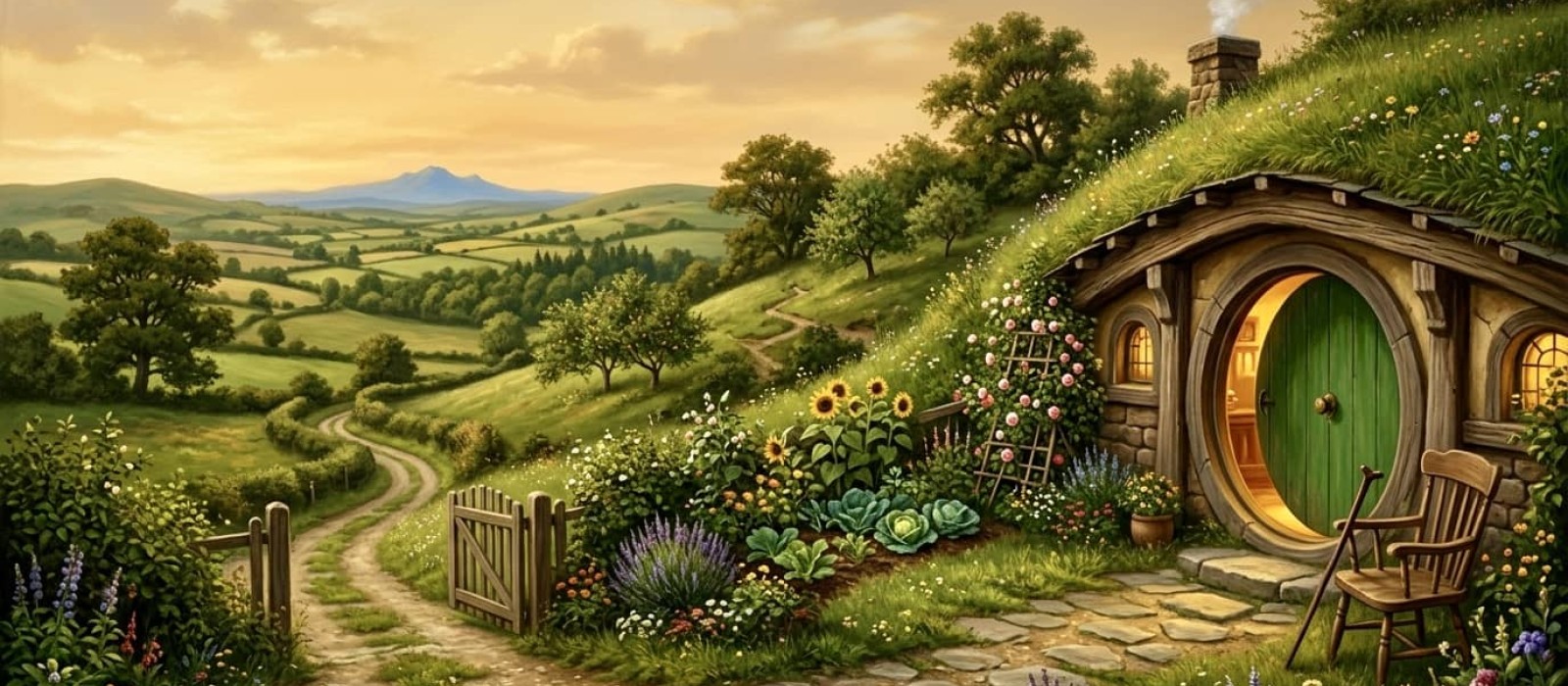
Bilbo was born in TA 2890 and spent his first fifty years as a model hobbit — a little more educated than average, a little more fond of Elvish poetry and maps than was strictly normal, somewhat eccentric by Shire standards but respected and comfortable. He had inherited Bag End from his father, who had built it for Belladonna Took when they married — a hole in the side of a hill, with round green doors and round windows, deep pantries and an excellent vegetable garden. He kept a good table, entertained politely, and was considered quite the catch if you were a hobbit of marriageable age.
He knew Gandalf — had known him since childhood, when the wizard had passed through the Shire occasionally and sent off young Tooks on the kind of adventures that were whispered about afterward. But he had not invited the association. When Gandalf appeared at his door in April TA 2941, Bilbo was fifty years old and had settled into the comfortable groove of his days with every intention of remaining there indefinitely.
He invited Gandalf for tea. By the next morning, thirteen Dwarves had eaten most of his pantry, there was a contract of employment on his kitchen table, and he was running — without his pocket-handkerchief — down the hill to catch up with a company of adventurers who had not yet decided whether to take him seriously.
The Quest of Erebor — There
The company's objective was Erebor — the Lonely Mountain, ancestral home of the Dwarves of Durin's Folk, taken from them sixty years before by the dragon Smaug. Thorin Oakenshield, the company's leader and the rightful King Under the Mountain, intended to go back and take it. The plan was short on detail and long on optimism. The Dwarves needed a burglar. Gandalf had decided that Bilbo was the burglar they needed, for reasons the Dwarves thought were insane and that Bilbo himself could not yet articulate.
The journey was long, dangerous, and repeatedly near-fatal. Trolls captured the company; Gandalf saved them by keeping the trolls arguing until dawn turned them to stone. Bilbo found their cave and retrieved the swords Orcrist and Glamdring — Elvish blades from Gondolin — as well as a short blade he called Sting, which turned out to glow blue in the presence of Orcs. Goblins captured them in the Misty Mountains. Bilbo was separated from the others in the dark tunnels. He found a small golden ring on the cave floor.
He pocketed it without thinking.
The Riddle Game — The Most Important Accident in History
In the dark beneath the Misty Mountains, Bilbo encountered Gollum — a pale, large-eyed creature who had lived in those tunnels for nearly five centuries, surviving on fish and the occasional Goblin. They played a riddle game, with Bilbo's life as the stake: if he won, Gollum would show him the way out; if he lost, Gollum would eat him.
Bilbo asked his last riddle almost by accident, groping in his pocket for something to ask about: "What have I got in my pocket?" It was not a fair riddle. Gollum objected furiously. But the rules of the game bound him — he had to try three guesses and failed. He went to his island to get his "birthday present" — the ring, his means of becoming invisible and sneaking up on prey — and found it was gone.
Bilbo, putting the ring on and discovering its effect, slipped past the raging Gollum and escaped through the gate of the mountain into daylight. He had the ring and Gollum did not. The implications of that fact would not become clear to anyone for sixty more years.
Tolkien later rewrote this chapter significantly for the second edition, after he had decided that the ring was not merely a convenient magic ring but the One Ring of Sauron — giving Gollum a more dangerous, obsessive character and changing what had been a fairly cheerful riddle game into something darker. The revised version is the one most readers know, and it is better — because it understands what the ring actually is and what Bilbo's finding of it actually meant.
The Burglar of Erebor — Who Bilbo Actually Was
The journey to Erebor revealed who Bilbo was underneath the comfort and the pantry. He was braver than he knew and quicker-witted than the Dwarves expected. He rescued the company from the Elven-king's dungeons by sealing them in barrels and floating them down the river. He crept alone into Smaug's treasure chamber and spoke in riddles with the dragon while standing invisibly on his hoard — an extraordinary act of courage that he managed largely through a hobbit's instinct for not letting things get out of hand.
He found the weakness in Smaug's armour — a patch on his belly left bare by a missing scale — and told a thrush about it, who carried the information to Bard of Lake-town, who killed the dragon. Bilbo did not take credit for this. It was characteristic: he found the solution, communicated it through the right channels, and stood quietly aside while others were celebrated for the outcome.
His most morally complex act came during the standoff after Smaug's death. Thorin, afflicted by dragon-sickness — the obsessive hoarding madness that the dragon's long possession of the gold had left embedded in it — refused to share the treasure with the Lake-men whose town had been destroyed and the Elves who had come to claim their share. A siege began. Bilbo, without telling anyone, crept out of the mountain and gave the Arkenstone — the most precious gem in the hoard, which he had found and kept, technically within his contracted share of the treasure — to Bard and Thranduil, so they would have a bargaining chip against Thorin.
He knew Thorin would call it theft. He knew it would destroy whatever trust remained between them. He did it anyway, because it was the right thing to do and there was no other way to prevent a war over gold in which his friends would die. The Battle of Five Armies came regardless — but Bilbo's act had changed the terms of it, and Thorin, dying of his wounds at its end, made peace with Bilbo before he went.
Back Again — The Hobbit Who Changed
Bilbo returned to the Shire in TA 2942 to find that he had been declared dead and an auction of his belongings was in progress. He bought back most of his things, settled into Bag End, and was regarded ever afterward with a mixture of affection and suspicion by his neighbours. He had been on an adventure. This was Not Done. He had also come back clearly different — writing poetry, receiving Dwarves as guests, going on long walks for extended periods, wearing the same ring and sometimes vanishing without explanation.
He adopted his young cousin Frodo as his heir and raised him in Bag End with the same love of maps and Elvish lore and the wide world that the adventure had given him. He wrote There and Back Again — the account of the Quest of Erebor that Tolkien presents as the source text of The Hobbit. He spent sixty years as the happiest he had ever been, reading and writing and receiving visitors, with the ring sitting in his pocket, and barely aging at all.
The Birthday Party — Letting Go
On September 22, TA 3001, Bilbo celebrated his 111th birthday — "eleventy-first," as hobbits said — at a party of legendary scale that he had been planning for years. He gave away most of his possessions in the Shire manner, made a speech, and vanished in a flash of light. He went to Rivendell, where he planned to finish his book.
The moment that mattered came just before he left. Gandalf asked him to leave the ring for Frodo. Bilbo immediately became defensive — reluctant, then angry, calling it "my precious" in a tone that alarmed Gandalf deeply. He had never used that phrase before. Then, with visible effort, he put it down on the mantelpiece and walked out the door. He was the only person in the history of the One Ring who ever gave it up willingly — who felt its pull and, with some difficulty, chose to put it down anyway. It was, Tolkien makes clear, one of the most difficult things anyone ever did in the entire story.
The Last Years — Rivendell and the Grey Havens
Bilbo spent the War of the Ring in Rivendell, old and increasingly frail — the Ring's life-extending effect fading now that he no longer carried it. He was aware, in a general way, that something important was happening in the south and east, but his days were spent finishing his book and dozing by the fire in Elrond's house, and the war was something other people were doing.
When Frodo arrived in Rivendell after the destruction of the Ring, Bilbo was 129 years old and looked every year of it. The Ring had kept him unnaturally preserved for sixty years and now, without it, time had caught up sharply. But he was lucid, and warm, and still interested in seeing the mithril shirt that Frodo had worn through the quest — which Bilbo had given him years before — and in hearing the story of what had happened.
On September 29, TA 3021, Bilbo Baggins sailed from the Grey Havens to the Undying Lands. He was 131 years old — the oldest hobbit in the history of Middle-earth, a record he still holds. He sailed with Frodo, Gandalf, Galadriel, and Elrond. Tolkien says he composed a last poem as they sailed, looking back at Middle-earth. He died in the West, as all mortals do. But as the only hobbit — and one of the very few mortals — ever to be granted passage to Valinor, he died in the most beautiful place that had ever existed in the world.
The Official One Ring — What Bilbo Found in the Dark
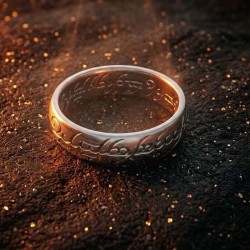
Bilbo found the One Ring in the tunnels under the Misty Mountains — picked it up from the cave floor in the dark without knowing what it was, put it in his pocket, and carried it for sixty years. The official One Ring collection at lotrjewelry.com is made in New Zealand — the country where Middle-earth lived on screen — by the New Line Productions licence holders. The same ring. Made properly, in the right place, by the right people.
One Ring — Sterling Silver
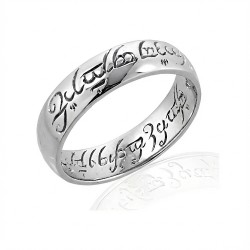
The precision engraved One Ring in solid 925 sterling silver — the ring Bilbo found in the dark, that he carried sixty years without suspecting what it was, and that he put down on a mantelpiece rather than take to Rivendell. Custom-made to your exact size. Made in New Zealand.
Shop One Ring →My Precious Ring
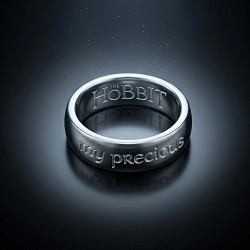
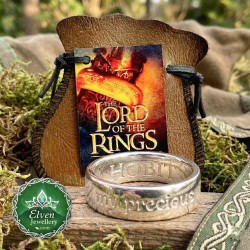
"My Precious" engraved outside. Official Hobbit logo inside. The ring Gollum carried for five centuries before Bilbo found it. Custom-made in solid 925 sterling silver. Made in New Zealand by the New Line Productions licence holders.
Shop My Precious →Sting — The Blade of Gondolin
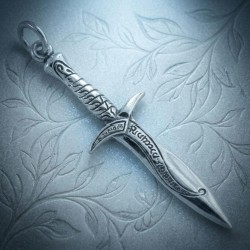
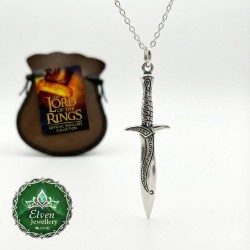
The official Sting pendant — the short Elvish blade Bilbo found in the trolls' cave and named after its first use against the spiders of Mirkwood. 60mm, solid 925 sterling silver. The dagger that glows blue near Orcs. Made in New Zealand.
Shop Sting →Frequently Asked Questions About Bilbo Baggins
Who is Bilbo Baggins?
Bilbo Baggins is the protagonist of J.R.R. Tolkien's 1937 novel The Hobbit and a supporting character in The Lord of the Rings. A hobbit of the Shire, born September 22, TA 2890, he was recruited by Gandalf and Thorin Oakenshield to join the Quest of Erebor as a burglar. During that quest he found the One Ring in the tunnels under the Misty Mountains, carried it for sixty years, and eventually gave it to his nephew Frodo at Gandalf's urging — the only person ever to give up the Ring voluntarily. He sailed to the Undying Lands in TA 3021 at the age of 131, the oldest hobbit in Middle-earth's history. In Peter Jackson's films he is played by Ian Holm (old) and Martin Freeman (young).
How did Bilbo find the One Ring?
By accident, in the dark, on the cave floor of the Goblin tunnels under the Misty Mountains in TA 2941. Bilbo had been separated from the rest of Thorin's company after a Goblin attack and was crawling through the tunnels alone. His hand closed on something small and cold and he pocketed it without looking at it properly. He did not know what it was — he thought it was a magic ring of invisibility and used it casually throughout the rest of the Quest of Erebor. The Ring had been lying on that cave floor since Gollum lost it, waiting, and it chose Bilbo. Tolkien understood it as an act of Providence.
Why is Bilbo important to The Lord of the Rings?
Without Bilbo, The Lord of the Rings does not happen. His finding of the Ring in TA 2941 is the event that brings it back into circulation after nearly two thousand years at the bottom of the Anduin. His sixty years of possession brought it to the Shire, where Gandalf eventually identified it and set the events of the main story in motion. His giving of the Ring to Frodo — voluntary, difficult, the only voluntary surrender in the Ring's history — placed it in the hands of the only bearer who could get it to Mount Doom. And his mercy toward Gollum during the riddle game — choosing not to kill him, because it would not have been fair — preserved the creature whose fall into the Cracks of Doom was the mechanism of the Ring's final destruction.
How old was Bilbo when he found the Ring?
Bilbo was fifty years old when he left on the Quest of Erebor and found the Ring in TA 2941. He was 111 years old — "eleventy-first" — at his famous birthday party in TA 3001, when he gave the Ring to Frodo and departed for Rivendell. He had carried it for sixty years, during which time he barely aged at all, sustained by the Ring's life-extending properties. By the time the Ring was destroyed in TA 3019, Bilbo was 129 — and began aging rapidly once the Ring's sustaining influence was gone.
What is the book Bilbo wrote?
Bilbo wrote There and Back Again — his account of the Quest of Erebor, begun upon his return to the Shire and completed in Rivendell during his retirement there. In Tolkien's narrative conceit, The Hobbit as published is Tolkien's "translation" of Bilbo's original text from Westron into English. Bilbo also translated several Elvish texts and contributed extensive notes and poems to what eventually became the Red Book of Westmarch — the combined record of the events of the Third Age's end that Tolkien presents as the source for both The Hobbit and The Lord of the Rings.
Did Bilbo go to the Undying Lands?
Yes — and this was extraordinary, because the Undying Lands were not available to mortals. Bilbo, as a mortal hobbit and former bearer of the One Ring, was granted passage as a special grace — the same grace given to Frodo. The presumption is that the experience of bearing the Ring had left both of them with wounds that could not be healed in Middle-earth, and that the Undying Lands offered healing unavailable elsewhere. Bilbo sailed on September 29, TA 3021, and died in the West as all mortals do — but he died in Valinor, which no hobbit before or after him ever reached.
Sources & Further Reading
- The Hobbit, or There and Back Again — J.R.R. Tolkien (1937) — Primary source for the Quest of Erebor, the riddle game, and Bilbo's discovery of the Ring
- The Lord of the Rings — The Fellowship of the Ring — 'A Long-Expected Party' and 'The Shadow of the Past' — Bilbo's birthday party and Gandalf's fire test
- The Lord of the Rings — Appendix C — 'Family Trees' — the Baggins and Took lineages
- Tolkien Gateway — tolkiengateway.net
Related Products