Sauron — born Mairon, the Admirable — was not created evil. He was a Maia: a divine spirit of the same order as Gandalf, made before the world began, gifted in craft and devoted to order and perfection. He became the greatest servant of Morgoth, the first Dark Lord, in the wars of the First Age. He survived Morgoth's defeat and spent the next six thousand years — across the Second and Third Ages of Middle-earth — rebuilding his power, deceiving entire civilisations, and pursuing a single objective: absolute dominion over all living things. He is the most complex villain in English fantasy literature, and the most dangerous, because he started as something good.
The image most people carry of Sauron is Peter Jackson's — the great lidless eye atop Barad-dûr, wreathed in flame, sweeping across the land. It is a powerful image and it captures something true: by the time of The Lord of the Rings, Sauron had become so thoroughly committed to domination that he had reduced himself to a disembodied will, a searching eye, a malice that could no longer take fair form.
But that is the end of the story. The beginning is very different.
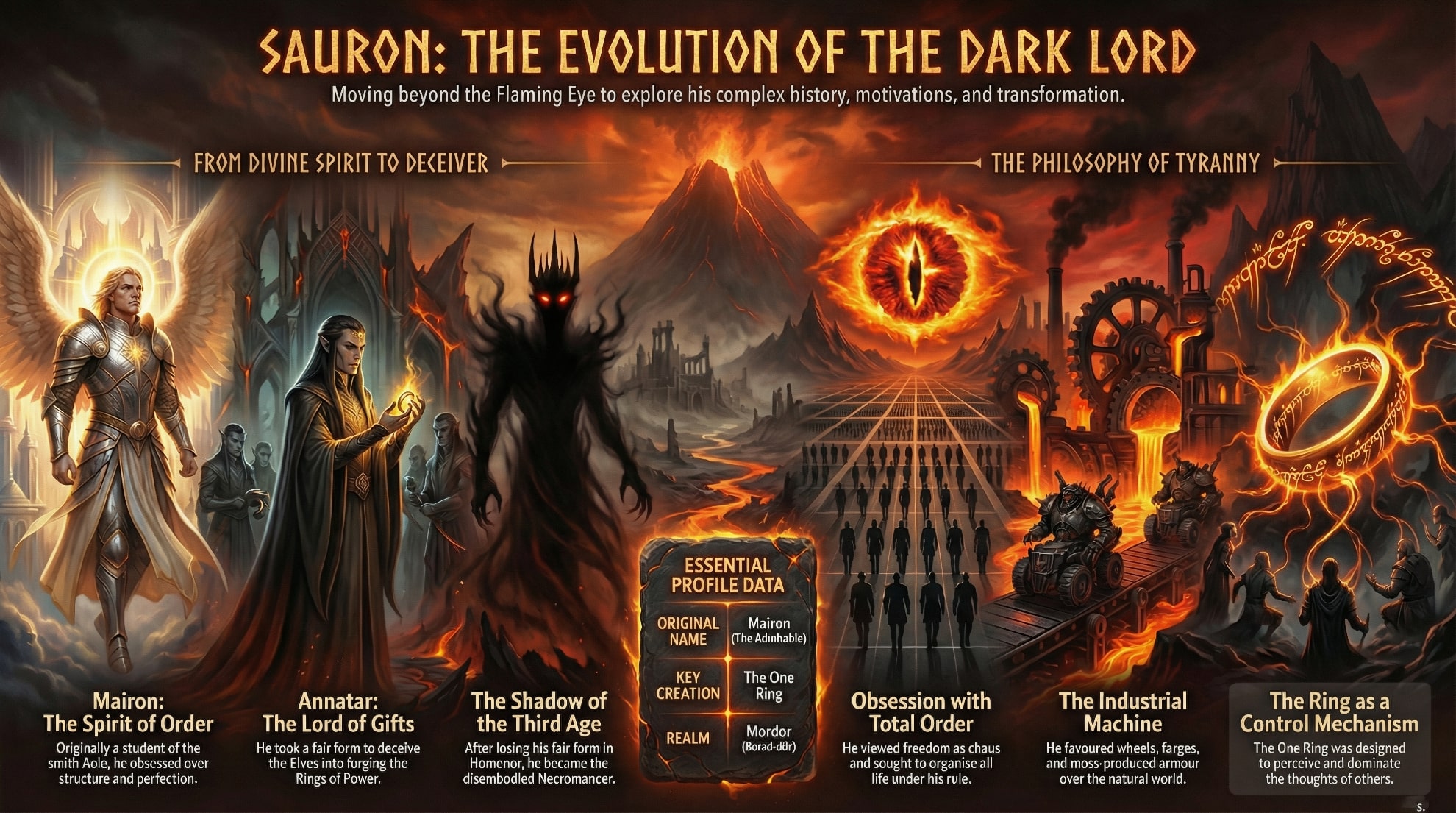
In the beginning, he was beautiful. He was the most gifted craftsman among the Maiar. He loved order, precision, and the satisfaction of things that worked. He was, as Tolkien put it, the kind of spirit who genuinely believed that the world would be better — more efficient, more beautiful, more fully realised — if it were properly organised. Under one will. His.
Understanding how Mairon became Sauron is understanding the deepest thing Tolkien believed about the nature of evil: that it does not come from nothing. It comes from something real, twisted almost beyond recognition.
Origins — Mairon, Student of Aulë
Before his fall, Sauron was known as Mairon — the Admirable. He was among the greatest of the Maiar, the second order of divine spirits who assisted the Valar in shaping the world. His allegiance was to Aulë the Smith — the Vala of craft, stone, metal, and making. The same divine craftsman who, in an act of passionate impatience, created the Dwarves before the Elves had awakened. Mairon shared his master's nature: a love of making, of structure, of the satisfaction that comes from a thing being precisely and permanently right.
This is why his corruption is so instructive. It was not desire for destruction that undid him — it was an excess of the same impulse that makes a craftsman great. He wanted order. He wanted precision. He wanted the world to work properly, without waste or friction or the maddening unpredictability of free will. And in Morgoth — the most powerful of all the Valar, who had turned against the Music of Ilúvatar and decided to impose his own order on creation — Mairon saw a means to that end. He defected.
He was, from the very beginning, the most capable of Morgoth's lieutenants. Not the most powerful in raw terms — Gothmog the Balrog held that title — but the most effective. Where Morgoth raged and destroyed, Mairon planned and built. He ran the logistics of Angband. He managed the breeding of Orcs and the forging of weapons. He was, in the most precise sense, the administrator of evil — the one who made Morgoth's destruction function as a system.
The First Age — Werewolf Lord and Deceiver
Sauron's most significant role in the First Age was the holding of Tol-in-Gaurhoth — the Isle of Werewolves — a fortress on an island in the River Sirion. It was here, in the tale of Beren and Lúthien, that Sauron first encountered the limits of his power.
He captured Beren and his companions and threw them into a pit, killing them one by one to feed his werewolves. But Lúthien — the daughter of the Maia Melian and the Elven-king Thingol, the most powerful half-divine being then walking in Middle-earth — came for Beren. She faced Sauron in a contest of power and defeated him. He was forced to yield the island and fled, reduced to wolf form, hiding in shame from the name he had earned.
After Morgoth's defeat at the War of Wrath — when the combined power of Valinor was brought to bear at the end of the First Age and Morgoth was cast into the Void — Sauron hid. He was not destroyed. He was not even significantly weakened. He simply withdrew, and he waited, and he thought about what to do next.
Annatar — The Lord of Gifts
In the Second Age, Sauron made his most audacious move. He disguised himself completely — took on a form of extraordinary beauty and wisdom — and presented himself to the Elves of Eregion as Annatar: the Lord of Gifts, an emissary of the Valar come to help them preserve the beauty of Middle-earth. He said the Valar had sent him. He said he bore their authority. He said he had knowledge of ring-craft that could help the Elves maintain the grace of their world against the slow entropy of time.
Galadriel and Elrond distrusted him immediately and refused to receive him. Gil-galad, the High King of the Noldor, was suspicious. But Celebrimbor — grandson of Fëanor, the greatest Elvish craftsman of the age — welcomed him. And together, in Eregion, they made the Rings of Power.
What Sauron understood, which Celebrimbor did not, was that every ring made in Eregion under Sauron's instruction would be subtly connected to the maker's will — and Sauron was planning to make a ring that would govern all of them. The Three Elven Rings that Celebrimbor made in secret, without Sauron's direct hand, were the only ones that escaped this trap. The Nine given to the kings of Men, and the Seven given to the Dwarf-lords, were all part of Sauron's design from the beginning.
When Sauron put on the One Ring and spoke his words of dominion, the Elves felt it immediately. They removed their rings at once. The deception was over. Sauron dropped the Annatar disguise and went to war.
The Forging of the One Ring
Tolkien's description of what Sauron did to create the One Ring is one of the most chilling things in the entire legendarium: he took a significant portion of his own essential being — his native power, his will, his capacity to create and to dominate — and poured it into the metal. The Ring was not merely an instrument he wielded. It was, in a real sense, an extension of his self. As long as it existed, his spirit could not be entirely extinguished. As long as it existed, his power could be restored.
This is also why its destruction was so catastrophic for him. When Gollum fell into the Cracks of Doom, Sauron did not merely lose a weapon. He lost the part of himself he had invested in the Ring across three thousand years. He was reduced, as Gandalf described, to "a mere spirit of malice that gnaws itself in the shadows" — unable to take form, unable to rebuild, permanently diminished beyond recovery.
The inscription Sauron put on the Ring — in the Black Speech he had devised as a language of command — was the binding spell: "One Ring to rule them all, One Ring to find them, One Ring to bring them all and in the darkness bind them." It was not a boast. It was a technical description of the Ring's function.
The Downfall of Númenor — His Greatest Deception
Númenor was the greatest kingdom of Men in the history of Middle-earth — an island continent in the western sea, given to the Dúnedain as a reward for their service against Morgoth. Its people were tall, long-lived, skilled in craft and seamanship, and increasingly obsessed with the one thing they could not have: immortality. The Elves had it. The Valar had it. The Númenóreans, who could see the western sky from their highest peak on clear days, were forbidden from sailing to Valinor.
Sauron allowed himself to be captured by Ar-Pharazôn, the King of Númenor. He came as a prisoner. Within three years he was the King's chief advisor. Within a generation he had introduced the worship of Morgoth — positioning the first Dark Lord as a god of power who rewarded his servants with eternal life. He convinced Ar-Pharazôn to build a fleet and sail against Valinor itself, to seize immortality by force.
Eru Ilúvatar — the One Creator — intervened directly. He sank Númenor beneath the sea. He changed the shape of the world so that Valinor was removed from the physical realm entirely and could only be reached by the Straight Road available to the Elves. Sauron's physical body was destroyed in the cataclysm. His spirit survived, but he had permanently lost the ability to take a form that appeared fair or beautiful. Every shape he wore from that point forward would carry the mark of his corruption.
He had destroyed the greatest human civilisation in history. And he had done it without an army — purely through manipulation, patience, and the exploitation of a desire he had spent decades cultivating.
The Necromancer — The Long Patience of Dol Guldur
After the Last Alliance of Elves and Men defeated him at the end of the Second Age — after Isildur cut the Ring from his hand and his physical form collapsed — Sauron's spirit fled east and lay dormant for over a thousand years. He rebuilt himself slowly, carefully, in shadow.
He took up residence in Dol Guldur — the Hill of Sorcery, a fortress in the southern reaches of Mirkwood — disguised as a sorcerer of dark power known only as the Necromancer. He was there for centuries. He corrupted the forest. He gathered the Nazgûl. He corrupted Saruman through the Palantír. He sent emissaries to find Gollum. He laid the groundwork for everything.
Gandalf suspected the Necromancer was Sauron and urged the White Council to act. Saruman, who was secretly searching for the One Ring himself and did not want Sauron disturbed, delayed for decades. When the Council finally drove the Necromancer from Dol Guldur, Saruman knew — and did not tell the Council — that Sauron had already found what he was looking for. He had always intended to be driven out. He was ready to return to Mordor openly.
Sauron's Philosophy — What He Actually Wanted
Tolkien was careful to distinguish Sauron from Morgoth in a way that most film adaptations flatten. Morgoth was a nihilist — he wanted to unmake creation because he could not bear that it existed outside his control. He hated beauty because he could not create it. He destroyed for the satisfaction of destruction.
Sauron was different. Sauron wanted to rule creation, not destroy it. He believed — genuinely, in a way that made him more dangerous than a simple tyrant — that the world would be better under his control. More efficient. More organised. More free of the waste and conflict that came from too many wills pulling in too many directions. He saw the Valar as absentee landlords who had given Middle-earth rules without enforcement. He was going to enforce them.
Tolkien described this in his letters as the corruption that comes from a start in Aulë's service — a craftsman's love of making things work, taken to its logical and terrible conclusion. Sauron's evil was the evil of the administrator who believes that the suffering caused by the imposition of order is worth it. The evil of the person who loves order more than the people order is supposed to serve.
His blind spot was identical to his governing philosophy: he could not imagine that anyone else would choose differently. He could not conceive of a person who, holding the Ring, would choose to destroy it rather than use it. The idea that two hobbits would walk into Mordor to throw power away was, to him, literally unthinkable. That unthinkability was the only gap in his defence — and it was enough.
The One Ring — Made in New Zealand
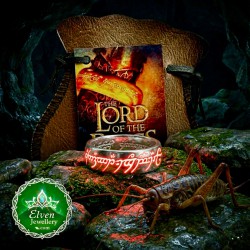
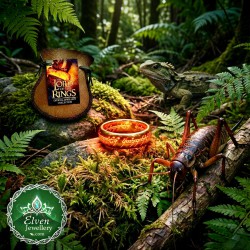
Sauron poured himself into the One Ring at Mount Doom — the anchor of his power and the instrument of his eventual destruction. The official One Ring collection at lotrjewelry.com is made in New Zealand, by the New Line Productions licence holders, in the country where Mount Doom itself was filmed. Solid 925 sterling silver or solid gold, custom-made to your exact size.
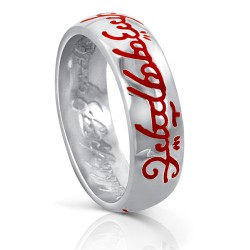
One Ring — Sterling Silver
The precision engraved One Ring in solid 925 sterling silver. Comfort Curve profile, custom-made to your exact size. The ring Sauron forged, Isildur took, Gollum kept, Bilbo found, and Frodo carried to the fires of Mount Doom. Made in New Zealand.
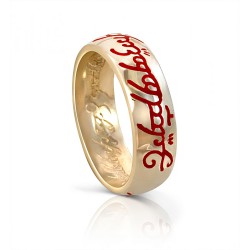
Shop One Ring Silver →One Ring — Gold
Solid 9ct or 18ct gold — as Tolkien described it: "a ring of fine gold." The One Ring as Sauron forged it, in the metal he chose. Custom-made in New Zealand by the New Line Productions licence holders. The definitive version of the most famous ring in literature.
Shop One Ring Gold →One Ring — UV Fire Script
Sterling silver with red UV-reactive resin — the inscription glows as if written in fire under UV light. The Ring as Gandalf saw it in Frodo's hearth: "The letters are Elvish, of an ancient mode, but the language is that of Mordor." Custom-made to size.
Shop UV Fire Script →Frequently Asked Questions About Sauron
Who is Sauron in Lord of the Rings?
Sauron is the primary antagonist of J.R.R. Tolkien's The Lord of the Rings — the Dark Lord whose Ring of Power drives the entire story. He is a Maia: a divine spirit of the same fundamental nature as Gandalf and the Balrogs. Originally known as Mairon, he was a gifted craftsman in the service of Aulë the Smith before defecting to Morgoth in the First Age. His power was inextricably linked to the One Ring he forged in the Second Age, and its destruction at the Cracks of Doom ended his capacity to ever threaten Middle-earth again.
Was Sauron once good?
Yes. In Tolkien's cosmology, nothing is created evil — evil is a corruption of something that began good. Sauron began as Mairon, a spirit of extraordinary craft and intelligence devoted to order and perfection. His fall came from his belief that order was worth imposing by force — that the ends of a well-organised world justified the means of absolute domination. He chose to serve Morgoth because Morgoth offered the power to achieve that order. The corruption was real and eventually total, but it began with something genuine: a craftsman's love of things working properly.
What was Sauron's original name?
Sauron's original name was Mairon — meaning "the Admirable" in Quenya. The name Sauron is a Sindarin Elvish word meaning roughly "the Abhorred" or "the Detestable" — a name given to him by his enemies after his corruption became known. He also went by Gorthaur among the Sindar, meaning "Dread Abomination." During his disguise in the Second Age he called himself Annatar, "Lord of Gifts." In the Third Age, before his return to Mordor, he was known as the Necromancer of Dol Guldur.
Why did Sauron take the form of an Eye?
By the time of The Lord of the Rings, Sauron had lost the ability to take physical form. He had spent so much of his essential power in the One Ring, and been further weakened by the destruction of Númenor and his defeat at the end of the Second Age, that he could no longer embody himself as he once could. The Eye — his heraldry and his chosen symbol of surveillance and dominion — became his effective presence in the world. In Tolkien's books, the Eye is somewhat more metaphorical than in Jackson's films; Tolkien notes that Sauron did have a physical hand in the Third Age (Gollum described seeing it), but the Eye is the dominant image of his presence and will.
How did Sauron destroy Númenor?
Sauron did not destroy Númenor directly — he manipulated its king into destroying it. He allowed himself to be captured by Ar-Pharazôn, became the king's chief advisor through charm and persuasion, introduced the worship of Morgoth, and eventually convinced the king to build a fleet and sail against Valinor to seize immortality by force. Eru Ilúvatar intervened directly — sinking the island, removing Valinor from the physical world, and destroying Sauron's physical body in the cataclysm. It was the greatest single act of manipulation in the history of Middle-earth, achieved without a weapon.
What is the difference between Sauron and Morgoth?
Morgoth — the first Dark Lord — was a nihilist who wanted to unmake creation. He destroyed beauty because he could not bear that it existed independently of his will. Sauron wanted to rule creation, not destroy it. He believed the world would be more orderly, more efficient, and ultimately better under his absolute control. Where Morgoth was motivated by spite and the desire to ruin, Sauron was motivated by the craftsman's desire for everything to work as it should — under one will, his. This made him, in many ways, more dangerous: he could offer things, build things, and persuade people, where Morgoth only ever threatened and broke.
Why didn't Sauron foresee the Ring's destruction?
Because it was literally unthinkable to him. His entire philosophy was built on the assumption that power, once possessed, would be used — that no rational being would choose to destroy something as powerful as the One Ring rather than wield it. He could not imagine a motivation that wasn't, at root, the desire for dominion. The idea of walking into the heart of Mordor specifically to throw power away was so contrary to his nature that he never genuinely considered it as a threat. This blind spot — identical to his greatest strength — was the only gap in his defence, and two hobbits walked through it.
What happened to Sauron after the Ring was destroyed?
When the One Ring was destroyed at the Cracks of Doom on March 25, TA 3019, Sauron's power collapsed instantaneously. The part of his essential being he had poured into the Ring was annihilated with it. His tower fell. His armies crumbled. His Nazgûl were consumed. His spirit survived but was permanently diminished — reduced, as Gandalf had predicted, to "a mere spirit of malice that gnaws itself in the shadows, but cannot again grow or take shape." He could never rebuild. He could never threaten Middle-earth again. The Third Age ended with his final defeat.
Sources & Further Reading
- The Silmarillion — 'Valaquenta' (Sauron's origins), 'Of the Rings of Power and the Third Age' (deception of the Elves, One Ring), and 'Akallabêth' (destruction of Númenor)
- The Lord of the Rings — The Fellowship of the Ring — 'The Council of Elrond' — Elrond's account of the Last Alliance
- Unfinished Tales, ed. Christopher Tolkien — 'The History of Galadriel and Celeborn' and 'The Hunt for the Ring'
- The Letters of J.R.R. Tolkien, ed. Humphrey Carpenter — Letters 131 and 183 — Tolkien's explanations of Sauron's nature and his relationship to Morgoth
- Tolkien Gateway — tolkiengateway.net
The Lord of the Rings: The Complete Guide to Sauron Video
Related Products