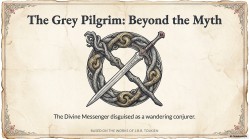
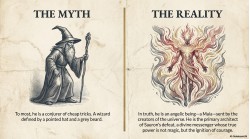
Gandalf — known to the Elves as Mithrandir, the Grey Pilgrim — was not a human wizard who had learned magic. He was Olórin, a Maia: an angelic spirit who had existed since before the world was made, dwelling in Valinor in the company of the divine. He came to Middle-earth around the year TA 1000 as one of five emissaries sent by the Valar to help the free peoples resist the returning shadow of Sauron. He was forbidden from matching Sauron's power with force. His task was to kindle courage in cold hearts — and it was the most important task ever given to anyone in the Third Age.
There is a moment in The Fellowship of the Ring that Tolkien never quite explains and never needs to. The Balrog of Moria stands on the Bridge of Khazad-dûm — a demon of shadow and fire from the First Age, ancient beyond counting, a being of Morgoth's own kindling. The Fellowship is behind Gandalf. The abyss is below. Gandalf turns to face it and says, in a voice that carries to the roof of the cavern: "You shall not pass."
It is not a statement of strategy. It is not a bluff. It is Olórin, a divine spirit who has walked the earth disguised as a tired old man for three thousand years, finally speaking as what he actually is. The Balrog knows it immediately. So does every reader.
This is the guide to who he actually was, and what he actually did.
Who Was Gandalf? — Olórin of the Maiar
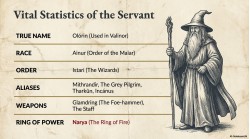
Before he was Gandalf, he was Olórin. The Maiar were the second order of divine beings in Tolkien's cosmology — below the Valar, the great powers who shaped the world under the direction of Ilúvatar, but still angelic spirits of extraordinary capability. Sauron was a Maia. The Balrogs were Maiar. Gandalf was a Maia. He and Sauron were, in the most literal sense, of the same fundamental nature — except that where Sauron had given his will over to Morgoth in the First Age and never recovered it, Olórin had remained faithful, spending his existence in compassion and wisdom.
Tolkien tells us that Olórin dwelt especially with Nienna, the Vala of grief and pity — the one divine figure whose entire nature was mourning and mercy. From her, he learned patience, and from patience, he learned that pity was often a more powerful force than swords. He was known among the Maiar as the wisest and the most subtle in understanding, but also the most hidden in his nature. He did not boast. He did not command. He moved quietly, and he waited.
He went by many names across Middle-earth's peoples. The Elves called him Mithrandir — the Grey Pilgrim. The Dwarves called him Tharkûn. The Men of the South knew him as Incánus. In the Shire, which he loved and visited often long before the story began, he was simply Gandalf — a name from the Old Norse, meaning something like "staff-elf" in Tolkien's etymological imagination. It was the plainest of his names and, in the end, the one that lasted.
Why the Wizards Were Sent — and What They Were Forbidden to Do
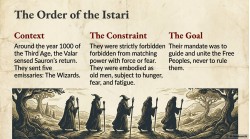
Around TA 1000, the Valar perceived that Sauron was stirring again. The Last Alliance had broken his physical form in SA 3441, but had not destroyed his capacity to return. Something had to be done before he gathered his full strength.
The Valar's answer was not to send armies from Valinor, or to use their own power directly. They had done something like that before, in the War of Wrath at the end of the First Age, and the collateral destruction had been catastrophic — entire regions of Middle-earth were drowned or devastated. This time they would send five emissaries: Maia spirits embodied as old men, limited by their bodies to hunger, weariness, and mortality, forbidden from matching Sauron's power with equivalent force, and instructed instead to encourage, advise, and unite the free peoples in their own resistance.
This limitation was not a weakness in the plan. It was the plan. The Valar had learned that intervening directly created dependency. What Middle-earth needed was not rescue — it needed to find its own strength. The wizards were there to kindle that strength, not to replace it.
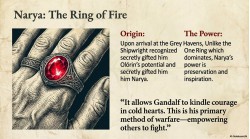
Gandalf was the last to agree to go. He was, Tolkien implies, somewhat afraid — afraid of Sauron, afraid of failing, afraid of being diminished by the journey into a mortal body. He went anyway. And at the Grey Havens, Círdan the Shipwright met him on the dock and gave him Narya — the Ring of Fire, one of the Three Elven Rings — telling him: "For this is the Ring of Fire, and with it you may rekindle hearts in a world that grows chill."
The Quest of Erebor — The Masterstroke Nobody Noticed
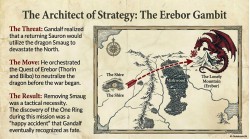
Long before the events of The Lord of the Rings, Gandalf was already working. His orchestration of the Quest of Erebor — the journey told in The Hobbit — was one of the most consequential pieces of strategic thinking in the history of the Third Age, and almost nobody understood what he was really doing.
The stated purpose of the quest was for Thorin Oakenshield's company to reclaim Erebor from Smaug. But Gandalf's actual concern was different. He had learned that Sauron, rebuilding in Dol Guldur, might find a way to use Smaug — the most powerful creature alive in the North — as a weapon. A dragon of Smaug's size and fire, directed by Sauron's will, could lay waste to Rivendell, destroy the Dwarven kingdoms, and break the defences of the free peoples before they had any chance to organise. Smaug had to die.
Gandalf could not kill Smaug himself. He had to arrange for it to happen indirectly. So he engineered a meeting between Thorin Oakenshield and a hobbit named Bilbo Baggins, pressed the case until Thorin agreed, and sent them off on what everyone else thought was a commercial venture to reclaim gold. Smaug died. The North was secured. And in the tunnels under the Misty Mountains, Bilbo found something entirely unforeseen — a small golden ring — which Gandalf eventually recognised as the most dangerous object in the world.
The Quest of Erebor was not a success because Gandalf planned perfectly. It was a success because Gandalf understood the shape of events well enough to create the conditions in which Providence could work. That is what made him different from every other player in the game.
The Bridge of Khazad-dûm — Death and Return
Durin's Bane — the Balrog that had driven the Dwarves from Moria centuries before — was not a monster in the ordinary sense. It was a Maia corrupted by Morgoth in the First Age: one of the ancient spirits of fire and shadow that had served the original Dark Lord in the wars before the world was properly made. It was, in terms of fundamental nature, the same kind of being as Gandalf. They were both Maiar. The difference was entirely in what they had chosen to become.
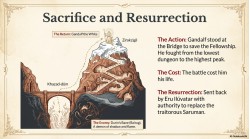
Tolkien describes the battle between Gandalf and the Balrog — which began on the Bridge of Khazad-dûm and continued for days, from the lowest dungeon to the peak of Zirakzigil — as a clash of divine powers expressed through embodied forms. They fought in fire and water and finally in lightning on the mountaintop. Gandalf threw down his enemy, and the Balrog broke the mountainside as it fell. Then Gandalf died. The effort had cost him his life in the mortal body he had been given.
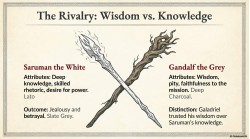
But his task was not finished. Tolkien understood this as the intervention of Eru Ilúvatar — the One Creator — who sent Gandalf back. He had been given, in effect, a resurrection: returned with greater authority, greater power, and a white raiment that replaced the grey. He came back as Gandalf the White, bearing the authority that had once belonged to Saruman, who had long since turned to treachery and self-interest.
"I am Gandalf the White. And I come back to you now — at the turn of the tide."
Gandalf the White — The Last Campaign
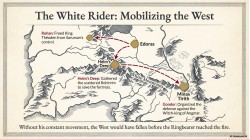
In his final phase, Gandalf operated at full authority. He freed Théoden of Rohan from Saruman's psychological control — a subtle domination worked through Wormtongue that had been slowly draining the king's will for years. He organised the defences at Helm's Deep. He rode to Minas Tirith and effectively commanded its defence against the armies of Mordor when Denethor, the Steward, had collapsed into despair and madness. He confronted the Witch-king of Angmar, Lord of the Nazgûl, at the gates of Minas Tirith — and might have faced him down entirely had the Rohirrim not arrived in that same moment.
He also understood something that no one else in the story fully grasped: that winning the war on the battlefield was insufficient. If Frodo did not reach Mount Doom and destroy the Ring, every victory of arms was temporary. The war had to be won twice — once on the Pelennor Fields and once in the Cracks of Doom. And only one of those victories could be won with swords.
His strategic master-stroke was the march to the Black Gate — Aragorn leading the combined armies of the West to challenge Sauron at the very doors of Mordor. It was not an attack they could win militarily. It was a deception: a way to draw Sauron's attention entirely toward the armies on his doorstep, so that his Eye would not sweep toward the two small figures in the shadow of Mount Doom. It worked. The Ring was destroyed. The Eye looked up from its armies too late.
Gandalf and Pity — The Philosophy That Saved the World
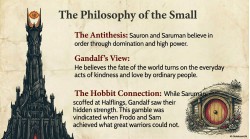
The deepest thing about Gandalf is not his power. It is what he chose to do with it — and specifically, the quality of mercy that runs through every major decision he makes in the story.
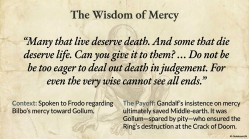
When Frodo expressed a wish that Bilbo had killed Gollum in the tunnels, Gandalf replied: "Many that live deserve death. And some that die deserve life. Can you give it to them? Then do not be too eager to deal out death in judgment, for even the very wise cannot see all ends."
This was not sentiment. It was a strategy of the deepest kind. Gandalf had watched Gollum for years, had tracked and caught and questioned him. He had looked at this ruined creature — who had possessed the Ring for five centuries, who had murdered his own friend for it, who had lost everything to the obsession — and had declined to eliminate him simply. He saw that even the most broken lives might contain some purpose not yet revealed.
He was right. Gollum's presence at the Cracks of Doom — alive, because Frodo had spared him, because Gandalf had encouraged that mercy — was the mechanism by which the Ring was finally destroyed. Frodo's will failed at the last moment. It was Gollum who bit the Ring free and fell with it into the fire. If Gollum had died anywhere along the road, the Ring would never have been destroyed. Middle-earth would have fallen.
The world was saved by an act of pity toward a creature who seemed to deserve none. Gandalf understood this was always possible. It is why he was the right being for the mission.
The Sailing West — The End of the Third Age
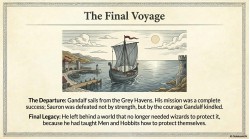
On September 29, TA 3021, at the Grey Havens, Gandalf boarded the last ship to the Undying Lands. With him sailed Frodo Baggins, Bilbo Baggins, Galadriel, Elrond, and Círdan. The Third Age was over. The Elves were departing. The age of Men had begun.
Gandalf's departure was not a retreat. His mission was complete — not merely accomplished but finished, in the sense that there was nothing left for him to do. He had spent three thousand years guiding, encouraging, warning, occasionally scolding, and enduring the frustration of beings far less wise than himself who repeatedly made the same preventable mistakes. He had done it without dominating them, without using his power to compel the outcomes he could see were correct, without ever becoming the thing he was fighting against.
The world he left behind no longer needed a wizard to protect it. That was the measure of his success.
Narya — The Ring of Fire
Círdan gave Narya to Gandalf in secret at the Grey Havens when the wizards first arrived in Middle-earth. He said: "Take this ring, Master, for your labours will be heavy, but it will support you in the weariness that you have taken upon yourself. For this is the Ring of Fire, and with it you may rekindle hearts in a world that grows chill."
Narya was one of the Three Elven Rings — made by Celebrimbor in Eregion without Sauron's direct influence, the greatest of the lesser rings and intended for preservation rather than domination. Gandalf bore it in secret throughout the Third Age. Even Sauron did not know he had it. Only after the One Ring was destroyed — when Narya, like all the Three, lost its power — was it revealed that Gandalf had carried it all along.
Its purpose was exactly what Círdan said: the kindling of courage. Not the creation of courage from nothing, but the rekindling of it in hearts that had grown cold and afraid. That is the most precise description of everything Gandalf did during three thousand years in Middle-earth.
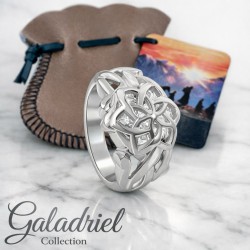
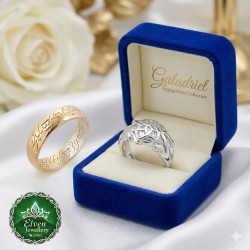
The official jewellery collection includes the Nenya ring — Galadriel's Ring of Water, one of the Three Elven Rings alongside Gandalf's Narya and Elrond's Vilya. The only officially licensed Elven ring of power in sterling silver and white gold, handcrafted in New Zealand by the New Line Productions licence holders.
Frequently Asked Questions About Gandalf
Who is Gandalf in Lord of the Rings?
Gandalf is a wizard — but not in the ordinary sense. He is Olórin, a Maia: an angelic spirit of the same divine order as Sauron and the Balrogs, who came to Middle-earth embodied as an old man around TA 1000. He was one of five Istari (wizards) sent by the Valar to help the free peoples resist Sauron's return. In Peter Jackson's films he was played by Ian McKellen. He bears the Elven Ring of Fire, Narya, secretly given to him by Círdan the Shipwright.
What is Gandalf's real name?
In Valinor, before coming to Middle-earth, Gandalf was known as Olórin. The name Gandalf is an Old Norse name given to him by the Men of the North; it means roughly "staff-elf." The Elves called him Mithrandir (the Grey Pilgrim). The Dwarves called him Tharkûn. The Men of the South knew him as Incánus. Each name reflects what that people saw in him — Gandalf is the plainest and most familiar, which is fitting for the wizard who loved hobbits and the ordinary world.
How did Gandalf come back after dying in Moria?
Gandalf died in his mortal body after his battle with the Balrog Durin's Bane — a battle that began on the Bridge of Khazad-dûm and ended days later on the peak of Zirakzigil. He was sent back by Eru Ilúvatar, the One Creator, because his task was not yet finished. He returned as Gandalf the White, with greater authority, carrying the status and power that had previously belonged to Saruman — who had abandoned his mission in favour of his own ambitions. Tolkien described this as the closest thing in his legendarium to a resurrection.
Why did Gandalf say "you shall not pass"?
The line — "You shall not pass" in the films, "You cannot pass" in the book — was Gandalf confronting the Balrog at the Bridge of Khazad-dûm and refusing to let it follow the Fellowship. He was not bluffing. He was speaking as Olórin, a divine spirit of the same fundamental nature as the Balrog, asserting his authority as a servant of the Secret Fire of Anor. The Balrog was a Maia corrupted by Morgoth. Gandalf was a Maia who had remained faithful. The confrontation was, on a metaphysical level, a clash of what they had each chosen to become.
What ring did Gandalf carry?
Gandalf carried Narya, the Ring of Fire — one of the Three Elven Rings made by Celebrimbor in Eregion. It was given to him in secret by Círdan the Shipwright when the wizards first arrived at the Grey Havens. Círdan told him it would "support him in the weariness he had taken upon himself" and help him "rekindle hearts in a world that grows chill." Gandalf bore it in secret throughout the Third Age. Even Sauron, who knew of the Three Elven Rings, did not know Gandalf had one. It was only revealed after the One Ring was destroyed and all three lost their power.
Why didn't Gandalf use more of his power?
The wizards were sent to Middle-earth under a specific limitation: they were forbidden from matching Sauron's power with equal force or from dominating the free peoples, even in their defence. The Valar had learned that direct intervention created dependency rather than strength. Gandalf's task was to inspire and advise — to kindle courage in others — not to do the work for them. Using his full divine power would have violated the terms of his mission and, more importantly, would have made him the same kind of being as Sauron: a powerful will imposing itself on the world. He was faithful to the restraint his mission required, right to the end.
Did Gandalf know the One Ring would be destroyed when he planned the quest?
No. When Gandalf orchestrated the Quest of Erebor in TA 2941, he did not yet know that Bilbo's ring was the One Ring. He was suspicious of it after the quest — the ring's longevity effect on Bilbo, and the strange way Bilbo had come to possess it, troubled him. It took him seventeen years of research before he finally confirmed its identity by the fire test at Bag End in TA 3018. The discovery of the One Ring through the Quest of Erebor was, as Gandalf later acknowledged, something beyond his planning — an act of Providence that he had not foreseen.
Where did Gandalf go when he sailed West?
Gandalf sailed to Valinor — the Undying Lands, the home of the Valar and the blessed realm beyond the Sea. As a Maia, this was his true home, the place he had come from before embodying as a wizard. His mission complete, he returned — alongside Frodo, Bilbo, Galadriel, Elrond, and Círdan — on the last ship to leave the Grey Havens on September 29, TA 3021. Tolkien intended this as the end of the Third Age and the beginning of the age of Men: Middle-earth's divine guardians departing, leaving the world to its mortal inheritors.
Sources & Further Reading
- The Silmarillion — 'Valaquenta' — Olórin's origins among the Maiar and his association with Nienna
- Unfinished Tales, ed. Christopher Tolkien — 'The Istari' — the wizards' mission, their limitations, and Círdan's gift of Narya to Gandalf
- The Letters of J.R.R. Tolkien, ed. Humphrey Carpenter — Letter 156 — Tolkien's explanation of Gandalf's resurrection and mission
- Tolkien Gateway — tolkiengateway.net
A Complete Guide to Gandalf
 Custom image caption
 Title
Title
 Title
Title
 Title
Title
Related Products