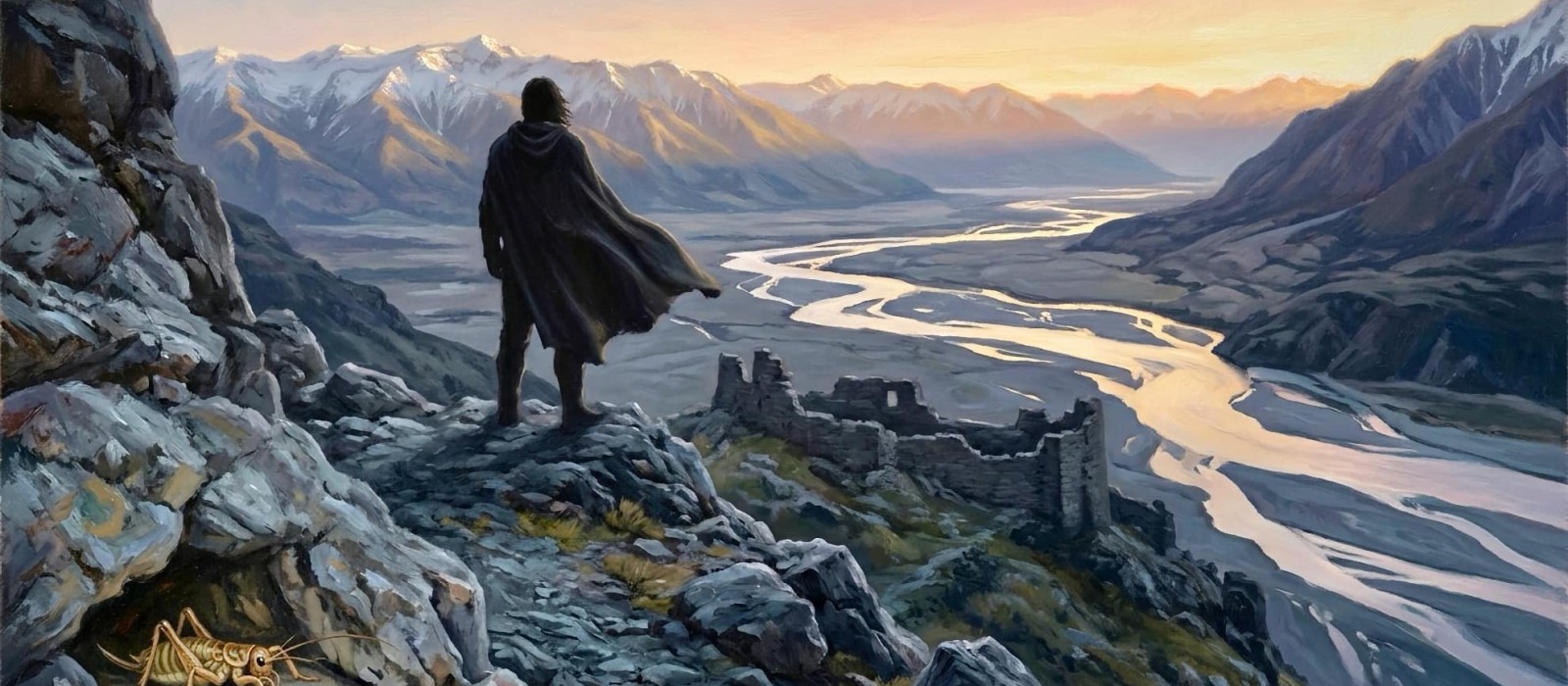
Aragorn II Elessar — known as Strider in Bree, Thorongil in Gondor, and Estel in Rivendell — was the heir of Isildur and the rightful King of Gondor and Arnor. Son of Arathorn II, born in TA 2931, he spent eighty-seven years in preparation for a single moment: the return of the King. He was the greatest huntsman of the Third Age, a healer of the hands of a king, the man who summoned the Army of the Dead and turned the tide of the War of the Ring — and the husband of Arwen Undómiel, who gave up immortality to be with him.
At the Prancing Pony in Bree, on the night Frodo and his companions arrived from the Shire, a weather-beaten man sat alone in the shadows with his hood pulled low. He was smoking a pipe. His boots were worn. His clothes were travel-stained. The barman's description was not encouraging: a Ranger, name of Strider, one of the wandering folk who came and went without explanation. Not entirely to be trusted.
This was Aragorn II, son of Arathorn, thirty-ninth heir of Isildur, direct descendant of Elendil and through him of Númenor, through him of the Half-elven line of Eärendil, carrying in his blood one of the oldest and most royal lineages in the history of the world. He had been in the wild for sixty years. He was eighty-seven years old. He looked about forty.
He had been waiting for this moment, and training for it, his entire adult life. Few characters in literature have had a longer run-up to their destiny — or a more convincing one.
Origins — The Hidden Heir
Aragorn was born on March 1, TA 2931, the only child of Arathorn II and Gilraen. His father was the Chieftain of the Dúnedain — the Rangers of the North, descendants of the Númenóreans who had survived the downfall of their island kingdom and settled in Middle-earth. They were a dwindling people, scattered across the wild lands north of Bree, their kingdoms long since fallen, their heritage preserved in bloodline and deed rather than in stone and gold.
When Aragorn was two years old, his father was killed by Orcs — an arrow through the eye, sudden and final, with no warning. Arathorn was thirty-six. The Rangers were a people who did not live long.
Gilraen took her son to Rivendell. Elrond accepted them. For Aragorn's protection, his identity was hidden — from Sauron's servants who would have killed him instantly, and even from Aragorn himself until the time was right. He was raised as Estel — Hope, in Sindarin — as the foster son of Elrond, brother to Elrohir and Elladan, student in the house of the wisest Elf-lord remaining in Middle-earth. He had the best education available in the Third Age, learning history, lore, warfare, and the languages of Men, Elves, and Dwarves. He knew nothing of his true name or destiny.
On his twentieth birthday, Elrond told him. He gave him the Shards of Narsil — the sword broken by Elendil's fall, with which Isildur had cut the Ring from Sauron's hand — and the Ring of Barahir, the ancient silver ring of two serpents that had been an heirloom of his house since the First Age. And he told him who he was: Aragorn, son of Arathorn, Chief of the Dúnedain, Heir of Isildur, the man with the best claim to the throne of Gondor in the history of the Third Age.
He met Arwen the same day, walking in the birch woods of Rivendell, and fell in love with her immediately — calling out "Tinúviel! Tinúviel!" because in the evening light among the silver trees he thought he had seen Lúthien come again. He had not. But he had seen the woman he would spend the next sixty-seven years trying to be worthy of.
The Long Preparation — Sixty Years in the Wild
A lesser character in a lesser story would have gone straight from the revelation of his heritage to the claiming of his throne. Aragorn went into the wilderness for sixty years.
He served as a Ranger of the North — one of the scattered Dúnedain who patrolled the empty lands between the Shire and Bree, protecting the peaceful hobbits from threats they never knew existed. He fought Orcs in the hills and Wargs on the plains. He guarded roads that no one thanked him for guarding. He was poor, weather-beaten, and largely unknown.
He also travelled. He served in the army of King Thengel of Rohan under the name Thorongil — the Eagle of the Star — where he earned a reputation as one of the finest soldiers in the kingdom. He served in Gondor under Steward Ecthelion II and led a naval raid on the Corsairs of Umbar that destroyed their fleet, then vanished before anyone could work out who he really was. He travelled far into the East and South, learning the world that he would one day need to lead.
He hunted Gollum. Gandalf, growing increasingly certain that the ring in Bag End was the One Ring, needed to confirm Gollum's knowledge of it — and needed Gollum found before Sauron's servants did. He sent Aragorn. The hunt lasted years, ranging across the Dead Marshes and the lands near Mordor. Aragorn caught Gollum near the Gladden Fields and delivered him to the Elves of Mirkwood. It was one of the most demanding feats of tracking and endurance in the Third Age, accomplished alone, in the wild, with no recognition.
All of this — every cold night in the wilderness, every unnamed battle, every thankless mile — was preparation. Aragorn was not waiting for his destiny. He was building the person his destiny required.
Elrond's Condition — The Price of Arwen
The arrangement Elrond imposed on Aragorn and Arwen was not cruelty. It was, from Elrond's perspective, the only honest position available to him. He loved his daughter. He knew that if she chose mortality for a man who then failed — who died obscure, never reclaiming his kingdom, never fulfilling his potential — she would have given up immortality for nothing. He told Aragorn: "Arwen Undómiel shall not diminish her life's grace for less cause. She shall not be the bride of any Man less than the King of both Gondor and Arnor."
And then, in the most bittersweet thing Elrond ever said: "To me then even our victory can bring only sorrow and parting — but to you hope of joy for a while. Alas, my son! I fear that to Arwen the Doom of Men may seem hard at the ending."
He was right on every count. Their victory did bring him sorrow. Aragorn and Arwen did have joy, for 122 years. And when Aragorn died at the age of 210, choosing his death before age stripped him of dignity, Arwen found the Doom of Men harder than she had imagined. She died the following year on Cerin Amroth, alone, in the empty forest where Galadriel's magic had faded.
Aragorn's entire adult life was shaped by that condition. Not bitterly — he understood it and accepted it — but it gave everything he did a double urgency. He was not merely trying to become king for the sake of Middle-earth. He was trying to become worthy of the woman who was, as Tolkien wrote, "the fairest of the Children of Ilúvatar in the Third Age."
Andúril — The Flame of the West
Narsil was the sword of Elendil, King of Arnor and Gondor in the Second Age — the sword that broke when Elendil fell in battle with Sauron, whose shards Isildur then used to cut the Ring from Sauron's hand. It had been kept in Rivendell ever since, a broken blade, waiting.
The Elven smiths of Rivendell reforged it before the Fellowship left — hammering the shards into a new blade, etching it with the sun and moon and the runes of Gondor, naming it Andúril: Flame of the West. When Aragorn drew it, it caught light along its entire length.
The sword was not merely a weapon. It was a statement — the announcement that the line of Kings had not ended, that the heir had come, that the long interregnum of the Stewards of Gondor was drawing to its close. In the books, Aragorn used its display strategically: showing it to Éomer on the plains of Rohan when he needed to establish his authority, revealing it to the Dead Men of Dunharrow as proof of his right to summon them. Every time he drew Andúril, he was making a political argument as much as a military one.
The Paths of the Dead — The Greatest Gamble of the War
The decision to take the Paths of the Dead was, by any military calculation, insane. The pass through the White Mountains was haunted by the spirits of Men who had broken their oath to Isildur three thousand years before and been condemned to walk in the shadow until they fulfilled it. They were terrifying — not merely frightening, but productive of a supernatural dread that broke the courage of trained soldiers. No one had used that path in living memory. No one had dared.
Aragorn dared because he had no choice. The armies available to him were insufficient. Minas Tirith was going to fall before reinforcements could arrive by any conventional route. He had the one thing that gave him access to the Oathbreakers: the sword of Elendil, and Isildur's blood, and the right to summon them.
Gimli recorded afterwards that he experienced fear unlike anything in his long life. Legolas, who feared almost nothing, was subdued. Aragorn walked first and did not look back.
He released the Dead after Pelargir — where they had driven the Corsair fleet from the docks and enabled him to commandeer the ships. They had fulfilled their oath. He let them go. Then he sailed up the Anduin with an army of the living — the men of southern Gondor — and arrived at the Battle of the Pelennor Fields as the black sails came around the bend of the river. Everyone watching thought they were Corsair reinforcements. Then Aragorn unfurled the banner Arwen had made — the White Tree and the Seven Stars in mithril and gems on black cloth — and the enemy faltered.
The Hands of the King — Healer
One of the most important things Tolkien establishes about Aragorn is something the films give relatively little space to: he is a healer. Not metaphorically — practically, with his hands, using kingsfoil (athelas) and ancient lore. The saying among the people of Gondor was: "The hands of the king are the hands of a healer."
After the Battle of the Pelennor Fields, Aragorn walked through the Houses of Healing and tended to Faramir, Éowyn, and Merry — all three of whom had been struck by the Black Breath of the Nazgûl and were dying. He used athelas, a herb considered of little value by those who had forgotten its proper use, and by touch and breath and calling of their names, drew them back from the shadow.
Tolkien intended this as one of the proofs of Aragorn's kingship — not the sword and the battle, but the healing. The line of Númenórean kings had always been characterised by this gift. It was the sign of legitimate royal authority that mattered most to Tolkien, and it is the one most easily overlooked in a story full of armies and dark towers and flaming eyes.
King Elessar — The Fourth Age
Aragorn was crowned King Elessar — Elfstone — on May 1, TA 3019. He took the name Telcontar as his royal house name: Strider, in the High-Elven tongue. He was choosing to be remembered as what he had been in the wilderness, not what he had come from. The man who had walked the wild lands unnamed for sixty years named his royal house after it.
He married Arwen on Midsummer's Day of the same year. They ruled together for 122 years. He replanted the White Tree of Gondor — a sapling found by Gandalf on the slopes of Mindolluin above Minas Tirith, a descendant of the original Tree of Númenor. He reunified the kingdoms of Arnor and Gondor. He rebuilt Annúminas as the northern capital. He was the last great king of the line of Elendil, and under his reign the Fourth Age began well.
He died on March 1, FA 120 — his birthday, at the age of 210 — choosing his death before age stripped him of himself, as the kings of Númenor had once had the right to do. He called it the Gift of Ilúvatar: "A long while I have been the master of my fate, but now I must accept my end." He died in the House of Kings, on the bed of Rath Dínen, looking at last like the high king he had always been.
Arwen, who had not believed the ending would be as hard as it was, said goodbye. She was alone, then, in a world that had no more use for immortal Elves. She went back to Lothlórien and lay down on Cerin Amroth. The last great love story of Middle-earth closed quietly, in an empty forest, on a green hill, with elanor flowers blooming around her.
The Official Arwen Evenstar — Made in New Zealand
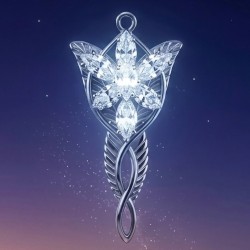
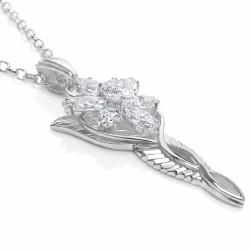
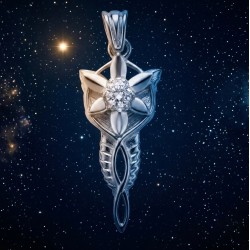
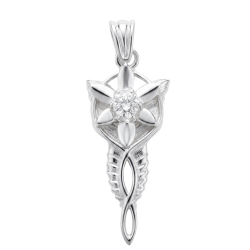
Arwen gave Aragorn the Evenstar — the pendant that bore the symbol of her love and her willingness to choose mortality — in Peter Jackson's films. In Tolkien's books the equivalent gift was the Elfstone, the green gem that gave Aragorn his royal name. In both versions, it was the object that represented everything Aragorn's long years in the wilderness were working toward: the woman who had chosen him, and whose choice he was trying to be worthy of.
The official Evenstar pendant is the most gifted piece of Lord of the Rings jewellery in the world. Made in New Zealand by the New Line Productions licence holders, in solid 925 sterling silver with claw-set stones. The most romantic object in the trilogy, available in CZ, genuine amethyst, and genuine blue topaz.
Arwen Evenstar — Classic CZ
The full-size official Evenstar in solid 925 sterling silver with claw-set CZ stones. 11.3g, 6cm × 2.5cm, 45cm Belcher chain. The piece Arwen gave to Aragorn. Leather Hobbit pouch and Licence of Authenticity. Made in New Zealand.
Shop Evenstar →Evenstar — Genuine Amethyst
The Evenstar with a genuine pear-cut amethyst at the centre — the only officially licensed Evenstar with a real gemstone. For someone who deserves the richest version of the most romantic piece of jewellery in Middle-earth. Made in New Zealand.
Shop Amethyst Evenstar →One Ring — The Wedding Band
The only official Lord of the Rings wedding band — solid gold, Black Speech inscription on the inside, Comfort Curve. For the couple who want their rings to mean what Aragorn and Arwen's meant. Made in New Zealand. The ring to rule all wedding rings.
Shop Wedding Band →Frequently Asked Questions About Aragorn
Who is Aragorn in Lord of the Rings?
Aragorn II, son of Arathorn, is the rightful King of Gondor and Arnor — the last in the line of Isildur and the heir of the ancient Númenórean kings of Middle-earth. He spent sixty years as a Ranger of the North, hiding his identity while guarding the Shire and the northern lands from threats the hobbits never knew existed. During the War of the Ring he led the Fellowship after Gandalf's fall, commanded the assault through the Paths of the Dead, and was crowned King Elessar in TA 3019. In Peter Jackson's films he is portrayed by Viggo Mortensen.
Why was Aragorn called Strider?
Strider was the name given to Aragorn by the people of Bree — a nickname for the long-legged Rangers who strode through the wilderness on their patrols. Aragorn used it as a working name during his decades as a Ranger, when he was deliberately keeping his true identity hidden. He embraced it so completely that when he took his royal house name after his coronation, he chose Telcontar — which means Strider in Quenya. He wanted his royal house to be named for who he had been in the wild, not for the ancient bloodline he was inheriting.
How old was Aragorn during The Lord of the Rings?
Aragorn was 87 years old during the events of The Lord of the Rings — but appeared roughly forty years old, due to his Númenórean heritage which granted the Dúnedain a naturally extended lifespan and slower aging. He was born on March 1, TA 2931, and died on March 1, FA 120, at the age of 210 — having chosen his own death, as the great kings of Númenor once had the right to do, before age could strip him of himself.
What was Aragorn's sword?
Aragorn carried Andúril — Flame of the West — the sword reforged by Elven smiths in Rivendell from the Shards of Narsil. Narsil was the sword of Elendil that broke when Elendil fell in battle with Sauron at the end of the Second Age. Isildur used the broken hilt-shard to cut the One Ring from Sauron's hand. The shards were kept in Rivendell for three thousand years until the Elves reforged them into Andúril before the Fellowship's departure. The sword was not merely a weapon but a political declaration — the announcement that the Heir of Isildur had returned.
Did Aragorn have healing powers?
Yes. Tolkien was explicit that the hands of a king of Gondor's true line were the hands of a healer — that the gift of healing was one of the marks of legitimate royal authority in the line of Númenor. After the Battle of the Pelennor Fields, Aragorn walked through the Houses of Healing and drew Faramir, Éowyn, and Merry back from the Black Breath of the Nazgûl using athelas (kingsfoil) and the power of his hands. Tolkien considered this scene one of the most important proofs of Aragorn's kingship — more significant, in some ways, than the battlefield victory.
Why did Aragorn wait so long to claim the throne?
Several reasons, all interconnected. The Gondorians had been ruled by the Stewards for nine hundred years and had come to doubt the line of Kings would ever return — Aragorn needed to prove his worth before claiming something so long absent. Elrond had made his claiming of Arwen conditional on becoming king, which gave him personal motivation but also the humility to spend decades earning the right rather than simply asserting it. And practically, claiming the throne of Gondor without the power to defend it would have been suicidal while Sauron was rebuilding in Mordor. The timing of the War of the Ring was also the timing of Aragorn's claim — both came together at the moment they were needed.
Why is Aragorn important to The Hunt for Gollum?
Aragorn is central to the story of The Hunt for Gollum — the new Lord of the Rings film releasing December 17, 2027. Tolkien records that Gandalf sent Aragorn to track and capture Gollum over a period of years, eventually catching him near the Gladden Fields. The film covers exactly this period: Aragorn's hunt, the capture, and the delivery of Gollum to the Elves of Mirkwood. Whether Viggo Mortensen returns to the role is as yet unconfirmed, with some reports suggesting a possible recasting, though nothing official has been announced.
What happened to Aragorn after the War of the Ring?
Aragorn was crowned King Elessar on May 1, TA 3019, and married Arwen on Midsummer's Day of the same year. He ruled the Reunited Kingdom of Gondor and Arnor for 122 years — rebuilding Annúminas as the northern capital, replanting the White Tree, and presiding over the beginning of the Fourth Age. He died on March 1, FA 120, at the age of 210, having chosen the manner of his death as was the right of the true kings of Gondor's line. Arwen died the following year on Cerin Amroth in Lothlórien.
Sources & Further Reading
- The Lord of the Rings — Appendix A — 'The Tale of Aragorn and Arwen' — Aragorn's lineage, his years in the wild, and the Paths of the Dead
- The Return of the King — 'The Houses of Healing' — Aragorn's gift as a healer
- Unfinished Tales, ed. Christopher Tolkien — 'The Hunt for the Ring' — Aragorn's role in tracking Gollum
- Tolkien Gateway — tolkiengateway.net
The Unlikely Hero: A Deep Dive into the Life of Frodo Baggins
Related Products