The barrel escape from the Woodland Realm is one of the most inventive sequences in The Hobbit — a daring plan hatched by a burglar with a stolen set of keys, thirteen Dwarves crammed into wine barrels in a cellar, and a river in the dark. In Peter Jackson's film The Desolation of Smaug, that escape was filmed on the Pelorus River in the Marlborough region of New Zealand's South Island — one of the most beautiful and least-changed waterways in the country, flowing through native forest so dense and ancient it looks precisely like Middle-earth's Mirkwood reaching the water. It is one of the most successful location choices of the entire film trilogy, and a river worth knowing about whether you are a Tolkien fan, a traveller, or both.
Tolkien's barrel escape is a comic masterpiece compressed into a single chapter — "Barrels Out of Bond" in The Hobbit — that manages to be simultaneously farcical, tense, and genuinely impressive as a piece of problem-solving under pressure. Bilbo, invisible with the Ring, steals the keys from a sleeping guard, unlocks thirteen Dwarf-cells one by one, packs the Dwarves into empty wine barrels in the cellar, closes the lids on them, and then watches as the Wood-elves' servants send the barrels rolling through a trapdoor into the underground stream that flows out of Thranduil's halls into the Forest River and eventually to the Long Lake.
He forgets, in his anxiety to get everything organised in time, to arrange a barrel for himself. He ends up clinging to the outside of a barrel in the freezing water, nearly invisible, soaking wet, and deeply unhappy about the whole thing. He arrives at Lake-town exhausted and half-drowned, while the Dwarves — who had rather a rough time inside the barrels but at least had something to hold onto — are merely damp and bruised.
It is the most hobbit moment in the entire book: competent, self-sacrificing, slightly undignified, and entirely effective.
The Woodland Realm — Why the Dwarves Were Imprisoned
Thorin's company entered Mirkwood from the west, following Gandalf's instructions to keep to the path and not stray into the forest on either side. They strayed. The enchanted forest had that effect — paths seemed to move, directions became uncertain, and the darkness between the trees pressed in on travellers in ways that were not entirely natural. They encountered the enchanted stream where Bombur fell in and slept for days. They abandoned their path looking for lights — the Wood-elves' feasts, which vanished whenever the Dwarves approached. They were attacked by giant spiders in the deep forest.
Bilbo killed his first spider with Sting during that attack — naming the blade in the same moment, giving himself a small private ceremony of courage that nobody else witnessed. He freed the Dwarves from the spiders' webs. Then Wood-elf patrols found them, and the Dwarves — exhausted, disoriented, and Gandalf-less — were captured and taken to Thranduil's underground halls in the north of Mirkwood.
Thranduil was not hostile to them as enemies. He simply wanted to know why they were crossing his forest and where they were going, and Thorin — suspicious, proud, and constitutionally unable to tell a Wood-elf anything — refused to explain. Thranduil put them in separate comfortable cells and fed them well and waited for one of them to explain. Thorin waited him out in silence. The Dwarves sat in their cells for weeks.
Bilbo, wearing the Ring, had not been captured. He was wandering invisible through Thranduil's halls, sleeping on the floor among the guards' rooms, stealing food from the kitchens, and working out how to free the company.
The Escape — Bilbo's Plan
Thranduil's halls were built into a great hill of living rock, with the Forest River running beneath them through a natural cavern. The Wood-elves used this for trade: empty barrels floated in from Lake-town via the river, were filled with provisions, and floated back out again through a water-gate that opened from the cellar floor. The system was entirely practical, and Bilbo — who had been studying the layout of the halls for weeks — saw how it could be used.
He stole the keys from the chief guard when the guard fell asleep. He unlocked every cell, brought all thirteen Dwarves to the cellar, packed each one into an empty barrel, replaced the lids, and waited for the trapdoor to open. It opened. The barrels went through into the underground stream and out through the water-gate into the Forest River beyond the cave entrance. Bilbo, with no barrel for himself, grabbed the largest one and held on.
The Forest River was cold, fast, and dark. The barrels jostled and spun. The Dwarves inside were thoroughly uncomfortable. Bilbo clung to his barrel in the open water, invisible when he needed to be, trying not to be smashed against the rocks. Elven guards at the water-gate came close to spotting them — a moment of genuine tension in a chapter that is mostly comic — but the barrels got through.
In Peter Jackson's version the escape is transformed into a spectacular action sequence, with the Dwarves riding in open barrels through rapids while Elven guards and Orc pursuers fight around them, and Legolas performing feats of improbable archery on the riverbanks. Tauriel appears for the first time in a significant role. The sequence is significantly more violent and kinetic than Tolkien's original, which is gentler in its comedy, but the fundamental invention — Bilbo's plan, the barrels, the river, the unlikely escape — is all Tolkien.
The Pelorus River — Middle-earth in the Marlborough Sounds
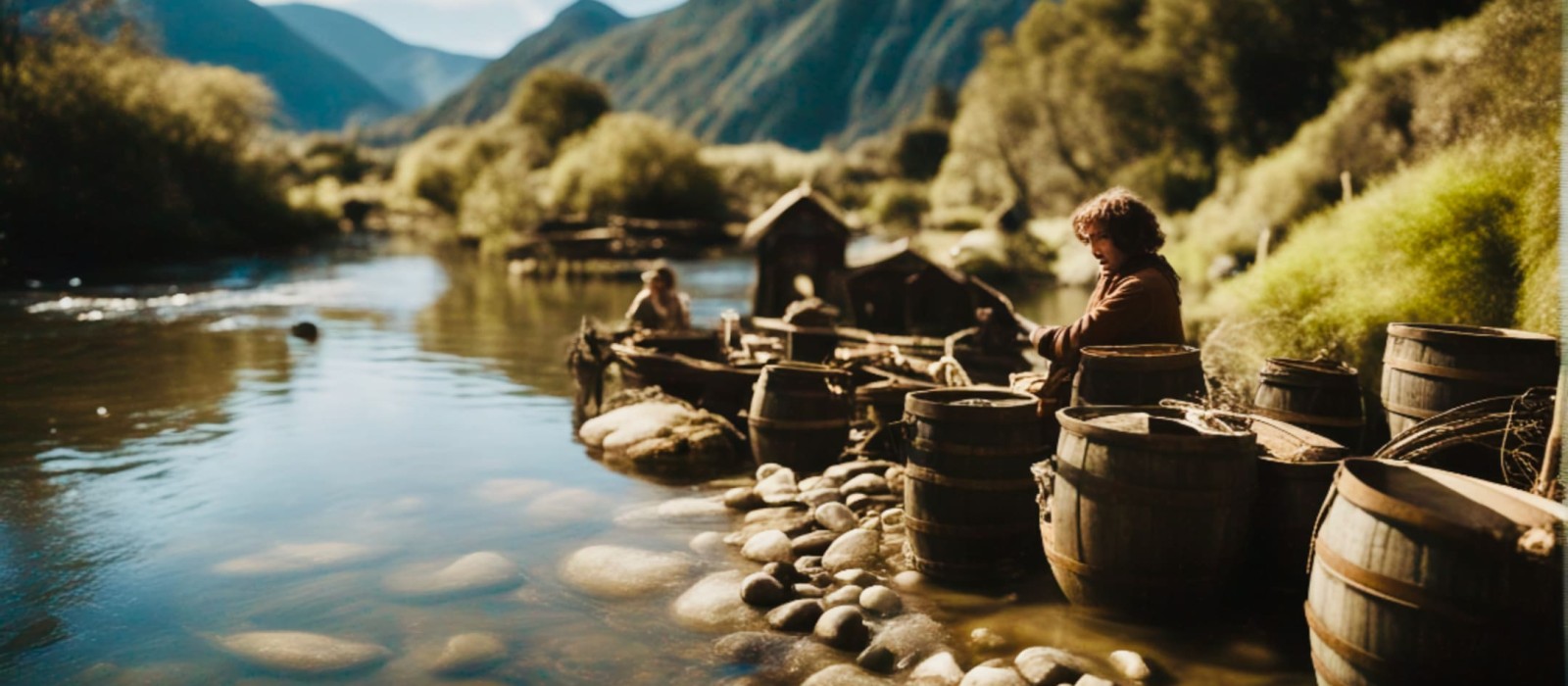
Peter Jackson chose the Pelorus River in the Marlborough region of New Zealand's South Island as the filming location for the barrel escape sequence, and it is one of the most obviously right decisions in the entire film trilogy.
The Pelorus is one of the clearest rivers in New Zealand — a waterway of exceptional purity flowing north through native podocarp and beech forest before reaching the Pelorus Sound and ultimately the Marlborough Sounds. The water is cold, fast-moving, and in the upper reaches an extraordinary shade of blue-green that is produced by the mineral composition of the rocks it flows over. The bush on both banks is dense, ancient, and largely unmodified — the same native trees, the same understorey of ferns and moss, the same quality of filtered light through a high forest canopy that existed there before the first European settlers arrived.
For the barrel scene, the Pelorus offered exactly what Tolkien described — a swift, cold, wooded river flowing through what feels like genuinely old forest, away from any sign of modern settlement. The forest on the riverbanks could plausibly be Mirkwood's edge. The water's clarity made underwater photography possible. The banks were accessible enough for the logistics of a major film production while remaining visually remote.
Filming took place on the river itself and along its banks, with the production building temporary structures and dressing the location with additional set elements. The rapids sequences involved significant practical stunt work in real water. The Pelorus in late summer — when the river runs lower and clearer than in the winter flood season — provided the ideal conditions for extended water work.
Visiting the Pelorus River — What to Expect
The Pelorus River is located in the Pelorus Bridge Scenic Reserve, administered by the Department of Conservation, approximately 18 kilometres west of Havelock in the Marlborough region. It is accessible by road and has been a popular recreational destination for New Zealanders long before The Hobbit made it internationally known.
The swimming holes at Pelorus Bridge are among the best in the South Island — deep, clear pools of the characteristic blue-green water, warm enough in summer for comfortable swimming, cold enough year-round to be bracingly refreshing. The reserve has walking tracks through the native forest, ranging from short flat walks along the riverbank to longer routes that climb through the bush above the water. A DOC campsite and café operate at the reserve entrance.
The most popular spot with Hobbit visitors is the main swimming hole directly below the historic Pelorus Bridge — a suspension bridge that predates the films by decades — where the barrel escape sequence was centred. The river here looks exactly as it does in the film: the same blue-green water, the same towering trees, the same quality of forest light. It is one of the few Lord of the Rings and Hobbit filming locations where the natural setting is essentially unchanged from how it appeared on screen.
Getting there: The Pelorus Bridge Scenic Reserve is approximately 110 kilometres from Nelson and 18 kilometres from Havelock. The drive from Nelson through the Rai Valley is one of the most beautiful in the region, passing through native bush and farmland before dropping into the river valley. The reserve is signposted from State Highway 6.
The NZ Location and the Official Jewellery
The Pelorus River is one of dozens of New Zealand locations that gave Peter Jackson's Middle-earth its visual identity — and New Zealand's connection to Tolkien's world goes beyond the films. The official licensed jewellery in the lotrjewelry.com collection is made in New Zealand, by the New Line Productions licence holders, in the same country where every frame of the barrel escape was filmed. The Key to Erebor — Thorin Oakenshield's pendant, the key that opens the secret door in the Lonely Mountain that the barrel escape was ultimately aimed at reaching — is one of the most distinctive pieces in the Hobbit collection.
Key to Erebor — Thorin's Key
The official Key to Erebor — the key Gandalf entrusted to Thorin, which opens the secret door on the Lonely Mountain. The entire Quest of Erebor, including the barrel escape, was undertaken to reach the door this key opens. Solid 925 sterling silver. Made in New Zealand by the New Line Productions licence holders.
Shop Key to Erebor →Sting — The Blade of Gondolin
The official Sting pendant — the short Elvish blade Bilbo found in the trolls' cave, named during the spider battle in Mirkwood just before the barrel escape. The blade that glows blue near Orcs. 60mm, solid 925 sterling silver. Made in New Zealand.
Shop Sting →My Precious Ring
"My Precious" engraved outside. Official Hobbit logo inside. The ring Bilbo used to turn invisible throughout the escape from Thranduil's halls — the same ring that had been Gollum's for five centuries. Custom-made in solid 925 sterling silver. Made in New Zealand.
Shop My Precious →Frequently Asked Questions
Where was the barrel escape scene filmed in The Hobbit?
The barrel escape sequence in The Hobbit: The Desolation of Smaug was filmed primarily on the Pelorus River in the Pelorus Bridge Scenic Reserve, Marlborough region, South Island, New Zealand. The river was chosen for its exceptional water clarity, the native forest on its banks, and its general appearance of being a wild, ancient waterway — exactly as Tolkien described the Forest River flowing from Thranduil's halls through Mirkwood. The reserve is accessible to visitors and is approximately 110 kilometres from Nelson.
What happens in the barrel escape in Tolkien's book?
In The Hobbit, Chapter X "Barrels Out of Bond," Bilbo uses the Ring to become invisible, steals the keys from a sleeping Elven guard, unlocks all thirteen Dwarf-cells, packs the Dwarves into empty wine barrels in the cellar of Thranduil's halls, and sends them out through a water-gate into the Forest River below. He forgets to arrange a barrel for himself and clings to the outside of a barrel in the cold water. They float downstream to Lake-town, arriving exhausted and sodden. There is no battle in Tolkien's version — the escape relies entirely on Bilbo's ingenuity and the Ring's invisibility rather than combat.
How is Peter Jackson's version different from the book?
Jackson's version transforms the quiet, comic escape into a major action sequence. The Dwarves ride in open barrels through white-water rapids. Orc pursuers attack on the riverbanks. Wood-elf guards, including Legolas and Tauriel, fight the Orcs while the barrels rush downstream. Kíli is shot with a Morgul arrow during the escape. None of this combat appears in Tolkien's book — the escape in the novel is conducted entirely through stealth and invisibility, with the tension coming from near-discovery at the water-gate rather than from battle. Both versions keep the core invention: Bilbo's plan, the barrels, the river.
Can you visit the Pelorus River filming location?
Yes. The Pelorus Bridge Scenic Reserve is a public Department of Conservation reserve open year-round. It has walking tracks, swimming holes, a campsite, and a café. The main swimming hole below the historic Pelorus Bridge is the central filming location and is freely accessible. The reserve is signposted from State Highway 6, approximately 18 kilometres west of Havelock in the Marlborough region. The best time to visit for swimming is summer (December–February) when the water is warmest, though the river is beautiful in any season.
Why did Thranduil imprison Thorin's company?
Thranduil captured the Dwarves after his patrols found them in Mirkwood — disoriented, exhausted, and recently attacked by spiders. He was not hostile to them as enemies but wanted to know why they were crossing his realm and where they were going. Thorin, distrustful of Elves and unwilling to reveal the Quest of Erebor to Thranduil, refused to explain. Thranduil imprisoned the company in comfortable cells and fed them well while waiting for an explanation. Thorin refused to provide one for weeks, leading to the situation that made the barrel escape necessary.
What is the Pelorus River known for besides The Hobbit?
The Pelorus River is one of New Zealand's clearest and most beautiful rivers, long known to New Zealanders as an outstanding swimming and recreation destination. The Pelorus Bridge Scenic Reserve was established in 1912 — one of the country's earliest scenic reserves — specifically to protect the native forest along the riverbanks. The reserve contains one of the most accessible examples of unmodified lowland podocarp-hardwood forest in the Marlborough region. It is popular for swimming, walking, kayaking, and simply experiencing the native bush. Its connection to The Hobbit brought it international attention, but its appeal exists entirely independently of the films.
Sources & Further Reading
- The Hobbit, or There and Back Again — J.R.R. Tolkien (1937): Chapter VIII 'Flies and Spiders' and Chapter X 'Barrels Out of Bond' — the primary source for the Mirkwood imprisonment and the barrel escape
- The Hobbit: The Desolation of Smaug (2013) — directed by Peter Jackson: the film adaptation of the barrel escape, filmed at Pelorus Bridge Scenic Reserve, Marlborough, New Zealand
- Department of Conservation New Zealand — doc.govt.nz: information on the Pelorus Bridge Scenic Reserve, walking tracks, and visitor facilities
- Tolkien Gateway — tolkiengateway.net
Related Products