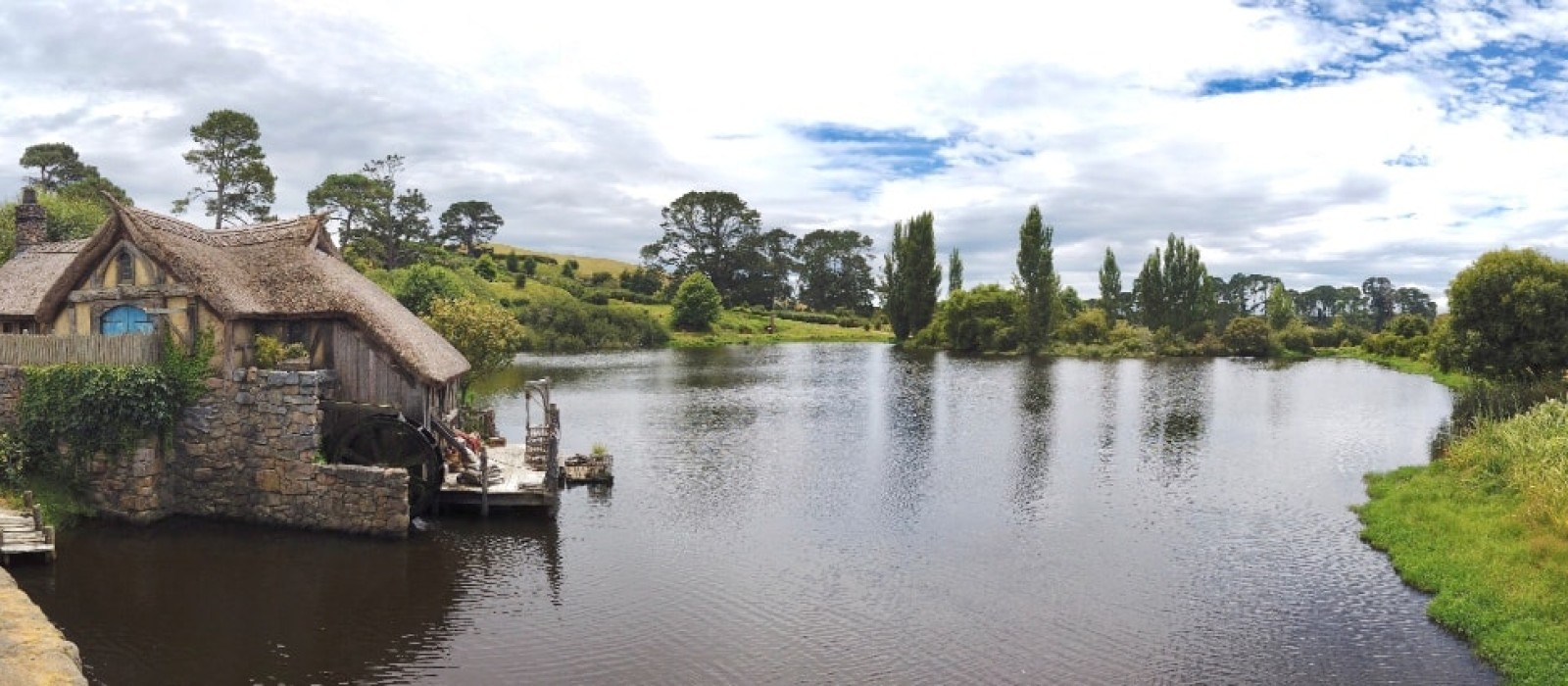
Hobbiton — the village at the heart of the Shire, home of Bilbo and Frodo Baggins, the place where the greatest adventure in Middle-earth history began with an unexpected knock at a round green door — sits in the Waikato region of New Zealand's North Island, on a working sheep farm outside Matamata. It is not a replica or a reconstruction. It is the actual filming location, built for Peter Jackson's original trilogy in 1999, rebuilt in permanent materials for The Hobbit trilogy in 2011, and open to visitors every day of the year. It is the single most visited Lord of the Rings filming location in the world, and it looks exactly as it does on screen — because it is the same place.
Tolkien based the Shire on a specific England — the England of the late Victorian countryside, the Midlands and the villages of his childhood, a world of market gardens and post roads and parish churches and pipe-weed, where nothing very alarming was supposed to happen and the most dramatic event in living memory was probably a disputed boundary between adjacent vegetable plots. He described hobbits as "a reflection of the English" — creatures who loved comfort, distrusted adventure, valued their pantries, and were, when pressed into circumstances beyond their experience, capable of an extraordinary quiet courage that no one, least of all themselves, had expected.
Hobbiton is the physical heart of all that. Everything the story is defending — everything Frodo carries in his mind across the Dead Marshes and up the slopes of Mount Doom — is concentrated here, in round green doors and kitchen gardens and the smell of pipe-weed drifting from Bag End on an autumn afternoon. To understand Hobbiton is to understand what the whole story is about.
Hobbiton in Tolkien's Lore — The Shire and Its History
The Shire was settled by hobbits in the year TA 1601 — reckoned as Year 1 in the Shire-reckoning that hobbits used for their own calendar thereafter. The first hobbits to settle it were led by the brothers Marcho and Blanco, who received permission from the King of Arnor to cross the River Baranduin and settle the fertile lands beyond. The Shire grew from that crossing: twelve farthings of rolling green country, governed by the Thain and the Mayor and the Master of Buckland, maintaining a comfortable independence from the wider world of Middle-earth that it largely succeeded in ignoring for more than a thousand years.
Hobbiton was not the capital of the Shire — that was Michel Delving, in the Westfarthing — but it was its most storied village, located in the heart of the Westfarthing on the banks of the Water, a gentle river that flowed through the village past the mill. It was home to several of the Shire's most prominent families: the Gamgees, who had been gardeners at Bag End for generations; the Sackville-Bagginses, who had their eye on the property and resented Bilbo's continued occupation of it; and the Bagginses themselves, the most respected family in the village, occupying the finest smial on the Hill.
A smial — the proper term for a hobbit-hole — was not a cave or a burrow in the crude sense. Tolkien was careful about this. A well-appointed smial like Bag End had panelled walls, tiled floors, multiple comfortable rooms, large round windows to let in the light, deep pantries, a proper kitchen, and — in Bilbo's case — an extensive library, several wardrobes of coats, and a collection of maps. The round doors and windows were an aesthetic preference, not a structural necessity. Hobbits liked curves. Angles felt unnatural to them.
Bag End — The House That Started Everything
Bag End was built by Bungo Baggins — Bilbo's father — for his wife Belladonna Took when they married. The name refers to the dead-end lane at the top of the Hill where it was located: "bag end" in English dialect means a cul-de-sac, a lane with no through road. It was the finest and largest smial in the area — the Bagginses were prosperous and well-regarded — with a notable front door painted green, a well-tended garden, and a reputation for excellent hospitality.
Bilbo inherited it when his parents died, and lived there for his entire life until his 111th birthday party, after which he disappeared in a flash of light and walked to Rivendell and never really came back. Frodo inherited it when Bilbo disappeared, and lived there for seventeen years before Gandalf came back with news about the ring that had been sitting in the mantelpiece drawer. The same house. The same green door. The same garden and pantry and fireside chair and view down the hill to the mill. The continuity of the place is part of its weight.
When Frodo finally leaves Bag End — walking down the hill in the dark, not looking back — he is leaving the only home he has ever known, probably forever. He knows this. And Tolkien has made you feel the texture of that home so completely in the preceding chapters that the departure costs something. That is the function of Hobbiton in the story: to establish what is being left, so that every step of the journey away from it carries the right emotional gravity.
The Party Tree and Bilbo's Birthday
The opening chapter of The Lord of the Rings — "A Long-Expected Party" — is one of the most carefully constructed openings in English fiction. Tolkien spends pages establishing the rhythms of the Shire, the social dynamics of hobbit life, the particular way that rumour and opinion move through a village where everyone knows everyone's business. He needs you to be comfortable there. He needs you to feel the safety and smallness of it before he begins dismantling it.
Bilbo's 111th birthday party is the centrepiece: a party of extraordinary scale, with fireworks by Gandalf, food and drink far beyond the occasion, and a speech that ends with Bilbo vanishing in a flash of light and leaving his astonished neighbours staring at the space where he had been. It is comic and strange and faintly alarming, and it sets the tone for everything that follows: a world where something magical is happening beneath the surface of an ordinary-seeming evening.
The Party Tree — the great tree on the party field under which the tables were set for Bilbo's speech — is one of the most specific visual details Tolkien gives Hobbiton. When Sam returns to the Shire after the War of the Ring and finds it devastated by Saruman's occupation, the Party Tree has been cut down. He plants a new one using the mallorn seed Galadriel gave him, and by the following spring it is the most beautiful tree in the Shire. The tree is a measure of what was lost and what was recovered. Its presence or absence tells you where the story is in its arc.
Hobbiton in New Zealand — Alexander Farm, Matamata
In 1998, location scouts for Peter Jackson's production were flying over the Waikato region when they saw a farm near Matamata that looked exactly right. The Alexander Farm — a 500-hectare sheep property — had a lake, a mature oak tree in exactly the right position for the Party Tree, gentle rolling hills with the specific quality of green that Tolkien had described, and a protected valley that would look from almost any angle like countryside that had never been developed. Jackson drove out, walked the land, and knew immediately. This was the Shire.
The original Hobbiton set was built for the 1999–2003 trilogy in temporary materials — the production expected to need it for a limited period and built accordingly. After filming, most of it was dismantled. When Jackson returned to Hobbiton for The Hobbit trilogy (2012–2014), he rebuilt it in permanent materials: steel-framed, weatherproofed, fully landscaped with the specific plants Tolkien had described, maintained with the same attention to detail that the films required. The 44 hobbit holes were constructed individually, each with its own character, garden, and interior fittings visible through the windows. The Green Dragon Inn was built as a fully functional pub. The mill was rebuilt on the Water. The Party Tree — a mature pine fitted with 15,000 artificial leaves in multiple shades of green to match the season required — was installed on the party field.
The farm has been open for guided tours since 2012 and receives hundreds of thousands of visitors annually. It is the most-visited non-urban tourist attraction in New Zealand. The Alexander family still farm the property around the film set, and the surrounding hills are still home to working sheep — exactly the pastoral continuity that makes the location feel as authentic as it looks.
Visiting Hobbiton — What to Expect
Tours of Hobbiton depart from the Shire's Rest visitor centre, approximately 10 kilometres from Matamata, and travel by bus to the film set. Tours are guided and run throughout the day, with evening Banquet tours available on selected dates. The standard tour takes approximately two hours and covers the full set, including the exterior of Bag End at the top of the Hill, the garden terrace, all 44 hobbit holes and their individual gardens, the Party Field and Party Tree, the Mill, and the Green Dragon Inn where tours conclude with an included drink.
Bag End's interior is not accessible — it was built as an exterior set only, with full interiors constructed separately at Weta Workshop studios. The famous door and the garden are fully visible and photographable. The hobbit holes on the lower levels of the Hill are built at two-thirds scale — designed so that actors of normal height appeared giant-sized in the same frame as hobbit-actors — while those at the upper levels are full-size, built for the close-up work and for the hobbit characters themselves. The difference in scale is noticeable once you know to look for it.
Getting there: Matamata is approximately 170 kilometres southeast of Auckland and 85 kilometres southeast of Hamilton. The Shire's Rest is signposted from State Highway 27. Bookings are essential and should be made in advance through the official Hobbiton website, particularly in summer (December–February) when the site is busiest. Evening Banquet tours must be booked well ahead.
The Scouring of the Shire — What the Films Left Out
Peter Jackson did not film the Scouring of the Shire — the final chapter of Tolkien's story, in which Frodo, Sam, Merry, and Pippin return home to find the Shire occupied by Saruman's men and the landscape damaged. Tolkien considered this chapter essential. He wrote in his letters that it was the point at which the hobbits' journey was completed: they had to bring their courage and experience home and use it, rather than simply returning to the comfort they had left.
In the chapter, the Party Tree has been cut down. Bag End is being used as Saruman's headquarters and has been dirtied and damaged. The mill has been replaced by a larger, noisier, more industrial structure. The hobbit holes and gardens are neglected. The Shire that the hobbits had been fighting to preserve — the Shire that every reader had been made to love in the opening chapters — has been despoiled in their absence.
Sam restores it. He plants the mallorn seed Galadriel gave him in the place where the Party Tree had stood. He uses the soil from her box on the fields Saruman's men had damaged. In the spring following, Tolkien writes, the Shire had its best year in living memory: the trees blossomed more beautifully, the harvests were more generous, the children born that year were unusually healthy. And on the Hill, where the Party Tree had been, a young mallorn grew — the only one in Middle-earth outside Lothlórien. Sam called the year FA 1 in his own memory: the year Middle-earth began again.
Hobbiton at Matamata, in full bloom under the New Zealand summer, is the closest thing in the physical world to that restored Shire. Standing at the Party Tree on a warm afternoon with the hills rolling away on all sides — the same hills, the same farm, the same quality of light — it is not difficult to understand why Tolkien needed the Shire to be worth saving.
The Official Hobbit Collection — Made in New Zealand
The official Hobbit jewellery collection at lotrjewelry.com is made in New Zealand — in the same country as Hobbiton, by the New Line Productions licence holders. The pieces of the Hobbit collection connect directly to the characters and objects whose stories began and ended in the Shire: the One Ring that Bilbo found and Frodo carried; the My Precious Ring that Gollum called his own for five hundred years before Bilbo stumbled onto it in the dark; and Sting, the short Elvish blade Bilbo found in the trolls' cave and passed to Frodo before the Fellowship left Rivendell.
The One Ring — Sterling Silver
The ring Bilbo found in the tunnels under the Misty Mountains and kept in his pocket — at Bag End, at Rivendell, on the road — for sixty years. Custom-made in solid 925 sterling silver, Comfort Curve. Made in New Zealand by the New Line Productions licence holders.
Shop One Ring →My Precious Ring
"My Precious" engraved outside. Official Hobbit logo inside. The ring Gollum called his own, found by Bilbo at the bottom of the Misty Mountains by accident and carried in a pocket to Bag End and back again. Solid 925 sterling silver. Made in New Zealand.
Shop My Precious →Sting — The Blade of Gondolin
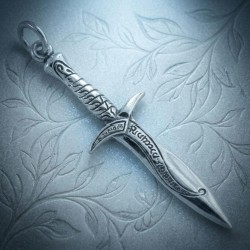
The official Sting pendant — the short Elvish blade Bilbo found in the trolls' cave and carried through the Quest of Erebor. 60mm, solid 925 sterling silver. The dagger that glowed blue near Orcs, passed by Bilbo to Frodo before Rivendell. Made in New Zealand.
Shop Sting →Frequently Asked Questions About Hobbiton
Where is Hobbiton in real life?
Hobbiton is located on the Alexander Farm near Matamata in the Waikato region of New Zealand's North Island, approximately 170 kilometres southeast of Auckland. The film set was originally built for Peter Jackson's Lord of the Rings trilogy in 1999 and rebuilt in permanent materials for The Hobbit trilogy in 2011. It has been open for guided tours since 2012 and is the most-visited non-urban tourist attraction in New Zealand. Bookings are essential and should be made through the official Hobbiton website.
Can you go inside Bag End?
No. The exterior of Bag End — the famous green door, the garden, the circular windows, the bench beside the front step — is fully accessible and photographable. But Bag End was built as an exterior set only. The interior scenes were filmed at separate, full-scale interior sets constructed at Weta Workshop studios in Wellington. The Bag End visible on the Hill at Hobbiton is a facade — a magnificently detailed and maintained facade, but a facade nonetheless.
Why are some hobbit holes smaller than others?
The hobbit holes at the lower levels of the Hill are built at two-thirds scale — approximately 60% of normal size. This was a filming technique that allowed actors of normal height to appear giant-sized in the same wide shot as hobbit actors or doubles, playing on forced perspective. The hobbit holes at the upper levels, used for close-up work with the actual hobbit characters, are built at full size. The size difference is noticeable once you know to look for it — the doors, windows, and garden details are proportionally smaller on the lower holes.
Is the Party Tree a real tree?
The Party Tree on the Party Field at Hobbiton is an artificial tree — a mature pine fitted with approximately 15,000 individually attached artificial leaves in multiple shades of green and autumn colour, adjusted between productions to match the season required. The tree was designed to be weather-resistant and permanent, and is maintained as part of the ongoing set. The real tree visible in wide shots of the party field in the film — a large oak — is a genuine mature tree growing on the Alexander Farm property.
What did Tolkien base the Shire on?
Tolkien based the Shire on the English countryside he knew and loved — specifically the Midlands and rural Warwickshire of his childhood, and the Oxfordshire villages near where he lived and worked as an adult. He described hobbits in letters as "a reflection of the English" and the Shire as representing an older, quieter England that was being lost to industrialisation. The round hobbit-holes were his invention — no direct real-world equivalent — but the social texture of the Shire, its market towns and post roads and parish gossip and allotment gardens, was drawn directly from English rural life of the late Victorian and Edwardian periods.
What happened to the Shire in the books after the War of the Ring?
In Tolkien's books — in the chapter "The Scouring of the Shire" which Peter Jackson did not film — Frodo, Sam, Merry, and Pippin return to find the Shire occupied by Saruman's men and the landscape deliberately damaged. The Party Tree has been cut down. Bag End is being used as Saruman's headquarters. Sam uses a gift from Galadriel — a box of soil and a mallorn seed — to restore the damaged land. By the following spring the Shire has recovered, and a young mallorn grows where the Party Tree had stood: the only mallorn tree in Middle-earth outside Lothlórien. Tolkien considered this chapter essential to the story's completion. Jackson omitted it for length, showing instead the four hobbits returning to find the Shire unchanged.
Sources & Further Reading
- The Lord of the Rings — The Fellowship of the Ring: 'A Long-Expected Party' and 'A Short Cut to Mushrooms' — Tolkien's introduction of Hobbiton, Bag End, and the Shire
- The Lord of the Rings — The Return of the King: 'The Scouring of the Shire' and 'The Grey Havens' — the Shire's occupation, restoration, and Sam's planting of the mallorn
- The Hobbit, or There and Back Again — J.R.R. Tolkien (1937): 'An Unexpected Party' — Bag End and Bilbo's first introduction
- The Letters of J.R.R. Tolkien, ed. Humphrey Carpenter: Letters 131 and 214 — Tolkien's descriptions of the Shire's English inspiration and the importance of the Scouring chapter
- Hobbiton Movie Set Tours — hobbitontours.com — official tour bookings and visitor information
- Tolkien Gateway — tolkiengateway.net
Related Products