
The short answer: Andy Serkis has said the hunt in The Hunt for Gollum "takes place in two different dimensions" — and refused to explain further. The leading theory points to Tolkien's Unseen realm, the wraith-world glimpsed whenever the One Ring is worn. Rival readings include Gollum's divided mind, a dual-timeline structure, and Sauron's own shadow-hunt. Here is every theory, weighed against the evidence.
One sentence from Andy Serkis's BBC interview has done what no casting announcement managed: it has made The Hunt for Gollum genuinely mysterious. If you missed the interview itself, our full breakdown of everything Serkis revealed covers the story, the New Zealand shoot and the casting conversation. This article is about the one line he wouldn't explain.
What Andy Serkis Actually Said
"The hunt takes place in two different dimensions really and that's about as far as I can say at the moment."
Dimensions. Not regions, not chapters, not acts. It is a precise and deliberately strange word — and Serkis is a filmmaker who chooses words carefully. He has been circling this idea for a while, too: back in 2024 he described the film as "the world of Middle-earth according to Gollum's experience of it." Screenwriter Philippa Boyens has likewise said the story is told through Gollum's perspective — an intense, untold chapter falling between Bilbo's birthday party and the Mines of Moria.
Put those three statements together and a picture forms: this is not a film that watches Gollum from the outside. It is a film that sees the world the way Gollum sees it. And Gollum does not see the world the way anyone else does — because for five hundred years, he held the One Ring.
Theory One: The Unseen Realm — Middle-earth's Wraith-World
Tolkien's world has always had two dimensions. The Seen — the physical Middle-earth of grass and stone — and the Unseen, the shadow-realm that spirits inhabit. Every time Frodo puts on the One Ring, the films show us the crossing: the physical world dims to a howling, smeared twilight, while things that were invisible blaze into view. The Nazgûl appear as they truly are — pale kings under tattered robes. At the Ford of Bruinen, Frodo glimpses Glorfindel as a figure of white light, because great Elves who have dwelt in the Blessed Realm live in both worlds at once.
What the Wraith-World Looks Like
Tolkien gives us tantalising variations. When Bilbo slips on the Ring escaping Gollum's cave, the Unseen appears pale, slowed and strangely calm — a muted echo of the world, because Sauron was still in hiding and the Eye was not yet searching. By Frodo's day, the same realm is a storm of malice. The wraith-world has weather. It changes as Sauron's power grows — which means a film set in the years the Dark Lord is rising could show the Unseen realm darkening in real time.
Why Gollum Is the Perfect Guide to the Unseen
Gandalf says it plainly in the book: Gollum bore the Ring so long that he became permanently stretched between the worlds — thin, faded, unable to be fully free of either. Five centuries under the mountain left him a creature of the threshold. If any character in Middle-earth could carry a film that moves between the Seen and the Unseen, it is the one who lived half in each. No Middle-earth film has ever made the wraith-world more than a brief effect. A story told through Gollum's eyes could make it a place.
Theory Two: The Hunt Within — Sméagol Against Gollum
The second reading is psychological. The outer dimension is the hunt we know from the book: Aragorn tracking Gollum across Wilderland at Gandalf's urging. The inner dimension is the hunt happening inside the creature himself — Sméagol, the river-hobbit who once had a family and a birthday, hunted through the corridors of his own ruined memory by the thing he has become.
Serkis's own framing supports this. He has called the film a deep dive into the psychology and history of Gollum before he became Gollum — and the whispered two-voice arguments he performed in the original trilogy remain the most celebrated depiction of a divided self in fantasy cinema. A film where the pursuer and the pursued share one body would be a genuinely new kind of Middle-earth story. Our Sméagol backstory guide traces the five-hundred-year fall that inner hunt would revisit.
Theory Three: Two Timelines — The Hunt and the Fall
A structural reading: the two dimensions are two eras. The present-day hunt — Aragorn and Gandalf racing to find Gollum before Sauron's servants do — is interwoven with the deep past at the Gladden Fields, where two cousins went fishing on a birthday and only one came home. Serkis's promise of Gollum's history "before he became Gollum" all but guarantees flashback material; a dual-timeline structure would simply elevate it from device to architecture. The strongest version of this theory combines it with Theory Two: the past isn't just shown; it intrudes — memory as a dimension Gollum cannot escape.
Theory Four: The Dark Hunt — Sauron Is Searching Too
Often forgotten: in Tolkien's account there are two hunts for Gollum, running simultaneously. While Aragorn searches on Gandalf's behalf, Sauron's power is drawing Gollum toward Mordor — a subconscious lure the creature cannot resist, which ends with his capture and interrogation in the dungeons of Barad-dûr. It is there, under torment, that Sauron learns two words that doom the world to war: Shire and Baggins.
Read this way, the two dimensions are the two sides of the chase — the hunt of the Wise and the hunt of the Shadow, closing on the same wretched creature from opposite directions. It would give the film a ticking clock worthy of a thriller, and it is fully canonical.
Which Theory Fits the Evidence Best?
The word "dimensions" does heavy lifting here. Timelines, parallel hunts and inner conflict are all things a director could describe in ordinary story language — Serkis chose a word that implies place. Combined with his "Middle-earth according to Gollum's experience" framing, the Unseen realm remains the theory with the strongest textual claim. But these theories are not rivals so much as layers: a film that moves through the wraith-world, intercut with the fall at the Gladden Fields, while both the Wise and the Shadow close in, is one film — and it may be exactly the film Serkis is making in New Zealand right now. We'll keep this article updated as production reveals more.
Own the Ring That Opens the Unseen World
The doorway between the dimensions is a plain gold band. The official One Ring is made in New Zealand by the New Line Productions licence holders — in the same country where The Hunt for Gollum is filming today.
The One Ring in Solid Gold
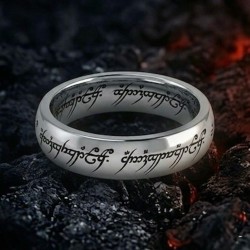
The official One Ring in solid 9ct, 14ct or 18ct gold, deeply engraved with the Black Speech of Mordor. Made in New Zealand by the New Line Productions licence holders.
View the Gold One RingThe One Ring — Precision Engraved Sterling Silver
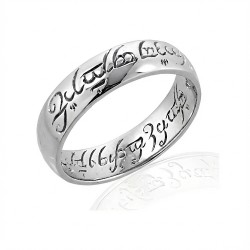
The ring before the fire: a subtle silver-on-silver Elvish engraving visible only when it catches the light. Made in New Zealand by the New Line Productions licence holders.
View the Silver One RingThe One Ring Gold Wedding Band
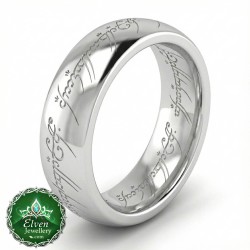
The official One Ring is a solid gold wedding band with a deep cast Elvish inscription. Made in New Zealand by the New Line Productions licence holders.
View the Wedding BandFrequently Asked Questions
What did Andy Serkis mean by "two different dimensions"?
Serkis has not explained the line. The leading fan theory is that The Hunt for Gollum will move between Middle-earth's physical world and the Unseen realm — the wraith-world seen whenever the One Ring is worn. Other theories include Gollum's divided mind, a dual-timeline structure, and the parallel hunts by Gandalf's allies and Sauron's servants.
What is the wraith-world in Lord of the Rings?
The wraith-world, or Unseen realm, is the shadow dimension of Middle-earth inhabited by spirits. Mortals enter it when wearing the One Ring: the physical world dims while invisible things — like the true forms of the Nazgûl — become visible. Long exposure to the Ring, as with Gollum, leaves a bearer permanently stretched between both worlds.
Did Sauron also hunt for Gollum?
Yes. In Tolkien's account, while Aragorn searched for Gollum on Gandalf's behalf, Sauron's power was drawing the creature toward Mordor. Gollum was captured, taken to Barad-dûr and interrogated — which is how Sauron learned the words "Shire" and "Baggins."
Will The Hunt for Gollum show Sméagol before he found the Ring?
Very likely. Andy Serkis has described the film as a deep dive into the psychology and history of Gollum before he became Gollum, which points to material from Sméagol's early life among the Stoor hobbits of the Gladden Fields.
Is The Hunt for Gollum one movie or two?
One movie. Screenwriter Philippa Boyens has confirmed The Hunt for Gollum is a single film; a second, separate Lord of the Rings film — Shadow of the Past, written by Stephen Colbert — is in development for later.
When does The Hunt for Gollum come out?
The Lord of the Rings: The Hunt for Gollum releases in cinemas worldwide on 17 December 2027. It is currently filming in New Zealand, directed by Andy Serkis and produced by Peter Jackson.
Sources and Further Reading
- BBC — Andy Serkis interview on The Hunt for Gollum (July 2026)
- ACE Superhero Comic Con — Serkis on Middle-earth "according to Gollum's experience" (2024)
- Empire / Variety — Philippa Boyens on the film's timeline, perspective and single-film status
- Tolkien Gateway — the Unseen realm and wraith-world in Tolkien's writing
- J.R.R. Tolkien — The Fellowship of the Ring, "The Shadow of the Past" and "The Council of Elrond" (the two hunts for Gollum)
Related Products