
Gollum — born Sméagol, of the Stoor hobbit-kin — possessed the One Ring for 478 years. He found it at the bottom of the Gladden Fields in TA 2463, murdered his friend Déagol to take it, was driven from his community, and spent the following five centuries in the dark under the Misty Mountains, reduced from a curious, river-fishing hobbit into something barely recognisable as the creature he had been. He is the living proof of what the Ring does to a person given enough time — and, paradoxically, the instrument of its final destruction.
Tolkien once described Gollum as the most important character in The Lord of the Rings. Not Frodo. Not Aragorn. Gollum.
He meant it structurally. Without Gollum's five-hundred-year preservation by the Ring, there would have been no Bilbo finding it in the tunnels. Without Bilbo's finding it, Gandalf would never have discovered Isildur's Bane. Without Gandalf's discovery, the War of the Ring would have been lost before it began. And without Gollum's presence at the Crack of Doom on the 25th of March TA 3019, biting the Ring from Frodo's finger and dancing with it into the fire, the Ring would never have been destroyed at all. Frodo's will failed at the last moment. It was Gollum who completed the quest.
He is also the story's most heartbreaking figure. He was not always what he became. His transformation is one of the most detailed and terrible things Tolkien ever wrote — and understanding it is essential to understanding everything the One Ring was, and everything the story was about.
Who Was Sméagol? — Before the Ring
Sméagol was born around TA 2430, one of a group of hobbit-folk who lived along the banks of the Gladden Fields — the marshy confluence of rivers east of the Misty Mountains where the Anduin broadens into a wide, reed-choked floodplain. They were called the Stoors, one of the three original breeds of hobbit, known for their fondness for boats, fishing, and river lore. They were not yet part of the Shire-culture that Bilbo and Frodo would later represent — they were wilder, more isolated, more connected to the river and its moods.
Tolkien tells us relatively little about who Sméagol was before the Ring found him. What emerges from scattered references is a picture of a hobbit who was naturally curious — interested in roots and beginnings, in tunnels and dark places, in the secrets underneath things. His grandmother was a woman of considerable importance in their community, and Sméagol was something of a favourite of hers. He was, in other words, someone — a member of a family, with relationships and standing and a place in the world. That matters. What the Ring made of him was not what he started as.
The Murder of Déagol — The First Five Minutes
On Sméagol's birthday in TA 2463, he went fishing with his friend Déagol. Their boat overturned. Déagol was dragged underwater — and at the bottom of the Gladden Fields, his hand closed on something. He came up holding a ring of gold. It was beautiful. It had lain there since TA 2 — since the night Isildur's ring slipped off his finger as Orcs drove him into the river, nearly twenty-five centuries before.
Sméagol saw it and wanted it immediately. He told Déagol it was his birthday and asked for it as a gift. Déagol refused. Sméagol strangled him and took it.
The Ring had been in Sméagol's possession for approximately five minutes when he committed his first murder. Tolkien was deliberate about this. The Ring did not slowly corrupt Sméagol over time before he became capable of killing. It found the desire that was already in him — a deep, acquisitive hunger beneath the surface of an ordinary hobbit's ordinary life — and expressed it immediately. The murder of Déagol is not the beginning of the Ring's corruption of Sméagol. It is the first visible symptom of a corruption that was already complete at the moment of contact.
Five Hundred Years in the Dark — The Making of Gollum
After killing Déagol, Sméagol returned to his community. The Ring made him invisible when he wore it. He used the invisibility to spy, steal and whisper poisonous things in people's ears. His family grew to hate and fear him. His grandmother eventually expelled him from the community entirely. He went away into the mountains, alone with the Ring.
He found his way under the Misty Mountains to a small island of rock in an underground lake. He lived there for 478 years. He caught fish by hand in the dark and ate them raw. He ate birds and small animals that came near enough to catch, and later, when he was truly far gone, he caught and ate Orcs that wandered too close to the water's edge. The Ring kept him alive — extending his lifespan far beyond anything natural, arresting his aging — but it did not sustain him. It simply continued him, in the way that a machine continues without growth or change.
What the centuries in the dark did to him physically was gradual but total. He lost the robust hobbit form — the broad feet, the comfortable rotundity, the healthy colour. He grew thin, pale, and large-eyed in the way of things adapted to darkness. His few remaining teeth were replaced by long, clinging fingers as his primary hunting tool. He moved in a crawling, crouching gait, his knees to his chest. He spoke to himself constantly — the Ring had split his mind into two voices, the remnant of Sméagol who occasionally still wanted company and normality, and the Gollum personality that wanted only the Ring and the dark and the fish and for nothing to change ever.
The name Gollum came from the horrible swallowing sound he made in his throat — described by those who heard it as something between a cough and a gulp. It was not his name. It was what other people called the sound he made. Eventually it became him.
The Riddle Game — How Bilbo Found the Ring
In TA 2941, a hobbit named Bilbo Baggins became separated from Gandalf and Thorin's company in the tunnels beneath the Misty Mountains. Stumbling in the dark, his hand closed on something small and round and cold on the cave floor. He pocketed it without looking at it properly and pressed on.
He encountered Gollum. They proposed a riddle game — the winner would get whatever he most desired. Gollum assumed he would be eating Bilbo. Bilbo asked his final riddle entirely by accident: "What have I got in my pocket?" It was not a fair riddle, Gollum objected strenuously, but by the rules of the game he had accepted, he had to try to answer it. He could not. The Ring was not in his pocket. It was in Bilbo's.
Bilbo ran. He put on the Ring, invisible, and escaped through the gate of the mountain to daylight. Gollum, arriving at the gate too late, understood what had happened. He had lost it. His Precious was gone.
The loss broke something in him. He had had nothing else. He had oriented his entire existence around the Ring for five hundred years. Without it, he was — what? A pale, fish-eating creature in the dark, with nothing to guard and nothing to love. He set out, driven by obsession, to follow the Ring wherever it had gone.
Captured by Sauron — What Gollum Told the Enemy
Gollum's wanderings brought him south. At some point — Tolkien places it around TA 3009 — he was captured by Sauron's forces and taken to Mordor. Sauron interrogated him personally. Under prolonged torture, Gollum revealed what he knew about the Ring's recent history: that it had passed from his possession to a creature called "Baggins," and that Baggins came from a place called "the Shire."
This was the most dangerous piece of information Sauron could have received. It told him that the Ring was not lost in the wild but in the hands of a traceable being in a traceable place. He dispatched the Nazgûl to find it. The search that would eventually drive Frodo from Bag End and toward the fires of Mount Doom began with Gollum's broken confession in the dungeons of Mordor.
Sauron released him — or perhaps he escaped, or Sauron let him go, calculating that a desperate creature searching for the Ring might lead his servants to it. Tolkien leaves the details vague. What is clear is that Gollum emerged from Mordor still alive and more desperate than ever, making for the one place he knew the Ring had last been: the Shire.
Aragorn's Capture — Delivered to the Elves
Gandalf, learning that Gollum had been to Mordor and had told Sauron what he knew, sent Aragorn to find him before Sauron's forces could use him again. Aragorn hunted Gollum for years across the wild lands of the North — through the Dead Marshes, through Rhovanion, into the approaches of Mordor itself — and eventually caught him near the Gladden Fields in TA 3017, close to where Déagol had found the Ring five and a half centuries before.
Gollum bit Aragorn's hand so badly during the capture that it left a permanent scar. He was bound and brought to Mirkwood, where Gandalf questioned him. From Gollum's testimony, broken and evasive and full of lies but yielding truth under pressure, Gandalf pieced together the Ring's complete history since Isildur's death. He had what he needed. He raced to the Shire.
Gollum was kept prisoner in Thranduil's halls. The Wood-elves treated him reasonably well — they let him climb trees in the forest — but he remained under guard. One day, an Orc raid struck the Wood-elves in the forest. In the confusion, Gollum vanished. He was making for Mordor to guide Sauron's forces personally to the Ring. He never arrived. Instead, in the depths of Moria, he encountered the Fellowship.
The Fellowship and Frodo's Pity
Gollum followed the Fellowship through Moria and out the other side. He tracked them to Lothlórien and waited. He tracked them down the Anduin. When Frodo and Sam separated from the rest at Amon Hen and entered the Emyn Muil, Gollum was already there, following them through the broken rocks like a spider.
They caught him. Sam wanted to kill him. Frodo refused — and what Frodo said to Sam in that moment is one of the most important things in the entire book: "Do you remember Gandalf's words: Even Gollum may have something yet to do? For good or ill?"
Frodo saw in Gollum a reflection of his own potential future. He had already felt the Ring pulling at him in ways he could not always control. He understood that Gollum was not simply a monster — he was what a person became if the Ring had them long enough. The pity he felt was not naive. It was clear-eyed recognition of shared vulnerability. Frodo spared Gollum's life and made him their guide into Mordor.
Gollum led them — treacherously, via Shelob's lair in Cirith Ungol — but he also led them truly, in the sense that no other creature alive knew those paths and could have taken them there. Both things were true simultaneously. Gollum was using them. Gollum was also genuinely useful. Gollum was also, at certain brief moments when the Sméagol personality briefly surfaced, something approaching grateful.
The Crack of Doom — Gollum Destroys the Ring
At the Crack of Doom, Frodo claimed the Ring. He had carried it from the Shire to Mordor and his will had broken at the last moment — consumed by the Ring's power at its most concentrated, at its home, where it was strongest.
Gollum attacked. He had been following them up the mountain, desperate, half-mad. He wrestled with Frodo, bit the Ring from his finger, and held it up in exultation at the edge of the fire. He danced. He fell. The Ring fell with him.
Tolkien was explicit that this was not accident. It was Providence — the operation of a design beyond the intentions of any person in the story. Gandalf had foreseen that even Gollum might have a part yet to play. Frodo's mercy toward Gollum — encouraged by Gandalf, exercised repeatedly against Sam's better judgment — was the act that kept Gollum alive long enough to be at this moment, in this place, carrying out what Frodo could not. The Ring destroyed itself through the creature it had most thoroughly destroyed.
It is the most elegantly structured thing in Tolkien's entire work. Evil, consuming a person over centuries, turns that same person into the instrument of its own undoing. The Ring's patient, complete destruction of Sméagol — the very thoroughness of what it had done to him — was precisely what made him capable of what nothing else could do. You cannot understand the destruction of the One Ring without understanding Gollum. You cannot understand Gollum without understanding pity.
Why Gollum Speaks in the Third Person — What "Precious" Really Means
The split speech pattern — "we wants it, precious, yes we does" — is not a quirk or a verbal tic. It is the linguistic expression of a mind divided into two personalities that have been at war for five hundred years.
Sméagol is the remnant of the original hobbit — naive, occasionally kind, childlike, capable of affection and gratitude. Gollum is the Ring-obsessed predator personality that formed around the object's influence. When Gollum speaks as "we," he is literally referring to both of them — acknowledging the duality that his centuries of possession have created. When he addresses "precious," he is sometimes addressing the Ring and sometimes addressing himself — the boundary between the two has blurred almost completely.
"Precious" itself began as a term of endearment for the Ring. It became, over centuries, also the name Gollum uses for himself. He is the Ring's most devoted servant, but also its victim — so thoroughly identified with it that he can no longer entirely separate where he ends and it begins. When the Ring was destroyed, the thing Gollum had been for five hundred years ceased to exist. Sméagol, in the last moment before the fire, may have been the only one of the two personalities who was glad.
The My Precious Ring — Official and Made in New Zealand
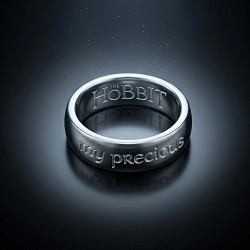
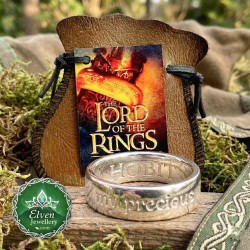
The official My Precious ring carries "My Precious" engraved on the outside and the Official Hobbit logo on the inside — the only licensed sterling silver ring made specifically to honour Gollum's five-hundred-year relationship with the One Ring. Custom-made to your exact size, in solid 925 sterling silver, made in New Zealand by the New Line Productions licence holders.
My Precious Ring
"My Precious" is engraved outside. Official Hobbit logo inside. Solid 925 sterling silver, Comfort Curve, custom-made in approximately 5–7 days. The ring Gollum called his own — worn as Gollum wore it, carried as Gollum carried it, kept close as Gollum kept it. Made in New Zealand.
Shop My Precious Ring →One Ring — Sterling Silver
The One Ring itself — the ring Déagol found and Gollum took, that Bilbo stumbled on in the dark, that Frodo carried across the world. Solid 925 sterling silver, precision engraved, Comfort Curve. Custom-made to size. Made in New Zealand by the New Line Productions licence holders.
Shop One Ring →One Ring — Gold
Solid 9ct or 18ct gold — as close to Tolkien's "fine gold" as it is possible to get. The Ring as Sauron forged it, as Gollum knew it, as Bilbo found it. Custom-made in New Zealand. The ultimate collector's piece in the official range.
Shop One Ring Gold →Frequently Asked Questions About Gollum
Who is Gollum in The Lord of the Rings?
Gollum — born Sméagol — was a hobbit-like creature who possessed the One Ring for 478 years. He found it at the bottom of the Gladden Fields in TA 2463, murdered his friend Déagol to take it, and lived with it in the tunnels under the Misty Mountains until Bilbo Baggins found it by accident in TA 2941. He spent the following decades searching for it, was captured by Aragorn and delivered to the Elves of Mirkwood, escaped, and followed the Fellowship into Mordor, where his fall into the Cracks of Doom with the Ring was the act that finally destroyed it. In Peter Jackson's films, he is voiced and motion-captured by Andy Serkis.
What does Gollum mean? Where does the name come from?
Gollum was not Sméagol's real name — it was a name given to him by others, derived from the horrible, gurgling sound he made in his throat. Tolkien described it as something between a cough and a gulp. The name appears to have Old Norse roots — the Old Norse word gull or goll, meaning gold or treasure, has been noted by Tolkien scholars as a potential etymological connection, though Tolkien himself pointed to the throat-sound as the direct source. Over time, "Gollum" became more his name than Sméagol — the sound that defined him had replaced the person he had been.
How old was Gollum when he died?
Sméagol was born around TA 2430 and died on March 25, TA 3019 — making him approximately 589 years old at the time of his death. Without the Ring's life-extending properties, a creature of his kind would have lived perhaps a century at most. The Ring kept him alive in a kind of desiccated suspension for nearly five centuries. He was far older than any being of his kind had ever been, and showed it — barely alive by the time he reached Mordor, but animated by the obsession the Ring had made him into.
Why did Gollum say "my precious"?
"Precious" began as Gollum's private term of endearment for the One Ring — the thing he valued above everything else in the world. Over centuries of isolation and Ring-addiction, the word came to be used both for the Ring and as a self-referential address — the boundary between Gollum and the Ring having blurred so completely that he could barely distinguish where his identity ended and the Ring's influence began. When he addresses "precious," he is sometimes speaking to the Ring, sometimes to himself, and sometimes to the divided personality that five hundred years of possession had created within him. It is the linguistic symptom of a mind that has been almost entirely consumed.
Did Gollum destroy the Ring on purpose?
No — his fall into the Crack of Doom was the result of his own ecstatic dancing with the Ring at the edge of the fire, almost certainly an accident of movement in his exultation. But Tolkien was explicit that the outcome was not purely accidental at a higher level — he saw it as an act of Providence, arranged through the cumulative effect of many choices: Frodo's mercy in sparing Gollum's life, Gandalf's wisdom in encouraging that mercy, and the Ring's own treachery in preserving Gollum as its most faithful servant for five hundred years. The mechanism of the Ring's destruction was built into the story's structure from the moment Bilbo showed mercy in the tunnels.
Was Gollum a hobbit?
Yes — of the Stoor variety. The Stoors were one of the three original hobbit breeds, living along the Gladden Fields in the river-lands east of the Misty Mountains. They were stockier than Shire-hobbits, more comfortable around water, and skilled at fishing and boating. Gollum retained certain hobbit characteristics throughout his long life — the disproportionately large feet, the love of fish, occasional flashes of the hobbit temperament — but five hundred years of Ring-possession, darkness, and isolation had transformed him physically and psychologically into something barely recognisable as the creature he had been.
Why is Gollum important to The Hunt for Gollum movie?
The Hunt for Gollum — releasing December 17, 2027, directed by Andy Serkis — is specifically about the period between Bilbo finding the Ring and Frodo leaving the Shire: Gandalf's investigation of Gollum's history, Aragorn's years-long hunt to capture him, and the interrogation that confirmed the Ring's identity. Gollum is the film's central figure and the key to understanding everything that sets the War of the Ring in motion. The story is, as Philippa Boyens put it, "told through the perspective of this incredible creature" — the most important character in Tolkien's legendarium, finally getting his own film.
Sources & Further Reading
- The Lord of the Rings — The Fellowship of the Ring — 'The Shadow of the Past' — Gandalf's account of Gollum's history; The Two Towers: 'The Taming of Sméagol'
- The Lord of the Rings — Appendix B — 'The Tale of Years' — Gollum's full chronology from TA 2463 to TA 3019
- Unfinished Tales, ed. Christopher Tolkien — 'The Hunt for the Ring' — Aragorn's capture of Gollum
- Tolkien Gateway — tolkiengateway.net
Related Products