



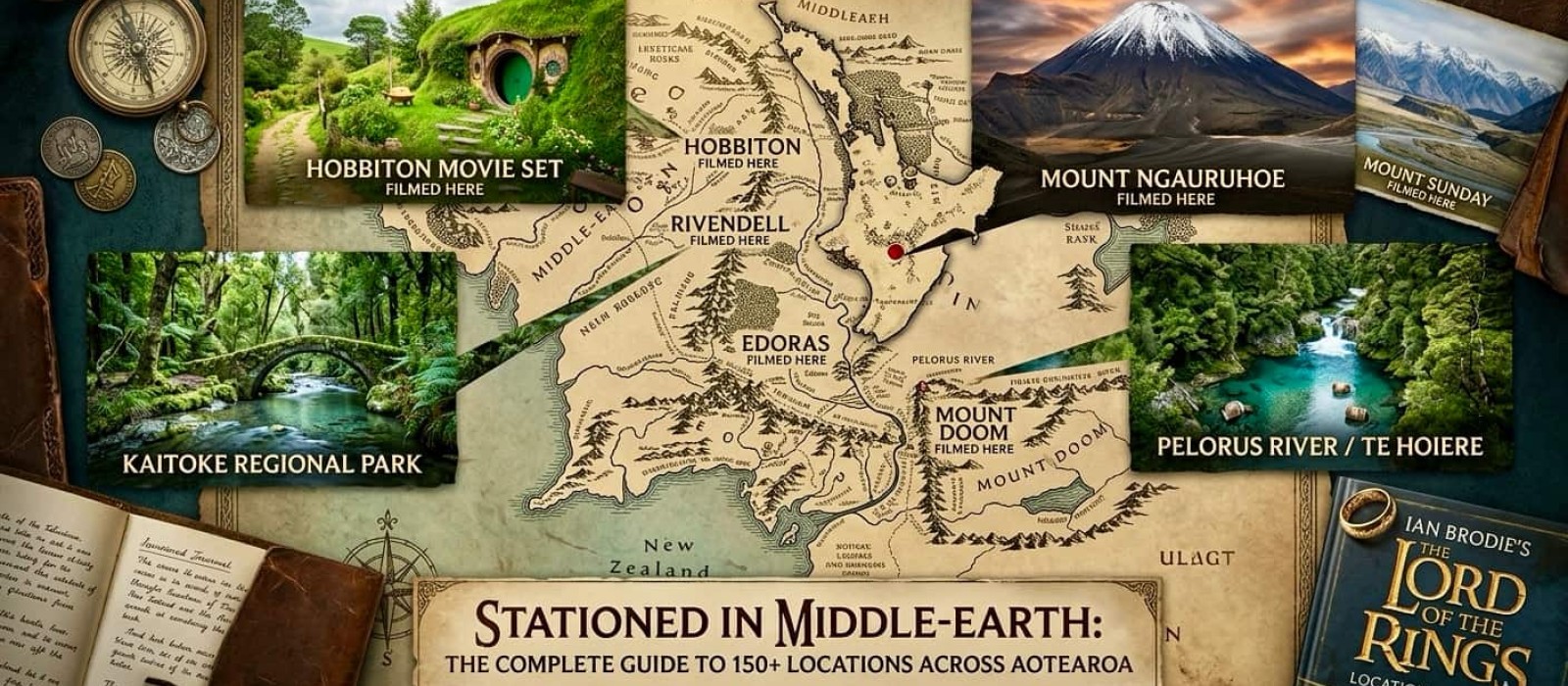
The Lord of the Rings and Hobbit trilogies were filmed entirely in New Zealand, across more than 150 locations on both the North and South Islands. The most visited include Hobbiton (Matamata, Waikato), Rivendell at Kaitoke Regional Park (Wellington), Mount Doom at Mount Ngauruhoe in Tongariro National Park, Edoras at Mount Sunday (Canterbury), and the barrel rider river — the Pelorus River / Te Hoiere in Marlborough. Most locations are free to visit independently. Some require guided tours or are on private land.
There is a particular kind of feeling that comes over you when you are standing in a New Zealand forest, and you realise, slowly, that you have been here before. Not you, exactly — but someone you care about. Frodo, hiding under a tree root while a Nazgûl sniffs the air above him. The Fellowship, departing from a riverbank flanked by ancient rimu. Thorin's Company, tumbling down a crystal-clear river in barrels.
This is what New Zealand does to you. The landscapes Peter Jackson chose were not chosen for convenience. They were chosen because they already looked like Middle-earth — because in some fundamental way, they are Middle-earth. The snow-capped volcanoes, the ancient beech forests, the rivers so clear you can count the pebbles at the bottom — none of it was computer-generated. You can walk into it. You can stand exactly where they stood.
This is the complete guide to finding Middle-earth in New Zealand — where each location is, what was filmed there, and precisely how to visit.
Before You Go — Essential Planning Notes
The films used over 150 locations across New Zealand, but not all are equally accessible. Some are in national parks with well-marked trails and free entry. Some are on private farmland accessible only through paid tours. A handful require helicopters or four-wheel drives. The guide below flags access type for each location so you can plan accordingly.
The essential companion for any serious pilgrimage is Ian Brodie's The Lord of the Rings Location Guidebook, which provides GPS coordinates and scene-by-scene photographs for hundreds of locations across both islands. Most LOTR fans who have made this trip consider it indispensable.
New Zealand is long and narrow — about the same length as the British Isles from north to south. A two-week self-drive covering both islands will give you time to visit most of the major locations. A dedicated 10–14-day tour hitting only LOTR sites is also possible. Many travellers recommend starting in Auckland, driving south to Wellington, taking the Interislander ferry to the South Island at Picton, and working south from there.
NORTH ISLAND LOCATIONS
1. Hobbiton — Matamata, Waikato
If you visit only one Lord of the Rings location in New Zealand, make it this one. The Hobbiton Movie Set — built on the Alexander sheep farm outside Matamata in the Waikato — is the only permanent film set from the trilogies still standing in its entirety. Every Hobbit hole, every garden, every detail of the Green Dragon Inn was rebuilt from scratch for The Hobbit films, and after filming wrapped, the production worked with the landowners to keep it as a permanent attraction.
The set contains 44 Hobbit holes built at three different scales — large, medium, and small — to create the illusion that the inhabitants are of different heights. Bag End sits at the top of the hill. The Party Tree still stands in the Party Field. The Green Dragon pub serves ales brewed specifically for the attraction, and your visit ends with a drink at the bar where Bilbo's neighbours gossiped about his peculiar habits.
The lush, rolling Waikato farmland around the set is exactly as it appears on screen: green, impossibly tidy, crossed by winding lanes and hedgerows. Tolkien never visited New Zealand, but the landscape around Matamata is so precisely what the Shire should look like that it is impossible to believe he didn't dream of it.
How to visit: The Hobbiton Movie Set can only be visited on an official guided tour — independent access is not permitted as the farm is private property. Tours depart regularly throughout the day. The standard tour lasts approximately two hours, including the Green Dragon drink. An evening Banquet Tour is also available for a more immersive experience. Book well in advance during peak season (December–February). From Auckland, a shuttle bus service operates to the farm and back. The nearest town for accommodation is Matamata itself, or Rotorua, approximately 45 minutes away. Visit: hobbitontours.com
2. Tongariro National Park — Central North Island
If Hobbiton is where the journey begins, Tongariro is where it ends. The volcanic plateau at the centre of the North Island — a dual UNESCO World Heritage Site — was Peter Jackson's Mordor. The perfectly conical peak of Mount Ngauruhoe, 2,291 metres of ash and lava, was Mount Doom. The blasted, boulder-strewn landscape at its feet was the Plains of Gorgoroth. The rugged eastern slopes of Mount Ruapehu above the Rangipo Desert were used for Frodo and Sam's approach to the Black Gate.
The best way to experience this landscape is the Tongariro Alpine Crossing — consistently ranked as one of the great day walks in the world. The crossing is 19.4 kilometres, takes 6–8 hours, and traverses the volcanic terrain between the mountains, passing the vivid Emerald Lakes and skirting the base of Mount Ngauruhoe close enough to feel the volcanic rock underfoot. It is not a technically difficult hike, but it is a full alpine day with significant elevation gain and unpredictable weather. Shuttle buses are required — private vehicles cannot be left at the trailhead.
Mount Ngauruhoe itself is a tapu (sacred) site for the local Māori iwi, Ngāti Tūwharetoa. The summit trail is closed by request of the iwi, and this should be respected absolutely.
Also in the park: Tawhai Falls, known to LOTR fans as Gollum's Pool — the Forbidden Pool where Faramir's rangers nearly shot Gollum as he fished in The Two Towers. The falls are a short, easy walk from the Whakapapa Village car park and are genuinely beautiful in their own right.
How to visit: The Tongariro Alpine Crossing requires a shuttle booking from either Whakapapa Village or National Park township. The crossing is weather-dependent — do not attempt in poor conditions. The Tawhai Falls walk is approximately 30 minutes return from the car park near the Chateau Tongariro Hotel, and is easy for all fitness levels. The nearest towns for accommodation are Whakapapa Village, National Park, and Turangi. Visit: tongarirocrossing.org.nz
3. Wellington — The Capital of Middle-earth
Wellington is, in every meaningful sense, the home of Middle-earth. Peter Jackson is a Wellingtonian. Weta Workshop — the company that created the armour, weapons, creatures, and props for both trilogies — is in the Miramar suburb. Park Road Post, where the films were edited, is here. And within a 40-minute drive of the city centre, you can visit three distinct filming locations on the same day.
Mount Victoria — The Outer Shire and Hobbiton Woods
The forested slopes of Mount Victoria, within walking distance of the Wellington city centre, were used for the opening woodland scenes of The Fellowship of the Ring — the Outer Shire, the sunken lane where the hobbits hid from the Black Rider, the famous "Get off the road!" scene where Frodo, Sam, Merry and Pippin dive under the roots of a tree. The tree itself — a large, distinctive pohutukawa — is still there, and fans queue to recreate the scene. The walk from the city to the filming sites takes about 20 minutes through pleasant bush tracks.
Kaitoke Regional Park — Rivendell
This is the filming location that affects people most deeply. Fifty minutes north of Wellington on State Highway 2, in the Tararua Ranges foothills, lies Kaitoke Regional Park — 2,860 hectares of mature native rainforest, ancient rimu and rātā, the clear Hutt River cutting through a wide valley. This is where Rivendell was filmed. The Council of Elrond. Frodo's recovery from the Ringwraith blade. Elrond's farewell to the Fellowship. The kiss between Aragorn and Arwen.
The original sets are long gone, but the park has interpretive signage showing exactly what was filmed where, with photographs. A replica Elven archway has been installed at the entrance to the filming area. The forest itself needs no decoration — the ancient trees filter light the way Tolkien described it filtering through the Golden Wood, and the birdsong is constant. A park ranger described it to one visitor as "the only filming location where the real thing is more beautiful than what ended up on screen." It is free to enter. It is worth every minute of the drive.
Harcourt Park — The Gardens of Isengard
In Upper Hutt, just beyond Kaitoke, Harcourt Park was transformed for the sweeping shots of Saruman's gardens at Isengard in The Two Towers. The park is pleasant and easy to walk, and the location is free.
Weta Workshop — Behind the Magic
The Weta Workshop in Miramar is where the One Ring was designed. Where the armour of Rohan was made. Where Gollum was conceived. The full workshop facilities are not open to the public, but the Weta Workshop Experience — a 60-minute guided tour through a purpose-built exhibition space — is outstanding, covering the making of both trilogies in detail. The gift shop alone is worth the visit: it carries handmade miniatures, replica weapons, and collectibles unavailable anywhere else.
How to visit: Mount Victoria is a 20-minute walk from central Wellington, or a short bus ride. Kaitoke is 50 minutes by car — follow State Highway 2 north through Upper Hutt to the park entrance. Harcourt Park is adjacent. The Weta Workshop Experience is in Weta Cave, 1 Weka Street, Miramar — bookings are recommended. Visit: wetaworkshop.com
4. Putangirua Pinnacles — Paths of the Dead
At the remote southern tip of the Wairarapa, near Cape Palliser on the coast road, stand the Putangirua Pinnacles — a maze of eroded badlands formed over hundreds of thousands of years, pillars of pale rock rising from a dry riverbed surrounded by bush-covered hills. They served as the Valley of the Dead — the Harrowdale — in The Return of the King, where Aragorn led Gimli and Legolas through the mountain to summon the Army of the Dead.
Even without the films, this place is extraordinary. The pinnacles feel genuinely otherworldly — a landscape that looks like nothing else in New Zealand and very little else on Earth. There is a 30-minute walk along the riverbed, or a more challenging 3-hour loop track to a ridge-top lookout. The road to Cape Palliser passes through some spectacular coastal scenery, and the lighthouse at the cape is a worthwhile stop. The nearest fuel and food is in Martinborough, so plan accordingly.
How to visit: Follow State Highway 2 south from Wellington to Martinborough, then the coastal road to Lake Ferry and on to Cape Palliser. The Putangirua Pinnacles Scenic Reserve is signposted. Free entry. Allow at least 2 hours for the valley walk. The road is unsealed in sections and can be dusty in dry weather.
SOUTH ISLAND LOCATIONS
5. Pelorus River / Te Hoiere — The Barrel Rider Scene
This one has particular significance for lotrjewelry.com — the barrel rider pendant in our official Hobbit collection commemorates exactly this sequence, filmed on exactly this river.
The Pelorus River — Te Hoiere in te reo Māori — flows through the Marlborough region at the top of the South Island, through forests of podocarp and beech, past waterfalls and swimming holes, over boulders smoothed by glacial action over thousands of years. Peter Jackson chose it for the barrel escape sequence in The Hobbit: The Desolation of Smaug — Thorin's company tumbling downriver in barrels as Elven arrows flew and Orcs gave chase. Stephen Hunter, who played Bombur, later described the barrel filming days as his favourite on the entire production.
The river is crystal clear and extraordinarily beautiful. The Pelorus Bridge Scenic Reserve — where the main filming took place — has a café, picnic areas, and easy walking tracks through the forest. The Pelorus Bridge itself, a historic wooden structure, crosses the river at the reserve entrance. Kayaking the same stretch of water the dwarves fled down is available through local operators, and is one of the more memorable ways to connect with a filming location anywhere in New Zealand.
How to visit: Pelorus Bridge Scenic Reserve is on State Highway 6, approximately one hour from Blenheim (the nearest large town at the top of the South Island) and 1.5 hours from Nelson. The reserve is free to enter. Café open most days. Guided kayak tours are available through Pelorus Eco Adventures and Wilderness Guides. The scenic reserve also has basic camping.
6. Mount Sunday — Edoras, Capital of Rohan
A sheer-sided hill rises from the flat Canterbury high country, surrounded on all sides by the braided channels of the Rangitata River and ringed by the distant peaks of the Southern Alps. On film, it was Edoras — the golden-halled capital of Rohan, where Théoden sat diminished under Wormtongue's influence, and Éowyn dreamed of battles she was told she could not fight. It took Peter Jackson's production crew nine months to build the Golden Hall on its summit. They dismantled it all after filming.
Nothing remains of the set. But the magic of the location is undamaged by its absence. Standing on the top of Mount Sunday and looking out at the 360-degree panorama — the braided rivers below, the tawny high country plains, the mountains receding in every direction — you understand immediately why Jackson chose it. It is, without alteration or digital enhancement, exactly what Edoras should look like.
The hill is accessible on foot via a short hike from the car park on Hakatere Potts Road — approximately 30 minutes to the summit. Four-wheel drive is recommended for the access road, which can be rough. Mount Potts Station nearby offers accommodation and a restaurant, and guided tours from Christchurch and Methven include this location on their itineraries.
How to visit: From Christchurch, take State Highway 72 south through Methven to Hakatere, then follow the unsealed road toward Mount Potts Station. The access road is approximately 45 minutes of unsealed driving from the main highway — check conditions before going. Day tours from Christchurch and Methven visit this location regularly and are the easiest option if you don't have a suitable vehicle.
7. Twizel and Lake Pukaki — Pelennor Fields and the Lonely Mountain
In the Mackenzie Country of the central South Island, the vast, flat grassy plains stretching to the foothills of the mountains became the Pelennor Fields — the site of the greatest battle of the Third Age. The filming here took 32 days. Up to 1,700 people were on set at once, including almost the entire town of Twizel, who served as extras. The scale of the landscape matched the scale of the battle: these are enormous, sweeping plains with mountains on every horizon and nothing to break the sky.
The Pelennor Fields land is private farming country, but guided tours operate from Twizel and can access the actual filming areas. The Peace Ring monument in Twizel (a small fee applies) marks the location and provides context for the filming.
Lake Pukaki, a few minutes from Twizel, is even more spectacular. Its waters are an impossible, almost artificial-looking turquoise blue — the colour comes from glacial flour carried by meltwater from the Southern Alps. In The Hobbit: The Desolation of Smaug, Lake Pukaki was the Long Lake where Lake-town was digitally constructed on the water. At the head of the lake, Mount Cook / Aoraki — New Zealand's highest peak at 3,724 metres — served as the Lonely Mountain. The view from the lake's edge, looking south toward the mountain across that luminous blue water, is genuinely one of the most beautiful things in New Zealand. It requires no imagination at all to see the Lonely Mountain at the far end of it.
How to visit: Twizel is approximately 3.5 hours from Christchurch via State Highway 8. The Lake Pukaki lookout is freely accessible on the main highway. For the Pelennor Fields location, guided tours depart from Twizel — ask at the i-SITE visitor centre. The Hooker Valley Track at the base of Mount Cook is a popular 3-hour return walk with extraordinary mountain views.
8. Queenstown and Glenorchy — Lothlórien, Isengard, Nen Hithoel
Queenstown is the adventure capital of New Zealand and the unofficial LOTR capital of the South Island. Within an hour's drive in any direction from the city, you can find more filming locations than most countries contain in total.
The road from Queenstown north to Glenorchy is one of the most beautiful drives in New Zealand — Lake Wakatipu on one side, the Remarkables range on the other, the mountains growing larger and wilder as you approach the head of the lake. The actor Sean Astin later wrote that sitting in Queenstown "against the mountain range aptly titled the Remarkables" made him feel he was actually living inside the books. The road to Glenorchy was used as the road to Isengard in The Two Towers.
At Glenorchy itself, the beech forest on the road to Paradise — a real place with a real name, 25 kilometres beyond the village — was used for several Lothlórien scenes. At Arrowtown, 20 minutes from Queenstown, the Arrow River doubled as the Ford of Bruinen where Arwen faced the Nazgûl in The Fellowship of the Ring. The scene where Arwen calls the flood was filmed at the river crossing on the outskirts of the village. Wilcox Green, near Arrowtown, was the Gladden Fields where Isildur was ambushed and the Ring was lost.
How to visit: Queenstown is a major international tourist hub with direct flights from Auckland, Christchurch, Sydney, and Melbourne. The road to Glenorchy is unsealed in parts but generally manageable in a standard vehicle in good weather. The Ford of Bruinen at Arrowtown is a short walk from the main street. Half-day guided tours from Queenstown cover multiple locations efficiently — operators include Safari of the Rings and Nomad Safaris.
9. Mavora Lakes — Nen Hithoel, Fangorn and the River Anduin
Two hours north of Queenstown, past Te Anau, the Mavora Lakes sit in a remote valley flanked by beech forest and mountain. This is one of the least visited major filming locations in New Zealand — and one of the most authentic. There are no tour buses, no gift shops, and no signs beyond the basic DOC markers. It is simply a landscape, a bird sound, and the memory of what was filmed here.
North Mavora Lake is Nen Hithoel — the lake where the Fellowship made their final camp on the River Anduin before the breaking of the Fellowship. The shoreline where Boromir was shot, where Frodo launched his boat alone, where the quest fractured irreparably — it looks today exactly as it looked in 2001. South Mavora Lake and the Mararoa River nearby were used for further Lothlórien departure scenes. The road through the valley also appears as Fangorn Forest in The Two Towers.
How to visit: Take State Highway 94 toward Te Anau, then turn off on Centre Hill Road to the Mavora Lakes. The access road is unsealed and takes approximately 45 minutes from the main highway. Basic camping is available at the lakes — no facilities. A 4WD or high-clearance vehicle is recommended after rain.
Practical Travel Tips — Making the Most of Your Middle-earth Journey
Getting Between Islands
The Cook Strait ferry between Wellington and Picton takes approximately 3 hours and runs several times daily. Book the Interislander in advance during summer. The crossing itself passes through the Marlborough Sounds — spectacularly beautiful and worth booking a morning sailing to see in daylight.
North Island vs South Island
The North Island holds Hobbiton, Tongariro, and the Wellington cluster. The South Island holds Edoras, Pelennor Fields, Lake Pukaki, Queenstown, and Mavora Lakes. Most visitors find the South Island locations more dramatic and remote. Most first-timers consider Hobbiton unmissable. Budget for both if you can.
Best Time to Visit
December–February (Southern Hemisphere summer) offers the best weather and longest days, but is peak season with higher prices and crowds at Hobbiton. March–April (autumn) is often the best combination of good weather and lower visitor numbers. Tongariro Alpine Crossing should not be attempted in winter without alpine experience.
Self-Drive vs Guided Tour
Self-drive gives you flexibility and access to remote locations on your own schedule. A guided tour handles logistics and provides context that enriches every location. The best approach for most visitors: self-drive as the base, with one or two specialist day tours for locations that benefit from expert guidance — Mount Sunday, Pelennor Fields, and the Queenstown cluster in particular.
The Guidebook
Ian Brodie's The Lord of the Rings Location Guidebook contains GPS coordinates, scene photographs, and detailed directions for hundreds of locations. It is the definitive resource for any serious visitor. Buy it before you go — it is available on Amazon worldwide and at most New Zealand bookshops.
Respect the Locations
Many of New Zealand's most beautiful filming locations are in national parks, DOC reserves, or on private farmland. Leave no trace. Do not climb on rock formations. Do not attempt to summit Mount Ngauruhoe — it is tapu (sacred) to Ngāti Tūwharetoa Māori, and the request to stay off the summit should be respected absolutely. These places were here long before the films, and they deserve to remain long after.
The Jewellery Made Where Middle-earth Was Filmed
lotrjewelry.com is owned by fans of LOTR and live under the shadow of Ngauruhoe (Mount Doom in “The Lord of the Rings" films) by Lake Taupo (which is one of the largest volcanic caldera lakes in the world). They sell official LOTR jewellery made by the New Line Productions licence holders in New Zealand — the same country where every scene in this guide was filmed. The pieces in the collection are not made in a factory overseas and exported here. They are made here, in Middle-earth, by craftspeople who live in the landscape you have just been reading about.
The barrel rider pendant commemorates the Pelorus River sequence — the same river you can walk or kayak today. The Elrond Star of Eärendil pendant is made near where Rivendell stood at Kaitoke Regional Park. The Evenstar was made in the country where Arwen wore it. The Key to Erebor was made near the mountain that stood in for the Lonely Mountain at the end of Lake Pukaki.
That provenance is not a marketing claim. It is a fact about where these things are made, and what the people who make them can see from their windows. Every piece in the collection ships worldwide from New Zealand, backed by a 5-year written guarantee, with an official Licence of Authenticity card approved by New Line Productions.
If you are planning a trip to New Zealand, or you have already made one and want to carry something of the landscape home, the official collection is here: lotrjewelry.com.
Frequently Asked Questions — New Zealand LOTR Locations
Where was Rivendell filmed in New Zealand?
Rivendell was filmed at Kaitoke Regional Park, located approximately 50 minutes north of Wellington in the Upper Hutt area. The park — 2,860 hectares of ancient native rainforest in the Tararua Ranges foothills — provided the exterior setting for the Council of Elrond, Frodo's recovery from the Ringwraith blade, and the Fellowship's departure. The park is free to enter and has interpretive signage showing exactly where each scene was filmed. A replica Elven archway marks the entrance to the filming area.
Where was the barrel scene filmed in The Hobbit?
The barrel escape sequence from The Hobbit: The Desolation of Smaug was filmed on the Pelorus River — Te Hoiere in te reo Māori — in the Marlborough region at the top of New Zealand's South Island. The Pelorus Bridge Scenic Reserve is the main filming site. It is freely accessible, approximately one hour from Blenheim, and guided kayak tours allow visitors to paddle the same stretch of river used in the film.
Where was Mount Doom filmed?
Mount Doom was filmed at Mount Ngauruhoe in Tongariro National Park on the central North Island. The 2,291-metre volcano — perfectly conical, still active — appears throughout the trilogy as the mountain where the One Ring was forged and ultimately destroyed. The surrounding volcanic plateau also served as the Plains of Gorgoroth and the approaches to Mordor. Mount Ngauruhoe is a tapu (sacred) site for the local Māori iwi, and the summit is closed to climbing by their request.
Where was Edoras filmed?
Edoras — the capital of Rohan — was filmed at Mount Sunday in the Ashburton Lakes region, approximately two hours from Christchurch in the South Island. The production built the Golden Hall and all supporting structures on the summit over nine months, then dismantled them completely after filming. The hill is freely accessible via a short walk from the car park on Hakatere Potts Road. Nothing remains of the set, but the 360-degree views of the surrounding mountains and braided rivers are spectacular.
How many Lord of the Rings filming locations are in New Zealand?
The Lord of the Rings and Hobbit trilogies used more than 150 filming locations across both the North and South Islands of New Zealand. The films were shot entirely in New Zealand — no overseas locations were used. The full list of sites is documented in Ian Brodie's The Lord of the Rings Location Guidebook, which is the most comprehensive resource for visitors planning a filming-location trip.
Can you visit Hobbiton without a tour?
No. The Hobbiton Movie Set is on private farmland owned by the Alexander family near Matamata, Waikato, and can only be accessed via the official guided tour. Independent access is not permitted. Tours depart throughout the day and must be booked in advance, particularly during the December–February peak season. The tour lasts approximately two hours and includes a drink at the Green Dragon pub. Visit hobbitontours.com to book.
Is there a Lord of the Rings tour of New Zealand?
Yes, multiple operators offer dedicated LOTR filming location tours of New Zealand. These range from full two-week guided itineraries covering both islands (typically NZ$4,000–$8,500 depending on accommodation level) to shorter day tours from major cities. Well-regarded operators include Nomad Safaris (Queenstown), Safari of the Rings (Queenstown), Red Carpet Tours (nationwide), and MoaTrek (small group tours). Self-drive touring is also popular and allows more flexibility for reaching remote locations.